Close Menu
  • Home
  • UNSUBSCRIBE
  • News
  • Lifestyle
  • Tech
  • Entertainment
  • Sports
  • Travel
Facebook X (Twitter) WhatsApp
Trending
  • Don Juan Pond: Antarctica’s salty, syrupy lake that never freezes, even when it’s minus 58 F
  • Withings ScanWatch 2 review: Style meets next-level health monitoring
  • AI Chatbots are turbo-charging violence against women and girls: We urgently need to regulate them | Yvonne McDermott Rees
  • ‘The biggest El Niño event since the 1870s’: ‘Super’ El Niño is now the most likely scenario by the end of this year ‪—‬ and the humanitarian cost could be huge
  • Antarctica’s sudden sea ice loss is one of the most extreme and confusing events in the modern climate record. Scientists now know why it’s happening.
  • ‘I heard gasps’: Artemis II astronauts reveal inside story of their mind-bending solar eclipse
  • A pill can stop people from developing COVID after being exposed to the virus, trial finds
  • ‘There are 4 people in those pixels’: Earth-based telescope snapped Artemis II crew orbiting the moon
Facebook X (Twitter) WhatsApp
Baynard Media
  • Home
  • UNSUBSCRIBE
  • News
  • Lifestyle
  • Tech
  • Entertainment
  • Sports
  • Travel
Baynard Media
Home»Lifestyle»‘Trash’ found deep inside a Mexican cave turns out to be 500-year-old artifacts from a little-known culture
Lifestyle

‘Trash’ found deep inside a Mexican cave turns out to be 500-year-old artifacts from a little-known culture

EditorBy EditorMay 26, 2025No Comments3 Mins Read
Share Facebook Twitter Pinterest LinkedIn Tumblr Reddit Telegram Email
Share
Facebook Twitter LinkedIn Pinterest Email

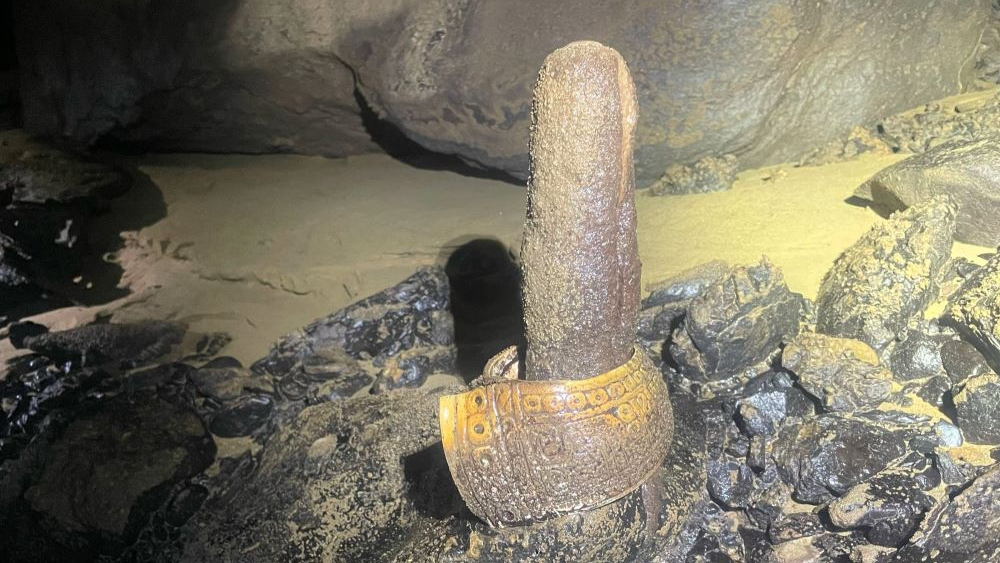
While investigating a cave high in the mountains of Mexico, a spelunker thought she had found a pile of trash from a modern-day litterbug. But upon closer inspection, she discovered that the “trash” was actually a cache of artifacts that may have been used in fertility rituals more than 500 years ago.

“I looked in, and it seemed like the cave continued. You had to hold your breath and dive a little to get through,” speleologist Katiya Pavlova said in a translated statement. “That’s when we discovered the two rings around the stalagmites.”

The cave, called Tlayócoc, is in the Mexican state of Guerrero and about 7,800 feet (2,380 meters) above sea level. Meaning “Cave of Badgers” in the Indigenous Nahuatl language, Tlayócoc is known locally as a source of water and bat guano. In September 2023, Pavlova and local guide Adrián Beltrán Dimas ventured into the cave — possibly the first time anyone has entered it in about five centuries.


You may like

Roughly 500 feet (150 m) into the cave, the ceiling dipped down. The pair of explorers had to navigate the flooded cave with a gap of just 6 inches (15 centimeters) between the water and the cave ceiling. “Adrián was scared, but the water was deep enough, and I went through first to show him it wasn’t that difficult,” Pavlova said.

While taking a break to look around, Pavlova and Beltrán were shocked to discover 14 artifacts.

“It was very exciting and incredible!” Pavlova said. “We were lucky here.”

Related: 2,500-year-old burials of 3 people discovered in a cave in Mexico

Get the world’s most fascinating discoveries delivered straight to your inbox.

Carved shell bracelet against a wine-red background

Archaeologists removed the bracelets from the stalagmites and cleaned them to reveal the design. (Image credit: Miguel Pérez)

Among the artifacts were four shell bracelets, a giant decorated snail shell (genus Strombus), two complete stone disks and six disk fragments, and a piece of carbonized wood. Pavlova and Beltrán immediately contacted Mexico’s National Institute of Anthropology and History (INAH), which sent archaeologists to recover the artifacts in March.

Given the arrangement of the bracelets — which had been looped over small, rounded stalagmites with “phallic connotations” — the archaeologists speculated that fertility rituals were likely performed in Tlayócoc cave, they said in the statement.

“For pre-Hispanic cultures, caves were sacred places associated with the underworld and considered the womb of the Earth,” INAH archaeologist Miguel Pérez Negrete said in the statement.

Three of the bracelets have incised decorations. An S-shaped symbol known as “xonecuilli” is associated with the planet Venus and the measurement of time, while the profile of a human-like figure may represent the creator god Quetzalcoatl.

Pérez dated the artifacts to the Postclassic period of Mesoamerican history, between A.D. 950 and 1521, and suggested that they were made by members of the little-known Tlacotepehua culture that inhabited the region.

“It’s very likely that, because they were found in a close environment where humidity is fairly stable, the objects were able to survive for so many centuries,” Pérez said.


Ancient Maya quiz: What do you know about the civilization that built pyramids across Mesoamerica?

Source link

Share. Facebook Twitter Pinterest LinkedIn Tumblr Email
Previous ArticlePowerful Mother’s Day geomagnetic storm created radio-disrupting bubbles in Earth’s upper atmosphere
Next Article GrAudio Flash delle 11:50 del 18 luglio
Editor
  • Website

Related Posts

Lifestyle

Don Juan Pond: Antarctica’s salty, syrupy lake that never freezes, even when it’s minus 58 F

May 16, 2026
Lifestyle

Withings ScanWatch 2 review: Style meets next-level health monitoring

May 15, 2026
Lifestyle

AI Chatbots are turbo-charging violence against women and girls: We urgently need to regulate them | Yvonne McDermott Rees

May 15, 2026
Add A Comment

Comments are closed.

Categories
  • Entertainment
  • Lifestyle
  • News
  • Sports
  • Tech
  • Travel
Recent Posts
  • Don Juan Pond: Antarctica’s salty, syrupy lake that never freezes, even when it’s minus 58 F
  • Withings ScanWatch 2 review: Style meets next-level health monitoring
  • AI Chatbots are turbo-charging violence against women and girls: We urgently need to regulate them | Yvonne McDermott Rees
  • ‘The biggest El Niño event since the 1870s’: ‘Super’ El Niño is now the most likely scenario by the end of this year ‪—‬ and the humanitarian cost could be huge
  • Antarctica’s sudden sea ice loss is one of the most extreme and confusing events in the modern climate record. Scientists now know why it’s happening.
calendar
May 2026
M T W T F S S
 123
45678910
11121314151617
18192021222324
25262728293031
« Apr    
Recent Posts
  • Don Juan Pond: Antarctica’s salty, syrupy lake that never freezes, even when it’s minus 58 F
  • Withings ScanWatch 2 review: Style meets next-level health monitoring
  • AI Chatbots are turbo-charging violence against women and girls: We urgently need to regulate them | Yvonne McDermott Rees
About

Welcome to Baynard Media, your trusted source for a diverse range of news and insights. We are committed to delivering timely, reliable, and thought-provoking content that keeps you informed
and inspired

Categories
  • Entertainment
  • Lifestyle
  • News
  • Sports
  • Tech
  • Travel
Facebook X (Twitter) Pinterest WhatsApp
  • Contact Us
  • About Us
  • Privacy Policy
  • Disclaimer
  • UNSUBSCRIBE
© 2026 copyrights reserved

Type above and press Enter to search. Press Esc to cancel.