
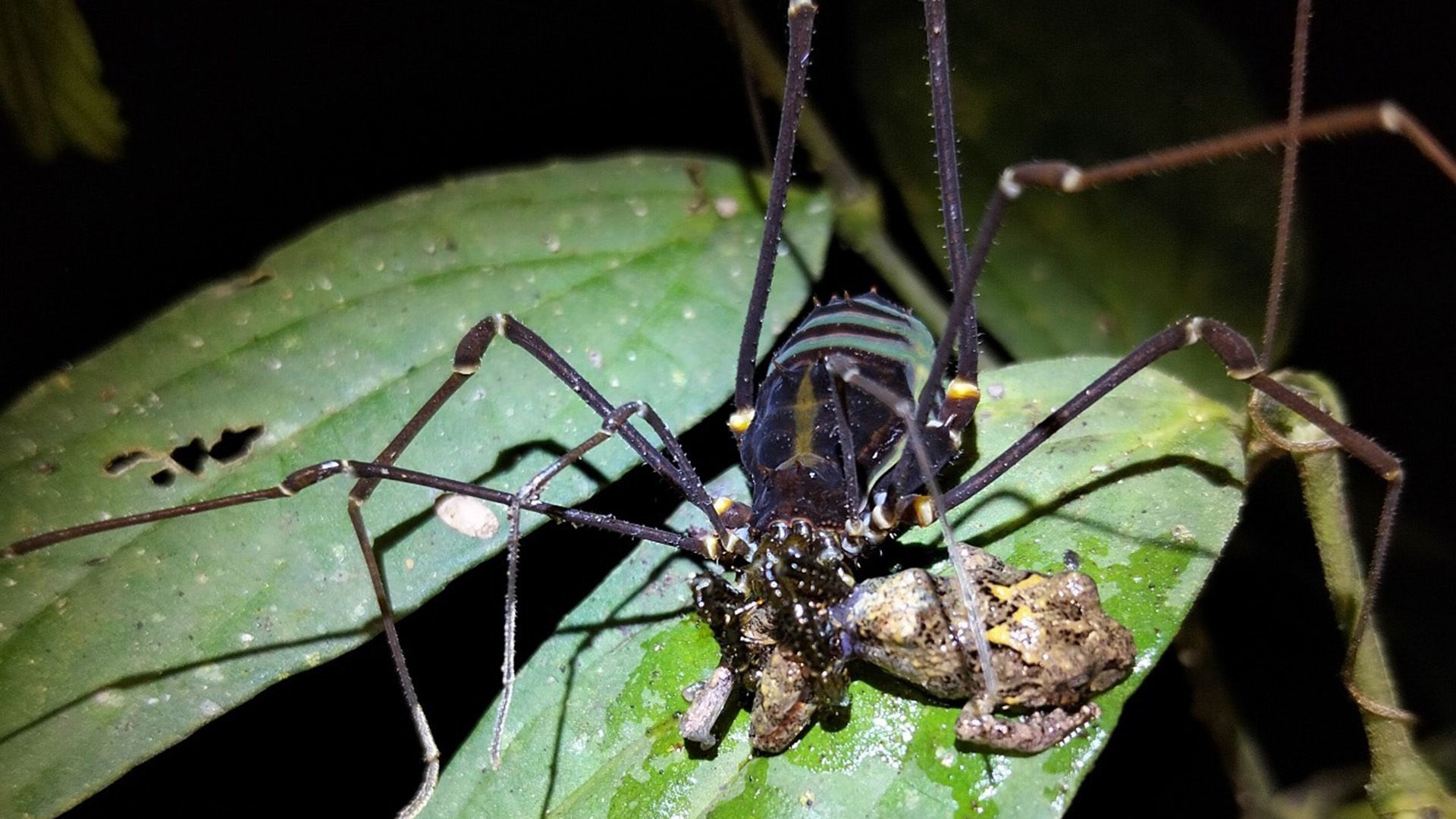
Daddy longlegs have been spotted devouring live frogs bigger than themselves in the tropical forests of South America, a new study reports. And this behavior might be more common than scientists expected.
“Finding these animals eating [live] frogs was a complete surprise, we didn’t expect them to be able to capture them,” study co-author Luís Fernando García, a biologist at the University of the Republic in Uruguay, told Live Science.
When arthropods, the group that includes animals like insects, spiders, centipedes and crustaceans, are observed eating vertebrates, it’s typically treated as a rare or isolated phenomenon. But Jose Valdez, an ecologist at Martin Luther University Halle-Wittenberg in Germany who was not involved in the new study, has found that this type of predation — mostly on frogs, lizards, bats and birds — is actually quite common.
In reality, arthropod predation on vertebrates is under-documented, Valdez told Live Science in an email. Valdez’s research has found it is most commonly spiders eating frogs, since frogs’ soft bodies and thin skin make them relatively vulnerable.
Yet harvestmen (order Opiliones), also known as daddy longlegs, are not technically spiders; they are part of the arachnid class alongside spiders, but they are more closely related to scorpions, so observations like this new study are particularly noteworthy, Valdez said.

Harvestman are arachnids that are more closely related to scorpions than they are to spiders.
(Image credit: Maida Gutiérrez-Arboleda)
In the new paper, published April 21 in the journal Ecology and Evolution, the research team compiled 10 reports in South America of harvestmen eating frogs around their body size. The reports come from field observations in Ecuador and Colombia, scientific papers, and one from the citizen science platform iNaturalist, which lets anyone with a camera upload photos of wildlife and plants.
“The availability of good quality cameras on mobile phones has enormously helped in recording such interactions and making them available to specialists, sometimes through citizen science platforms,” Olivier Pauwels, a conservation biologist at the Royal Belgian Institute of Natural Sciences who was not involved in the new study, told Live Science in an email.
Get the world’s most fascinating discoveries delivered straight to your inbox.

Arthropod predation on vertebrates is under-documented, researchers say.
(Image credit: Maida Gutiérrez-Arboleda)
Previous anecdotal reports of daddy longlegs eating frogs have been unclear about whether the arachnid had killed the frog or scavenged an already dead amphibian.
“What we found is that they are able to capture frogs, because many frogs were still moving” in these observations, García said, suggesting that the arachnids might be actively hunting frogs.
The researchers don’t know exactly how harvestmen capture frogs, since the arachnids are rather slow and don’t have venom, García said. They may be hunting sleeping or resting frogs, or grabbing them with their strong front limbs, known as pedipalps, which are similar to the forelegs of praying mantises and can grasp prey.
“The most surprising aspect is how these harvestmen are able to subdue their prey” without venom to chemically immobilize animals, Valdez said. “Instead, they must rely entirely on physical restraint,” an impressive feat since some frogs were up to 1.29 times the size of the arachnids eating them, the study found.
“We now have a new field to explore: the feeding and behavior of these animals, which is basically unknown,” García said. “We think it is opportunistic behavior, they are generalist predators.”
New discoveries about arthropods’ diets in the tropics, and their interactions with other species, can help scientists understand how to conserve these ecosystems.
“The fate of some species is often linked to others,” Pauwels said.
Calvache, E., Villarreal, O., Ávila‐Rojas, C., Bentley, A. G., Brito, K., Correa‐Zanotti, C., Gutiérrez‐Arboleda, M., Iñiguez, K., Narváez, J. C., Proaño, L., Reyes‐Vizcaíno, M., & García, L. F. (2026). Harvestmen (Arachnida: opiliones) as overlooked predators of anurans in the neotropics. Ecology and Evolution, 16(4), e73542. https://doi.org/10.1002/ece3.73542
