
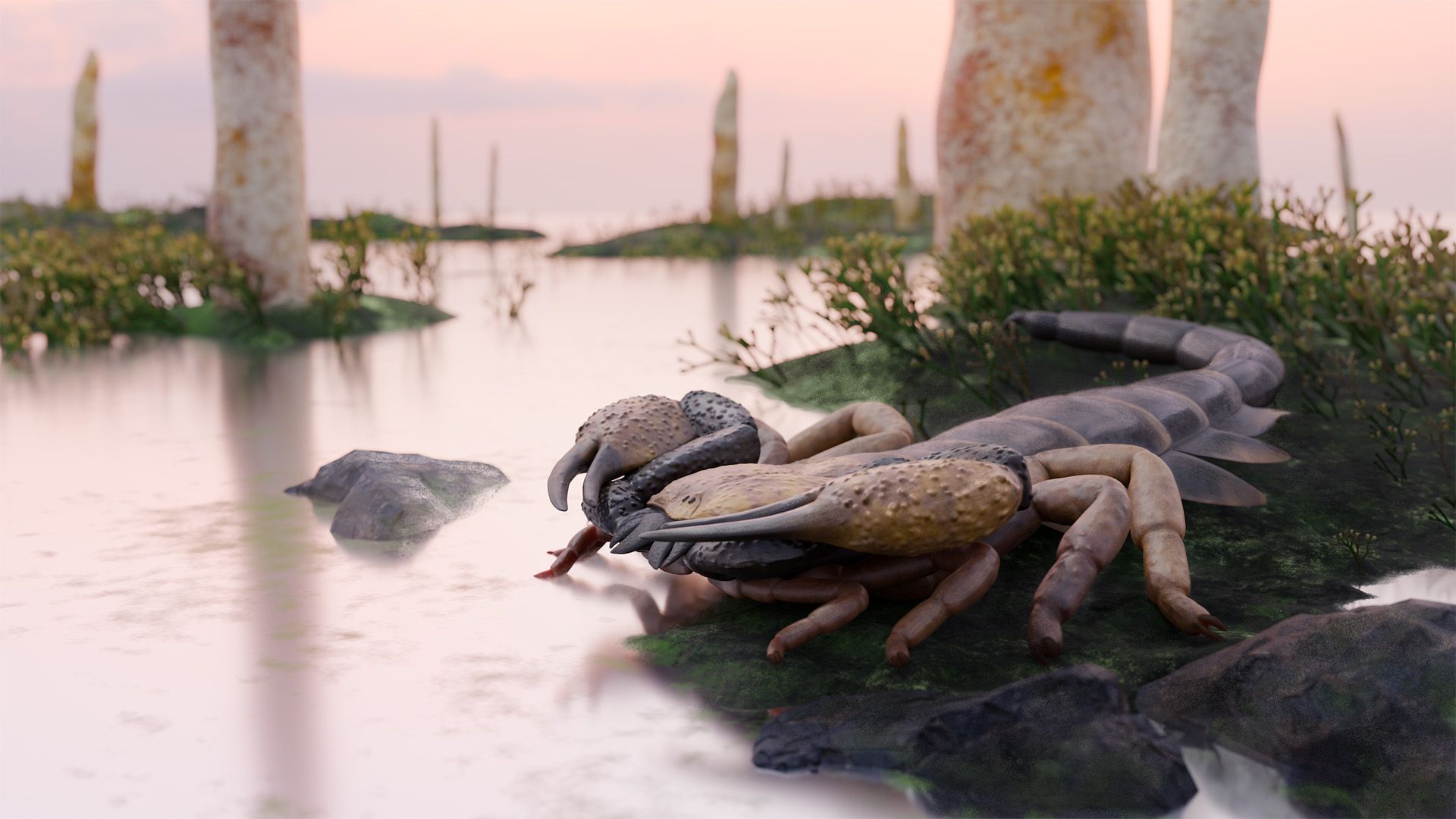
The world’s largest known scorpion lived at a time when other land animals were relatively small, around 415 million years ago in what is now the U.K., a new study finds.
The prehistoric creature, named Praearcturus gigas, is estimated to have grown to lengths of around 3.3 feet (1 meter) and was equipped with formidable pincers measuring roughly 6.2 inches (16 centimeters) long, according to a statement from the University of Manchester.
The scorpion would likely have been a fearsome apex predator that stalked floodplains during the Early Devonian Period, when life on land was still in its relatively early stages and dominated by small arthropods. Arthropods are now the most diverse animal group on Earth, as they include insects, crustaceans, scorpions and spiders.
The discovery that such a large scorpion was living 415 million years ago — long before the appearance of complex terrestrial ecosystems, such as forests — offers new insights into the evolutionary history of gigantism in arthropods.
“Confirming that this animal is a scorpion fundamentally changes our understanding of how and when these creatures evolved to such extraordinary sizes,” study first author Richard Howard, curator of fossil arthropods at the Natural History Museum, London, said in the statement.
Remains of P. gigas, which have so far been recovered from places in England and Wales, were first documented in the 1870s, but researchers have long debated the type of animal it was.

Fossils of Praearcturus gigas in the Natural History Museum, London.
(Image credit: The Natural History Museum)
“Praearcturus has puzzled us palaeontologists for more than a century,” study co-author Russell Garwood, a paleontologist at the University of Manchester, said in the statement.
Get the world’s most fascinating discoveries delivered straight to your inbox.
Researchers initially suspected that the remains represented a large woodlouse-like crustacean. Then in the 1980s, research suggested that the fossils instead belonged to a scorpion. But that interpretation was subsequently challenged due to the fragmentary nature of the known remains and a lack of the characteristic scorpion tail.
In the latest study, published Tuesday (June 2) in the journal Palaeontology, the authors re-examined key P. gigas specimens held in the NHM’s collections using modern imaging and analytical techniques. They also compared them with other fossil material and recently described prehistoric animals that were more confidently identified as scorpions.
Their analysis indicated that P. gigas is likely a scorpion, and the team also reassigned several other specimens found in the same geological formation to the species, the study reported. Furthermore, the researchers suggested that the creature may have been at least partially aquatic based on the presence of flap-like structures known as epimera — similar to those which provide support and protection to the hard upper shells of lobsters and crabs — in some of the fossils.

A fossil showing the pincer of Praearcturus gigas.
(Image credit: The Natural History Museum)
“Without complex ecosystems to support Praearcturus on land, these animals probably spent part of their lives hunting in water,” Howard said in a Natural History Museum statement.
A semi-aquatic lifestyle could partially explain the scorpion’s greater size compared to its modern-day relatives, as water can support large bodies. But it also may reflect the relative lack of competition from other large terrestrial predators, potentially enabling it to reach sizes that would have been more difficult to attain had they been present.
“By bringing together material from several collections and using cutting edge imaging techniques, we’ve been able to build a clearer picture of the animal than was previously possible, which is really exciting,” Garwood said.
“What makes Praearcturus so interesting is that it became enormous at a time when life on land was otherwise very small. But it was a world that could somehow support a giant predator.”
Howard, R. J., Garwood, R. J., Edgecombe, G. D., & Legg, D. A. (2026). A revision of Praearcturus gigas : a giant scorpion from the Lower Devonian (Lochkovian) of Britain. Palaeontology, 69(3). https://doi.org/10.1111/pala.70064
