Around 5.4 million years ago, two rivers flowed across present-day Turkey and Syria and into the Mediterranean Sea — and eventually, they would merge to form the Euphrates River, new research suggests. The merged river would play a pivotal role in the development of early human civilizations in the Fertile Crescent.
Scientists revealed that the Paleo-Karasu and Paleo-Murat rivers discharged into the Mediterranean Sea until around 3.6 million years ago, when tectonic shifts altered their paths. The Paleo-Murat River changed course first, and the Paleo-Karasu River was rerouted 800,000 years later. Both waterways combined to flow southeast into the Persian Gulf by roughly 1.6 million years ago, according to the new study.
“The modern landscape onshore, along with buried sediments offshore, still preserves clear signs of the ancient Euphrates River,” said study first author Andrew Madof, a senior seismic stratigrapher at the oil and gas corporation Chevron. “If the Palaeo-Murat and Palaeo-Karasu rivers had not switched course and merged when they did, it is unclear whether the Fertile Crescent would have formed in the way it did,” he told Live Science in an email.
Often referred to as the “cradle of civilization,” the Fertile Crescent is a boomerang-shaped region in Western Asia that stretches from present-day Egypt to southeastern Iraq. Its eastern branch, known as Mesopotamia, contains the Tigris and Euphrates rivers. These two rivers created an oasis of fertile soil in an otherwise arid region, which helped ancient civilizations such as the Sumerians and Assyrians flourish some 6,000 years ago.
Despite the Euphrates playing a central role in the success of these early civilizations, the origins of the 1,900-mile-long (3,000 kilometers) river have until now remained enigmatic. Some researchers previously proposed that the Euphrates evolved from a single river that flowed into the Mediterranean Sea or into ancient lakes in what is now Turkey, while others suggested it evolved from a river ending somewhere on the Arabian Peninsula.
But in the new study, published Monday (June 1) in the journal Nature Geoscience, Madof and his colleagues showed that the Euphrates was born from the marriage of two rivers, rather than from a single waterway.
The researchers used seismic data, maps of the land surface, and satellite data to reconstruct the Euphrates’ geological history. They identified 5 million to 6 million-year-old river deposits buried off the coast of Lebanon and compared them to previously documented river deposits of a similar age off the coast of Turkey. These deposits revealed two ancient waterways: the Paleo-Karasu and Paleo-Murat.
Get the world’s most fascinating discoveries delivered straight to your inbox.
These rivers flowed into the Mediterranean Sea during and after the Messinian salinity crisis, a period of about 700,000 years when tectonic processes caused most of the sea to dry up. The Mediterranean refilled 5.33 million years ago, submerging the grooves and sediments that the two rivers left on the seabed. It was those remnants that the new study uncovered.
“A useful way to think about this is that we were tracing the buried ‘footprints’ of the ancient Euphrates offshore and connecting them to where those footprints reappear on land,” Madof said.
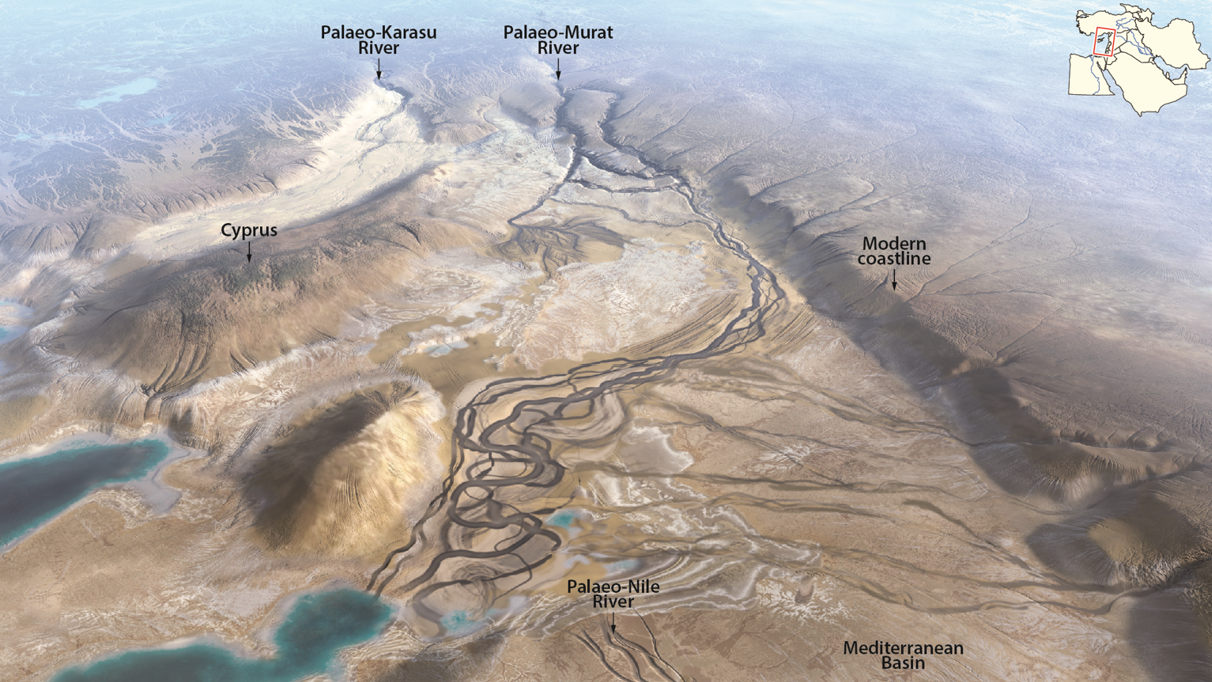
The Paleo-Murat River (in the foreground) altered course around 3.6 million years ago, while the Paleo-Karasu River’s path changed around 2.8 million years ago. At its southernmost extent, the Paleo-Murat approached the Paleo-Nile River.
(Image credit: Reconstruction by Lina Jakaitė and Andrew S. Madof)
Tectonic shifts involving mountain-building episodes, faulting processes and earthquakes moved the Paleo-Karasu and the Paleo-Murat around 3.6 million years ago, so the researchers had to piece together the clues on land.
“Where these ancient river channels crossed faults, the landscape behaved like a conveyor belt that had shifted sideways,” Madof said. “By measuring how much the river was offset and how fast the fault moves, we could estimate when this motion occurred.”
The team also modeled sediment transport in the Paleo-Karasu and Paleo-Murat rivers to estimate the rivers’ size and the extent of their drainage areas. The team found that each waterway was larger than the modern Nile River before they merged to form the modern Euphrates 1.6 million years ago.
Some stretches of the Paleo-Karasu and Paleo-Murat rivers changed very little, while others were completely rerouted. The position of these rivers likely influenced the routes mammals took when they migrated out of Africa and through the Levant by determining water availability, Madof said.
Understanding how the Euphrates formed helps us to better understand “how large-scale changes in water distribution can reshape landscapes and influence the conditions needed to support life,” he noted.
Madof, A. S., Laugier, F. J., Baumgardner, S. E., Zaki, A.S., Laugier, E. J., Bertoni, C., Walker, R. T., Rivero, C., Lang, S. C. (2026). Late Miocene Euphrates River drained into a partially desiccated eastern Mediterranean. Nat. Geosci.https://doi.org/10.1038/s41561-026-01962-x