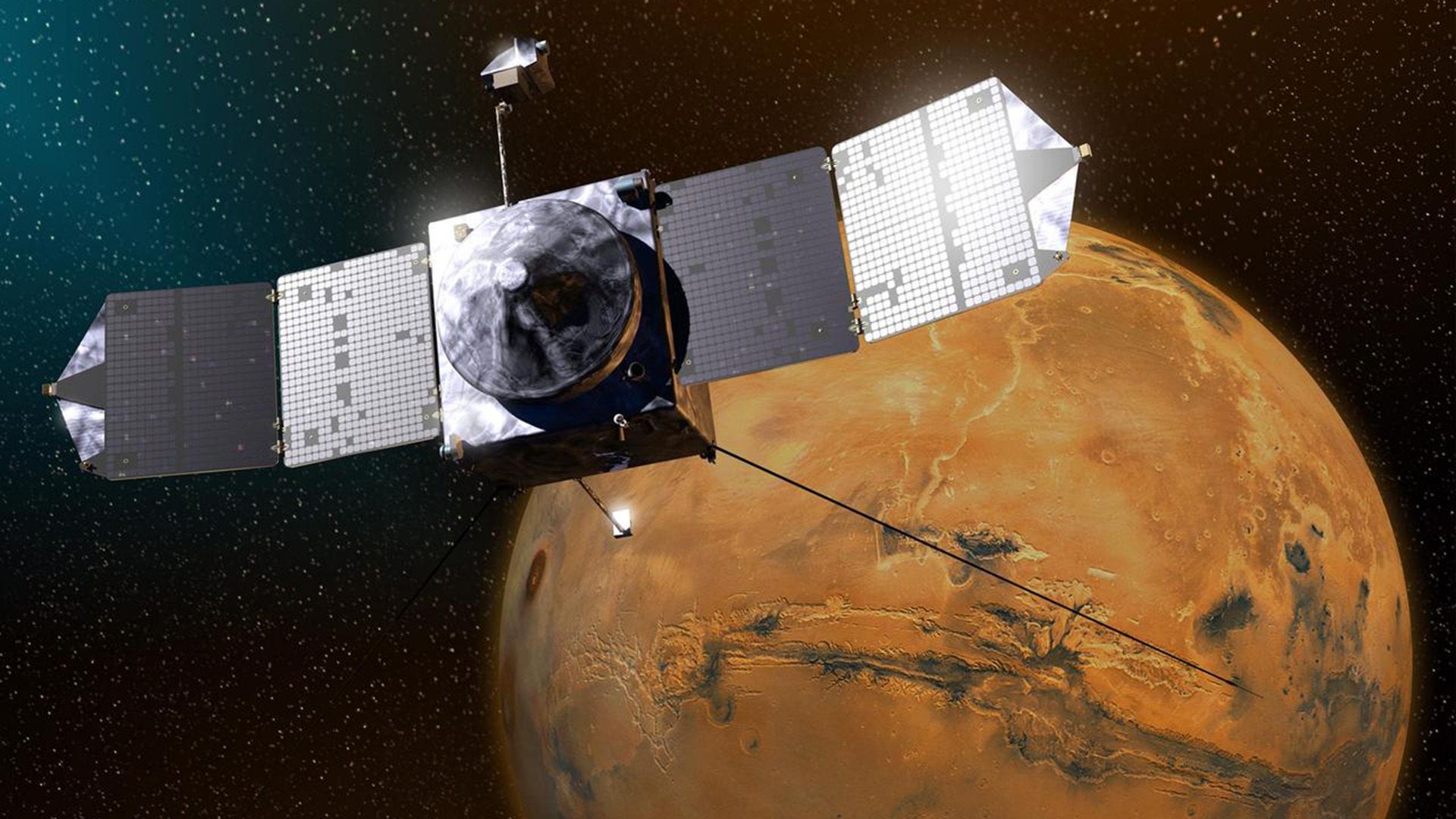
After 11 years studying Mars from above, NASA’s MAVEN spacecraft is officially dead, the agency announced in a statement on Wednesday (June 3). The culprit: a drained battery, triggered by an as-yet-unknown anomaly.
MAVEN (short for Mars Atmosphere and Volatile Evolution) began orbiting Mars on Sept. 21, 2014, on a mission to study the Red Planet’s mysterious atmosphere. Circling Mars roughly 6.6 times every Earth day, the spacecraft has facilitated countless discoveries over the last decade — including the first direct observations of a multi-million-year process that has been steadily stripping Mars of its atmosphere.
But on Dec. 6, 2025, NASA unexpectedly lost contact with the probe when it swung behind Mars during a regular orbit. At the time of the probe’s expected reemergence, NASA’s Deep Space Network (DSN) could not detect a signal from MAVEN. (DSN is an international array of radio antennas that connects Earth with various spacecraft).
The agency convened an anomaly review board in February to assess the probe’s status. Now, the team has shared their findings: The spacecraft is not recoverable, and its mission is officially at an end.
The precise cause of MAVEN’s death remains unknown, and NASA will continue its assessment over the coming months. However, the board did share some preliminary details. A “brief fragment of telemetry data” obtained by the DSN indicated that MAVEN was rotating at an unusually high rate when it reemerged from behind Mars in December, indicating a change in its orbital trajectory.
“The review board concluded that due to this rotation, the batteries on the spacecraft had drained, causing the communications system to lose power and rendering MAVEN in an unrecoverable state,” NASA officials wrote in the statement.
An illustration of water escaping Mars’ atmosphere, based on data collected by MAVEN.
(Image credit: NASA Goddard)
NASA will host a public media teleconference to discuss the anomaly, as well as highlights of MAVEN’s mission, on June 3 at 2 p.m. EDT.
Get the world’s most fascinating discoveries delivered straight to your inbox.
MAVEN has also revealed the first direct evidence of “sputtering” — a process by which solar wind collides with Mars’ upper atmosphere and flings particles into space, gradually eroding the Red Planet’s atmosphere. This could explain why Mars became a dry, ostensibly dead planet while Earth has flourished.
The spacecraft also detected several types of auroras on Mars, and showed that Mars’ magnetosphere can balloon outward by thousands of miles when solar wind calms down. All of these discoveries paint a more detailed and complex picture of how Mars’ atmosphere and magnetic shield interact with solar radiation — which will be crucial to understand before sending human astronauts to the Red Planet.
What do you know about the Red Planet? Test your knowledge with our Mars quiz!