Close Menu
  • Home
  • UNSUBSCRIBE
  • News
  • Lifestyle
  • Tech
  • Entertainment
  • Sports
  • Travel
Facebook X (Twitter) WhatsApp
Trending
  • AI could consume up 3% of world’s electricity the UN warns
  • Kaleidoscopic meteorite could be a piece of a ‘lost world’ from the early solar system — Space photo of the week
  • Some ‘extinct’ volcanoes may just be going through a growth spurt, before they ‘wake up in this catastrophic stage,’ emerging research suggests
  • Jupiter and Venus conjunction 2026: See two bright planets at the same time this weekend
  • Flu drugs might fight cognitive decline seen in HIV, early study hints
  • NASA astronauts briefly shelter in ‘safe haven’ procedure following worsening leaks on International Space Station
  • Why can’t we figure out how strong gravity is?
  • Stupid hot: Heat waves cause cognitive changes in animals, making them more aggressive and unable to complete basic tasks
Facebook X (Twitter) WhatsApp
Baynard Media
  • Home
  • UNSUBSCRIBE
  • News
  • Lifestyle
  • Tech
  • Entertainment
  • Sports
  • Travel
Baynard Media
Home»Lifestyle»Rare colorful lightning caught on camera by ISS astronaut. ‘OK, this is kind of out there’
Lifestyle

Rare colorful lightning caught on camera by ISS astronaut. ‘OK, this is kind of out there’

EditorBy EditorApril 8, 2025No Comments2 Mins Read
Share Facebook Twitter Pinterest LinkedIn Tumblr Reddit Telegram Email
Share
Facebook Twitter LinkedIn Pinterest Email

NASA astronaut Don Pettit captured breathtaking video of a rare atmospheric phenomenon from his perch high above Earth on the International Space Station.

While the International Space Station (ISS) was orbiting above South America, Pettit recorded what are known as Transient Luminous Events, or TLEs. These are bright, colorful flashes of light faster than lightning and are sometimes referred to as “sprites.”

Pettit was able to view the sprites from directly above, looking down at what is known as the nadir, the point directly below a particular location. “OK, this is kind of out there and caters to your inner Uber-Geek,” Pettit posted to X (formerly Twitter along with the video. “Nadir view of Transient Luminous Events (TLE ) or upper atmospheric lightning.”

OK, this is kind of out there and caters to your inner Uber-Geek. Nadir view of Transient Luminous Events (TLE ) or upper atmospheric lightning. This clip real time is about 6 seconds over the Amazon basin and shows a number of TLE displays from Sprites to blue jets from a… pic.twitter.com/IE0Edtm2RlApril 3, 2025

The video captures around six seconds of sprites over the Amazon basin. And it’s not the first time these phenomena have been caught on camera from the ISS.

In 2024, NASA astronaut Matthew Dominick caught a glimpse at one of the most elusive atmospheric phenomena known as red sprites. These occur during particularly powerful thunderstorms and travel upwards into the atmosphere, as opposed to normal lightning which travels downward to the surface of Earth.
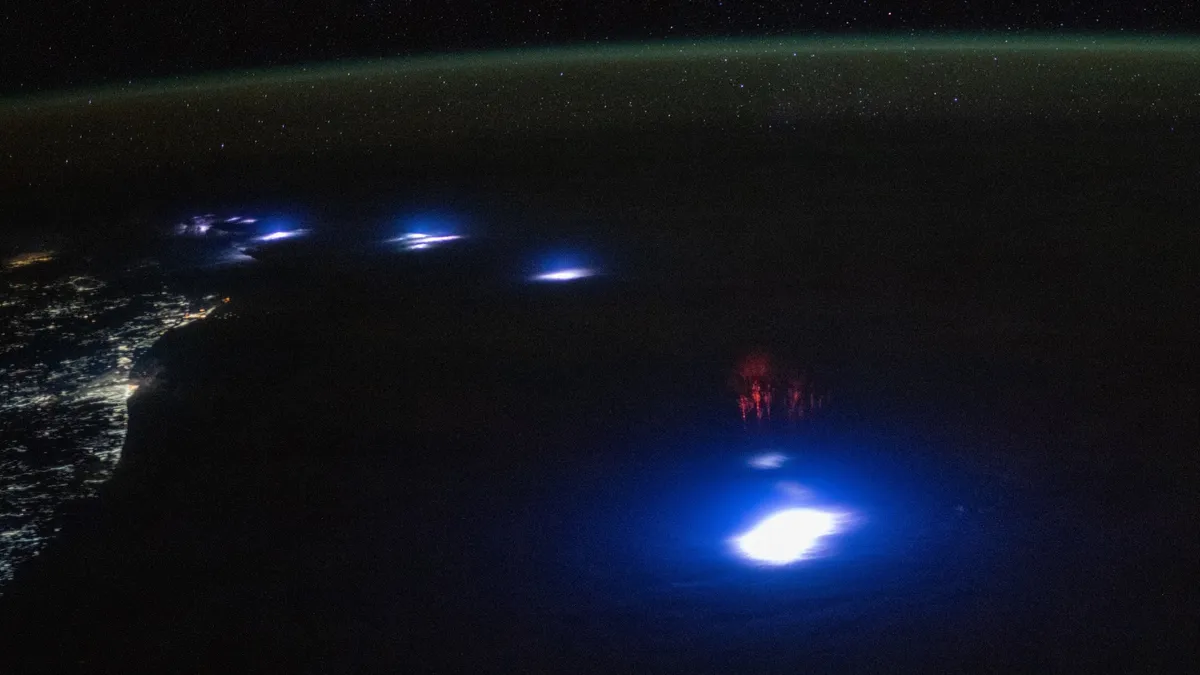
red and blue flashes of light next to the edge of a landmass lit up by city lights at night, as seen from high above

A rare red sprite captured from the International Space Station posted on X (formerly Twitter) on June 20, 2024, showing an event earlier in the year. (Image credit: Matthew Dominick/NASA/X)

Sprites like the ones Pettit captured on video occur much higher than regular lightning. Their name is an acronym, short for stratospheric perturbations resulting from intense thunderstorm electrification.

Sprites are created when electrical discharges created by lightning shoot upward, creating bursts of plasma in the ionosphere, found around 50 miles (80 km) above Earth’s surface. They were not captured on camera until 1989.

Get the world’s most fascinating discoveries delivered straight to your inbox.

Originally posted on Space.com.


Source link

Share. Facebook Twitter Pinterest LinkedIn Tumblr Email
Previous ArticleOrigins of schizophrenia linked to epigenetics of the placenta
Next Article Comet SWAN25F: How to see the bright green comet just discovered by amateur astronomers
Editor
  • Website

Related Posts

Lifestyle

AI could consume up 3% of world’s electricity the UN warns

June 7, 2026
Lifestyle

Kaleidoscopic meteorite could be a piece of a ‘lost world’ from the early solar system — Space photo of the week

June 7, 2026
Lifestyle

Some ‘extinct’ volcanoes may just be going through a growth spurt, before they ‘wake up in this catastrophic stage,’ emerging research suggests

June 7, 2026
Add A Comment

Comments are closed.

Categories
  • Entertainment
  • Lifestyle
  • News
  • Sports
  • Tech
  • Travel
Recent Posts
  • AI could consume up 3% of world’s electricity the UN warns
  • Kaleidoscopic meteorite could be a piece of a ‘lost world’ from the early solar system — Space photo of the week
  • Some ‘extinct’ volcanoes may just be going through a growth spurt, before they ‘wake up in this catastrophic stage,’ emerging research suggests
  • Jupiter and Venus conjunction 2026: See two bright planets at the same time this weekend
  • Flu drugs might fight cognitive decline seen in HIV, early study hints
calendar
June 2026
M T W T F S S
1234567
891011121314
15161718192021
22232425262728
2930  
« May    
Recent Posts
  • AI could consume up 3% of world’s electricity the UN warns
  • Kaleidoscopic meteorite could be a piece of a ‘lost world’ from the early solar system — Space photo of the week
  • Some ‘extinct’ volcanoes may just be going through a growth spurt, before they ‘wake up in this catastrophic stage,’ emerging research suggests
About

Welcome to Baynard Media, your trusted source for a diverse range of news and insights. We are committed to delivering timely, reliable, and thought-provoking content that keeps you informed
and inspired

Categories
  • Entertainment
  • Lifestyle
  • News
  • Sports
  • Tech
  • Travel
Facebook X (Twitter) Pinterest WhatsApp
  • Contact Us
  • About Us
  • Privacy Policy
  • Disclaimer
  • UNSUBSCRIBE
© 2026 copyrights reserved

Type above and press Enter to search. Press Esc to cancel.