
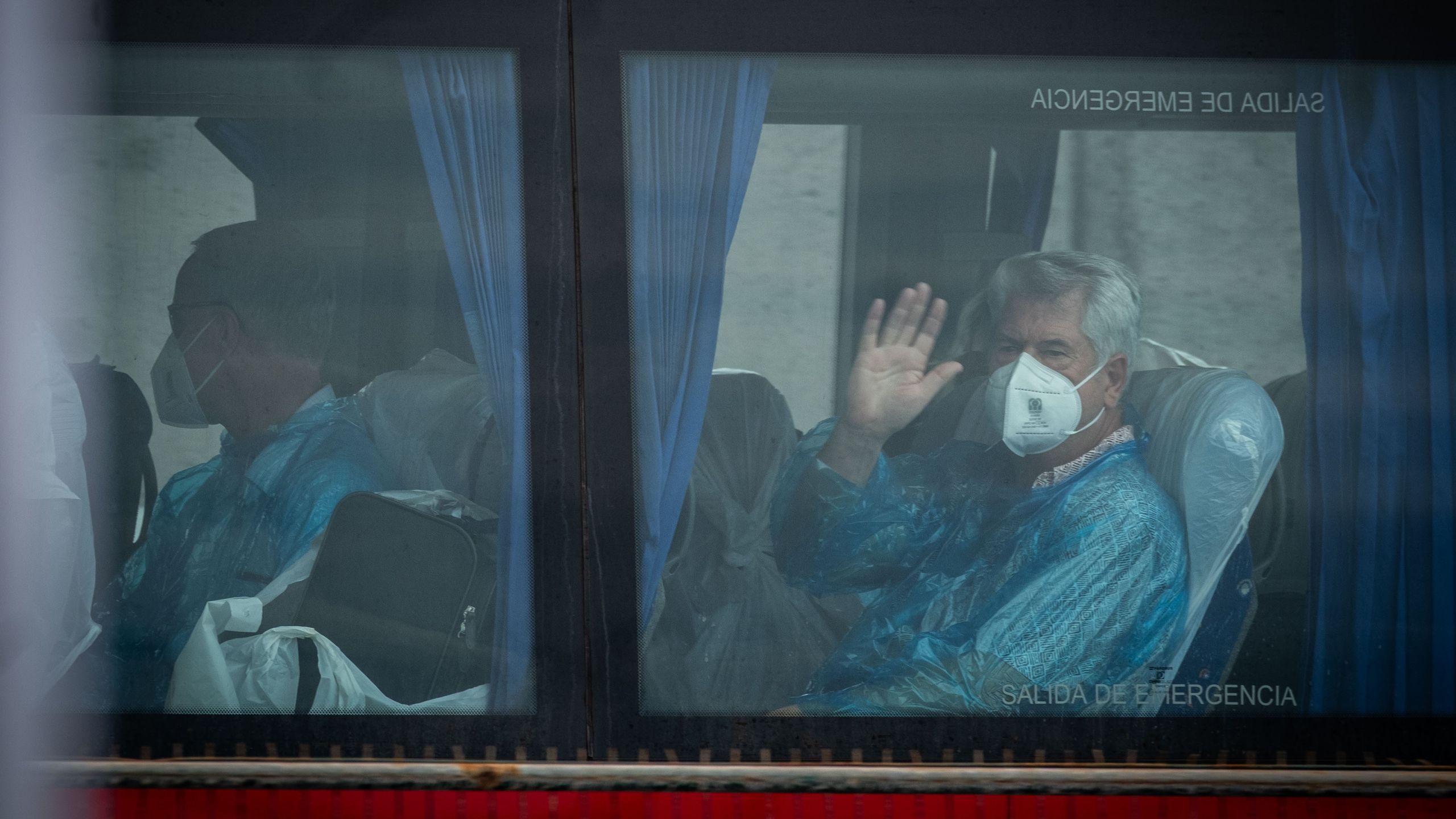
In the aftermath of the hantavirus outbreak on the cruise ship MV Hondius, many of the 150 passengers are currently being monitored or undergoing up to six weeks of quarantine, based on the virus’s lengthy incubation period. Public health authorities have emphasized that person-to-person transmission of Andes virus — the only type of hantavirus known to spread between humans — is rare and associated with “close and prolonged contact.”
But there’s no clear and consistent definition of what that means.
The World Health Organization says high-risk contacts include “intimate partners, household members, and persons with prolonged close indoor exposure.”
When it comes to precautions healthcare providers should take while caring for patients, personal protective equipment (PPE), such as a high-quality face mask, is recommended.
“In terms of any kind of recommendations for taking care of patients, you’d err on the safe side,” said Dr. Dean Blumberg, chief of the Division of Pediatric Infectious Diseases at the University of California, Davis (UC Davis). “That’s why the recommendations are to use N95s [respirators designed to filter at least 95% of airborne particles] and to do airborne precautions for those patients.”
Airborne diseases are those that spread when infectious particles remain suspended in the air and cause disease after being inhaled by others; COVID-19, tuberculosis and measles are examples of airborne diseases. Airborne spread may occur over short or long distances and may involve either small or large infectious particles that the infected person expels.
When it comes to Andes virus, it’s known that people can get sick after breathing in tiny bits of infected rat droppings, urine or saliva floating in the air — which may have been disturbed while someone cleaned a room, for example. People have also caught the virus after dining indoors near an infected person. For some experts, that points to some degree of spread through the air. But if it does occur, that doesn’t mean this mode of spread is super common.
There were 94 other people at the party, and they didn’t get the virus.
Dr. Dean Blumberg, chief of the Division of Pediatric Infectious Diseases at UC Davis
“There’s quite a bit of concern about this genotype that is transmitted from person to person, but in Argentina, it’s been here for decades and the outbreaks are contained,” said Juan Diego Pinotti, a postdoctoral researcher for Argentina’s National Council of Research, based at the Institute of Animal Diversity and Ecology at the National University of Córdoba.
“What we know is that it’s not common,” Blumberg added. “Otherwise, there would be [more] person-to-person outbreaks in Argentina. And really just a handful of events have been described.”
The largest documented Andes virus outbreak took place from late 2018 to early 2019 in Epuyén, a Patagonian town of around 2,400 people. The outbreak began when one person experiencing fever attended a birthday party with about 100 guests. Five people sitting near them at the party went on to develop symptoms in the following weeks, leading to a chain of infections, with 34 confirmed cases and 11 deaths by the outbreak’s end.
Argentine researchers studying the outbreak identified three patients as “superspreaders,” the source of 21 cases — over 60% of the outbreak. Laboratory investigations found these patients had liver damage, as well as higher viral loads than the other infected individuals.
The timing of when symptoms began seemed to be a critical factor in transmission: In more than half of the cases, transmission could be traced to a single day when the infected person first developed fever and then came into contact with another person, who later became ill.
While the Epuyén outbreak demonstrates Andes virus’s ability to spread between humans under certain conditions, experts caution against overinterpreting its transmissibility.
“There were 94 other people at the party, and they didn’t get the virus,” Blumberg said. “And there were 82 healthcare workers who cared for the infected patients, many without using masks or any other PPE, and they didn’t get infected either.”
Then there’s the case of a woman who, in 2018, carried Andes virus to Delaware after being infected in Argentina. Over 50 people were monitored after potentially being exposed to the virus, but none developed the infection.
Keeping the definition of “close and prolonged contact” somewhat vague might be most useful from a public health messaging standpoint, Blumberg said. “We don’t know exactly the timing or the distance, and that’s probably going to vary depending on the stage of the illness of the person who’s infected and how symptomatic they are,” he said.
The environment of a cruise ship — where passengers have significantly more close contacts than they might in daily life — is what likely allowed the virus to spread, he added.
“You’re going to be at increased risk for every infection, including something like this that’s not very transmissible,” he said. “I think it’s the cruise ship that really allowed this to happen in an unusual way.”
This article is for informational purposes only and is not meant to offer medical advice.
