Close Menu
  • Home
  • UNSUBSCRIBE
  • News
  • Lifestyle
  • Tech
  • Entertainment
  • Sports
  • Travel
Facebook X (Twitter) WhatsApp
Trending
  • Andes virus spreads via ‘close contact’ — but what exactly does that mean?
  • 8-year-old African American boy from Colonial Maryland found buried with white Colonists, and it’s unclear if he was enslaved
  • Science news this week: PCOS has a new name, Neanderthals were the world’s oldest dentists, and the first nuclear bomb explosion spawned an ‘alien’ crystal
  • Newly discovered, blue-whale-size asteroid will fly super close to Earth Monday — and you can watch it live
  • Don Juan Pond: Antarctica’s salty, syrupy lake that never freezes, even when it’s minus 58 F
  • Withings ScanWatch 2 review: Style meets next-level health monitoring
  • AI Chatbots are turbo-charging violence against women and girls: We urgently need to regulate them | Yvonne McDermott Rees
  • ‘The biggest El Niño event since the 1870s’: ‘Super’ El Niño is now the most likely scenario by the end of this year ‪—‬ and the humanitarian cost could be huge
Facebook X (Twitter) WhatsApp
Baynard Media
  • Home
  • UNSUBSCRIBE
  • News
  • Lifestyle
  • Tech
  • Entertainment
  • Sports
  • Travel
Baynard Media
Home»Lifestyle»Divers discover 500,000-year-old treasure trove of fossils in Florida sinkhole
Lifestyle

Divers discover 500,000-year-old treasure trove of fossils in Florida sinkhole

EditorBy EditorFebruary 18, 2025No Comments4 Mins Read
Share Facebook Twitter Pinterest LinkedIn Tumblr Reddit Telegram Email
Share
Facebook Twitter LinkedIn Pinterest Email

Fossil collectors have discovered a prehistoric graveyard buried in Florida’s Steinhatchee River.

The site has yielded a remarkable collection of more than 500 fossils dating back roughly half a million years. It was full of exceptionally well-preserved bones from ancient mammals, including horses, giant armadillos, sloths and possibly a new species of tapir.

Around 500,000 years ago, before the river flowed over the site, a sinkhole opened up in Florida’s Big Bend region and became a death trap for hundreds of animals. Sediment filled the sinkhole over time, entombing their remains in near-pristine condition.

These fossils remained hidden until 2022, when fossil collectors Robert Sinibaldi and Joseph Branin stumbled upon them during a routine diving expedition in the river’s murky waters. After Branin spotted horse teeth sticking out of the sediment, the pair uncovered a hoof core and a tapir skull, signaling a potential major discovery.

“It wasn’t just quantity, it was quality,” Sinibaldi said in a statement released on Feb. 12 by the Florida Museum of Natural History. “We knew we had an important site, but we didn’t know how important.”

The Florida Museum recognized the significance of the find and dated it to the middle of the Irvingtonian North American Land Mammal Age (1.6 million–250,000 years ago)—an evolutionary transition period with a sparse fossil record.

“The fossil record everywhere, not just in Florida, is lacking the interval that the site is from,” Rachel Narducci, vertebrate paleontology collections manager at the Florida Museum and coauthor of a study of the site published Nov. 15 in the journal Fossil Studies, said in the statement.

Get the world’s most fascinating discoveries delivered straight to your inbox.

Snapshots of evolutionary transitions

One of the key discoveries are fossils from an extinct giant armadillo-like creature called Holmesina. Within this genus, scientists knew that there was a transition from a species that lived two million years ago, the 150-pound H floridanus, to H. septentrionalis, which reached a whopping 475 pounds — but there was little evidence of how the change in size occurred.

“It’s essentially the same animal, but through time it got so much bigger and the bones changed enough that researchers published it as a different species,” Narducci said.

Ancient armadillo fossils arranged in a partial reconstruction of the animal’s foot.

Holmesina fossils arranged in a partial reconstruction of the animal’s foot. (Image credit: Florida Museum/Kristen Grace)

The fossils from the Steinhatchee River offer a snapshot of this evolutionary change, as the study revealed ankle and foot bones that match the size of the later, larger Holmesina species while retaining features of their smaller ancestors.

“This gave us more clues into the fact that the anatomy kind of trailed behind the size increase,” Narducci said. “So they got bigger before the shape of their bones changed.”

A glimpse at a new species?

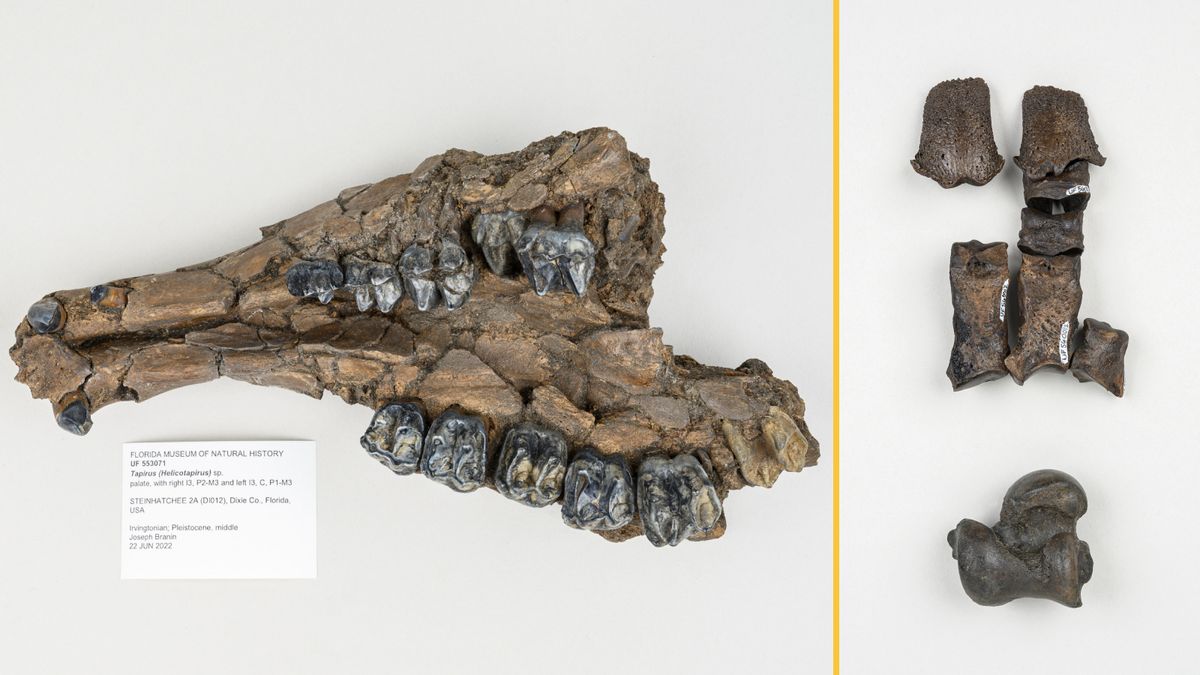
One intriguing specimen found at the site was the skull of an ancient tapir — a pig-shaped mammal with a short elephant-like trunk. Puzzlingly, the skull had lots of features not seen in the fossil record before, leading the researchers to consider whether the specimen might belong to a previously unknown species.

Lower jaw bone of a tapir.

Lower jaw bone of a tapir found at the site, which might represent a new species. (Image credit: Florida Museum/Kristen Grace)

However, Richard Hulbert, lead author of the study, cautioned against making that leap just yet. “We need more of the skeleton to firmly figure out what’s going on with this tapir,” he said in the statement. “It might be a new species. Or it always could just be that you picked up the oddball individual of the population.”

Views of an ancient landscape

Partial fossils of ancient horses.

Around 75 percent of the fossils discovered belong to an early species of caballine horses . (Image credit: Florida Museum/Kristen Grace)

Among the 552 fossils recovered, about 75 percent belong to an early species of caballine horses — the subgroup that includes modern domestic horses.

Horses tend to dwell on large expanses of grassland rather than dense forests such as those that occupy the Big Bend region today. Since horses make up such a large chunk of the fossils discovered at Steinhatchee River, the researchers concluded that the site area may have once been more open and grassy.

Horse teeth were some of the best preserved fossils in the sinkhole. “For the first time, we had individuals that were complete enough to show us upper teeth, lower teeth and the front incisors of the same individual,” Richard Hulbert, lead author of the paper, said in the statement. With wear and tear still visible on the teeth, researchers may be able to study the horses’ diet in unprecedented detail.

Source link

Share. Facebook Twitter Pinterest LinkedIn Tumblr Email
Previous ArticleF1 75 LIVE: 2025 season launch, updates, video, stream, interviews from O2 event in London | F1 News
Next Article Why Gabby Petito’s Parents Kept Parts of Her Van After Her Murder
Editor
  • Website

Related Posts

Lifestyle

Andes virus spreads via ‘close contact’ — but what exactly does that mean?

May 16, 2026
Lifestyle

8-year-old African American boy from Colonial Maryland found buried with white Colonists, and it’s unclear if he was enslaved

May 16, 2026
Lifestyle

Science news this week: PCOS has a new name, Neanderthals were the world’s oldest dentists, and the first nuclear bomb explosion spawned an ‘alien’ crystal

May 16, 2026
Add A Comment

Comments are closed.

Categories
  • Entertainment
  • Lifestyle
  • News
  • Sports
  • Tech
  • Travel
Recent Posts
  • Andes virus spreads via ‘close contact’ — but what exactly does that mean?
  • 8-year-old African American boy from Colonial Maryland found buried with white Colonists, and it’s unclear if he was enslaved
  • Science news this week: PCOS has a new name, Neanderthals were the world’s oldest dentists, and the first nuclear bomb explosion spawned an ‘alien’ crystal
  • Newly discovered, blue-whale-size asteroid will fly super close to Earth Monday — and you can watch it live
  • Don Juan Pond: Antarctica’s salty, syrupy lake that never freezes, even when it’s minus 58 F
calendar
May 2026
M T W T F S S
 123
45678910
11121314151617
18192021222324
25262728293031
« Apr    
Recent Posts
  • Andes virus spreads via ‘close contact’ — but what exactly does that mean?
  • 8-year-old African American boy from Colonial Maryland found buried with white Colonists, and it’s unclear if he was enslaved
  • Science news this week: PCOS has a new name, Neanderthals were the world’s oldest dentists, and the first nuclear bomb explosion spawned an ‘alien’ crystal
About

Welcome to Baynard Media, your trusted source for a diverse range of news and insights. We are committed to delivering timely, reliable, and thought-provoking content that keeps you informed
and inspired

Categories
  • Entertainment
  • Lifestyle
  • News
  • Sports
  • Tech
  • Travel
Facebook X (Twitter) Pinterest WhatsApp
  • Contact Us
  • About Us
  • Privacy Policy
  • Disclaimer
  • UNSUBSCRIBE
© 2026 copyrights reserved

Type above and press Enter to search. Press Esc to cancel.