Close Menu
  • Home
  • UNSUBSCRIBE
  • News
  • Lifestyle
  • Tech
  • Entertainment
  • Sports
  • Travel
Facebook X (Twitter) WhatsApp
Trending
  • Complex animals evolved up to 10 million years earlier than previously thought, fossil discovery shows
  • Scurvy-plagued whalers’ remains discovered at ‘Corpse Point’ on Arctic island
  • Some cancer patients don’t respond to immunotherapy. An existing asthma drug could change that.
  • The Appalachian Mountains hold enough lithium to make 500 billion cellphones, researchers discover
  • 800-year-old notebook with ‘rather unpleasant odor’ found in medieval German toilet
  • Celestron AstroMaster LT 70AZ review
  • Global warming is accelerating 5,000 times faster than rice can evolve
  • Scientists discover deadly, highly venomous box jellyfish near Singapore’s ‘Island of Death Behind’
Facebook X (Twitter) WhatsApp
Baynard Media
  • Home
  • UNSUBSCRIBE
  • News
  • Lifestyle
  • Tech
  • Entertainment
  • Sports
  • Travel
Baynard Media
Home»News»A new analysis of underwater videos shows octopuses are ‘incredible multitaskers’
News

A new analysis of underwater videos shows octopuses are ‘incredible multitaskers’

EditorBy EditorSeptember 14, 2025No Comments2 Mins Read
Share Facebook Twitter Pinterest LinkedIn Tumblr Reddit Telegram Email
Share
Facebook Twitter LinkedIn Pinterest Email

Each minute of video took hours to analyze, Buresch said. All in all, the researchers cataloged 3,907 arm actions that required 6,871 arm deformations.

The inventory of the animals’ arm movement could help researchers better understand the neural connections that allow octopuses to coordinate their arms to work in different combinations and to receive feedback from the environment.

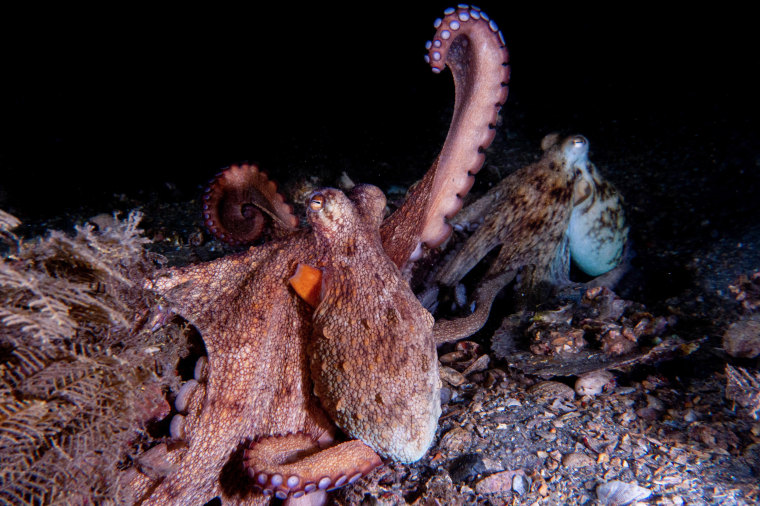
A mating pair of wild Octopus americanus, one displaying the arm action ‘raise’.
A mating pair of wild Octopus americanus, one displaying the arm action “raise.”Chelsea Bennice, Ph.D. / Florida Atlantic University Marine Science Laboratory

Octopuses have a complex and poorly understood nervous system, with nerves that run down each of their eight arms. Suckers on each arm give the animals a sense of touch, but also have chemoreceptors that allow them to essentially taste by touch.

“If I’m an octopus, I’m using my arms to run over surfaces, stick them in holes in the seafloor, looking in crevices in coral heads or rocky ledges and feeling around in there, but mostly tasting around in there to see what’s happening,” Buresch said.

Octopuses have a decentralized nervous system with more neurons in their arms than in their central brain, Buresch said.

“We’re all sort of starting to piece together the different parts of the puzzle that explain, How does this bizarre nervous system work?”

Source link

Share. Facebook Twitter Pinterest LinkedIn Tumblr Email
Previous ArticleJames Webb telescope’s ‘starlit mountaintop’ could be the observatory’s best image yet — Space photo of the week
Next Article Who Is Nate Bargatze? Meet the Host 
Editor
  • Website

Related Posts

News

Omar files new financial form in response to Trump, GOP critics

April 21, 2026
News

Ex-CENTCOM commanderwarns against ‘risky’ US ground op to seize Iran uranium

April 21, 2026
News

Santa Ana’s Upcoming Report on Police Firing on ICE Protesters Lacks Details

April 21, 2026
Add A Comment

Comments are closed.

Categories
  • Entertainment
  • Lifestyle
  • News
  • Sports
  • Tech
  • Travel
Recent Posts
  • Complex animals evolved up to 10 million years earlier than previously thought, fossil discovery shows
  • Scurvy-plagued whalers’ remains discovered at ‘Corpse Point’ on Arctic island
  • Some cancer patients don’t respond to immunotherapy. An existing asthma drug could change that.
  • The Appalachian Mountains hold enough lithium to make 500 billion cellphones, researchers discover
  • 800-year-old notebook with ‘rather unpleasant odor’ found in medieval German toilet
calendar
May 2026
M T W T F S S
 123
45678910
11121314151617
18192021222324
25262728293031
« Apr    
Recent Posts
  • Complex animals evolved up to 10 million years earlier than previously thought, fossil discovery shows
  • Scurvy-plagued whalers’ remains discovered at ‘Corpse Point’ on Arctic island
  • Some cancer patients don’t respond to immunotherapy. An existing asthma drug could change that.
About

Welcome to Baynard Media, your trusted source for a diverse range of news and insights. We are committed to delivering timely, reliable, and thought-provoking content that keeps you informed
and inspired

Categories
  • Entertainment
  • Lifestyle
  • News
  • Sports
  • Tech
  • Travel
Facebook X (Twitter) Pinterest WhatsApp
  • Contact Us
  • About Us
  • Privacy Policy
  • Disclaimer
  • UNSUBSCRIBE
© 2026 copyrights reserved

Type above and press Enter to search. Press Esc to cancel.