Close Menu
  • Home
  • UNSUBSCRIBE
  • News
  • Lifestyle
  • Tech
  • Entertainment
  • Sports
  • Travel
Facebook X (Twitter) WhatsApp
Trending
  • New robotic heart mimics common, mysterious condition to help researchers study it
  • Canon EOS R6 III review: A wildlife wonder
  • Medieval babies and adults buried together in Sweden were not related, archaeologists discover — raising big questions about early Christian burial practices
  • NASA is creating a fifth state of matter on the ISS, thanks to an upgrade to a mini-fridge-sized quantum lab
  • New sodium metal battery design charges in just 4 minutes and retains its capacity for years
  • Quantum computing wielded to create extremely rare material critical to nuclear fusion
  • Scientists build tiny ‘diving suit’ for cockroaches, turning them into search-and-rescue cyborgs
  • Physicists develop the first working model of quantum mechanics using only ‘real’ numbers
Facebook X (Twitter) WhatsApp
Baynard Media
  • Home
  • UNSUBSCRIBE
  • News
  • Lifestyle
  • Tech
  • Entertainment
  • Sports
  • Travel
Baynard Media
Home»Lifestyle»James Webb telescope’s ‘starlit mountaintop’ could be the observatory’s best image yet — Space photo of the week
Lifestyle

James Webb telescope’s ‘starlit mountaintop’ could be the observatory’s best image yet — Space photo of the week

EditorBy EditorSeptember 14, 2025No Comments3 Mins Read
Share Facebook Twitter Pinterest LinkedIn Tumblr Reddit Telegram Email
Share
Facebook Twitter LinkedIn Pinterest Email

QUICK FACTS

What it is: Pismis 24, a young star cluster

Where it is: 5,500 light-years away, in the constellation Scorpius

When it was shared: Sept. 4, 2025

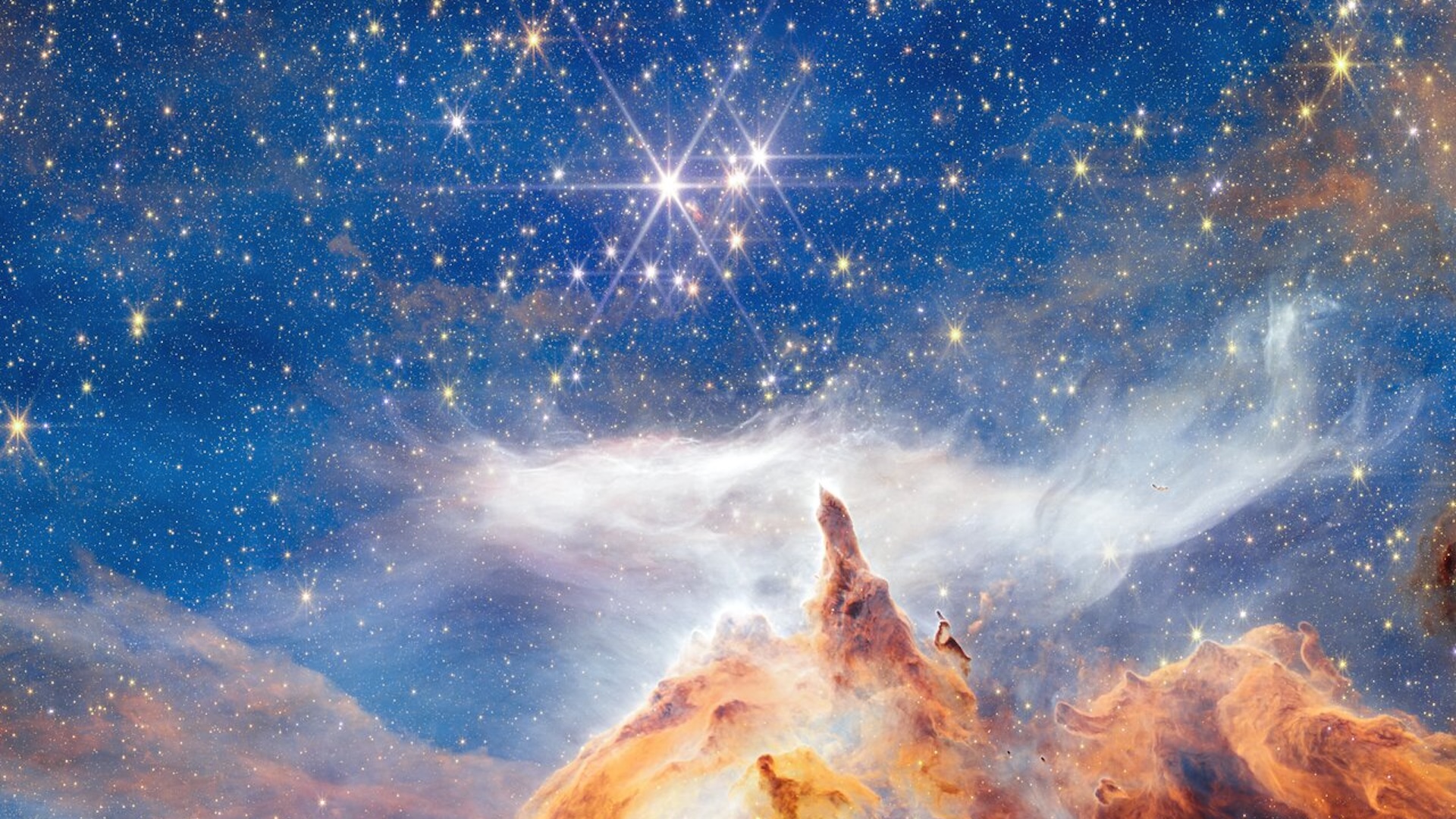
A craggy mountain peak, a tower, perhaps even a finger — in this new celestial dreamscape from the James Webb Space Telescope (JWST), something seems to be pointing at a cluster of bright stars above, as if a stargazing session were going on deep in the Milky Way.

This is Pismis 24, a small open star cluster at the core of the Lobster Nebula in the constellation Scorpius. This vast region of interstellar gas and dust is one of the closest sites to the solar system where our galaxy’s most massive and extreme stars burn fast and die young.

The orange and brown craggy peaks are huge spires of gas and dust, the European Space Agency wrote in a description of the image. The tallest, in the center of the image, is 5.4 light-years from base to tip — as wide as about 200 solar systems placed side by side out to Neptune’s orbit. Erosion within these spires is caused by powerful stellar winds and ultraviolet radiation from the massive newborn stars in the star cluster above. It’s all part of the process — as the gas is eroded and compressed by young stars’ radiation, new stars are born within the spires.


You may like

A JWST image of a star cluster with sparkling stars and cloudy rainbow colors

The James Webb Space Telescope’s view of a young star cluster 5,500 light-years from the solar system. (Image credit: NASA, ESA, CSA, and STScI, A. Pagan (STScI))

It’s a self-sustaining nursery, but there’s nothing ordinary about the stars in Pismis 24, which are among the most massive known stars in the galaxy. The brightest star in the cluster, Pismis 24-1, was once thought to be a single star with a mass of 200 to 300 suns. That’s almost twice the generally accepted upper mass limit for stars.

However, in 2006, the Hubble Space Telescope found that Pismis 24-1 is actually at least two separate stars orbiting each other. At 74 and 66 solar masses, respectively, the two stars remain among the most massive and luminous stars in the Milky Way. Their intense ultraviolet radiation and stellar winds have produced the dusty dreamscape captured in infrared by JWST’s Near Infrared Camera.

As with all of JWST’s images, there’s a color code to understand before you can fully appreciate what you’re seeing. Astronomers assign different color filters to different wavelengths of light: Cyan is hot, ionized hydrogen gas; orange is dust; deep red is cooler and denser hydrogen; and white is starlight scattered by dust. The darker, blacker regions show gas and dust so thick that even JWST’s infrared sensors cannot penetrate it.

For more sublime space images, check out our Space Photo of the Week archives.

Get the world’s most fascinating discoveries delivered straight to your inbox.

Source link

Share. Facebook Twitter Pinterest LinkedIn Tumblr Email
Previous ArticlePresidential historian contrasts instant social media clips with JFK’s Zapruder film that remained unseen for over a decade
Next Article A new analysis of underwater videos shows octopuses are ‘incredible multitaskers’
Editor
  • Website

Related Posts

Lifestyle

New robotic heart mimics common, mysterious condition to help researchers study it

July 11, 2026
Lifestyle

Canon EOS R6 III review: A wildlife wonder

July 10, 2026
Lifestyle

Medieval babies and adults buried together in Sweden were not related, archaeologists discover — raising big questions about early Christian burial practices

July 10, 2026
Add A Comment

Comments are closed.

Categories
  • Entertainment
  • Lifestyle
  • News
  • Sports
  • Tech
  • Travel
Recent Posts
  • New robotic heart mimics common, mysterious condition to help researchers study it
  • Canon EOS R6 III review: A wildlife wonder
  • Medieval babies and adults buried together in Sweden were not related, archaeologists discover — raising big questions about early Christian burial practices
  • NASA is creating a fifth state of matter on the ISS, thanks to an upgrade to a mini-fridge-sized quantum lab
  • New sodium metal battery design charges in just 4 minutes and retains its capacity for years
calendar
July 2026
M T W T F S S
 12345
6789101112
13141516171819
20212223242526
2728293031  
« Jun    
Recent Posts
  • New robotic heart mimics common, mysterious condition to help researchers study it
  • Canon EOS R6 III review: A wildlife wonder
  • Medieval babies and adults buried together in Sweden were not related, archaeologists discover — raising big questions about early Christian burial practices
About

Welcome to Baynard Media, your trusted source for a diverse range of news and insights. We are committed to delivering timely, reliable, and thought-provoking content that keeps you informed
and inspired

Categories
  • Entertainment
  • Lifestyle
  • News
  • Sports
  • Tech
  • Travel
Facebook X (Twitter) Pinterest WhatsApp
  • Contact Us
  • About Us
  • Privacy Policy
  • Disclaimer
  • UNSUBSCRIBE
© 2026 copyrights reserved

Type above and press Enter to search. Press Esc to cancel.