Close Menu
  • Home
  • UNSUBSCRIBE
  • News
  • Lifestyle
  • Tech
  • Entertainment
  • Sports
  • Travel
Facebook X (Twitter) WhatsApp
Trending
  • James Webb telescope may have discovered a mysterious, never-before-seen substance on Pluto and Titan
  • Diagnostic dilemma: Improper use of a massage gun tore holes in a man’s retinas
  • Study suggests life on Earth has around 1.8 billion years left — but the biosphere might evolve to survive even longer
  • Ancient-DNA analysis solves 500-year-old mystery of what killed 2 Medici brothers
  • Antarctica’s first dinosaur fossil belonged to a group of the largest land animals ever
  • Scientists propose launching a giant ‘airbag’ into space to protect us from solar superstorms ‪— and experts say it’s ‘quite feasible’
  • Dead-end bitcoin mining wastes as much energy as Switzerland’s entire hydropower generation capacity
  • 66 billion trees have been planted in China’s Great Green Wall — and they appear to be growing faster than natural forests
Facebook X (Twitter) WhatsApp
Baynard Media
  • Home
  • UNSUBSCRIBE
  • News
  • Lifestyle
  • Tech
  • Entertainment
  • Sports
  • Travel
Baynard Media
Home»Lifestyle»Complex animals evolved up to 10 million years earlier than previously thought, fossil discovery shows
Lifestyle

Complex animals evolved up to 10 million years earlier than previously thought, fossil discovery shows

EditorBy EditorMay 21, 2026No Comments4 Mins Read
Share Facebook Twitter Pinterest LinkedIn Tumblr Reddit Telegram Email
Share
Facebook Twitter LinkedIn Pinterest Email

A trove of fossils uncovered in northwestern Canada suggests that complex animals evolved in North America earlier than previously thought.

The site houses more than 100 fossils, including six taxa never found in North America before, with some dating back 567 million years. The findings push back the origins of animals that can move themselves in search of food by several million years, according to a study published May 20 in the journal Science Advances.

“For 3 billion years, life on Earth was dominated by microbes,” study co-author Scott D. Evans, assistant curator of invertebrate paleontology at the American Museum of Natural History in New York City, said in a statement. Then, all of a sudden, “we get these strange-looking marine animals big enough to see and capable of behaviors we would find familiar today. If we want to understand this transition, when life first became large, complex and unmistakenly animal, this new site has tremendous potential.”


You may like

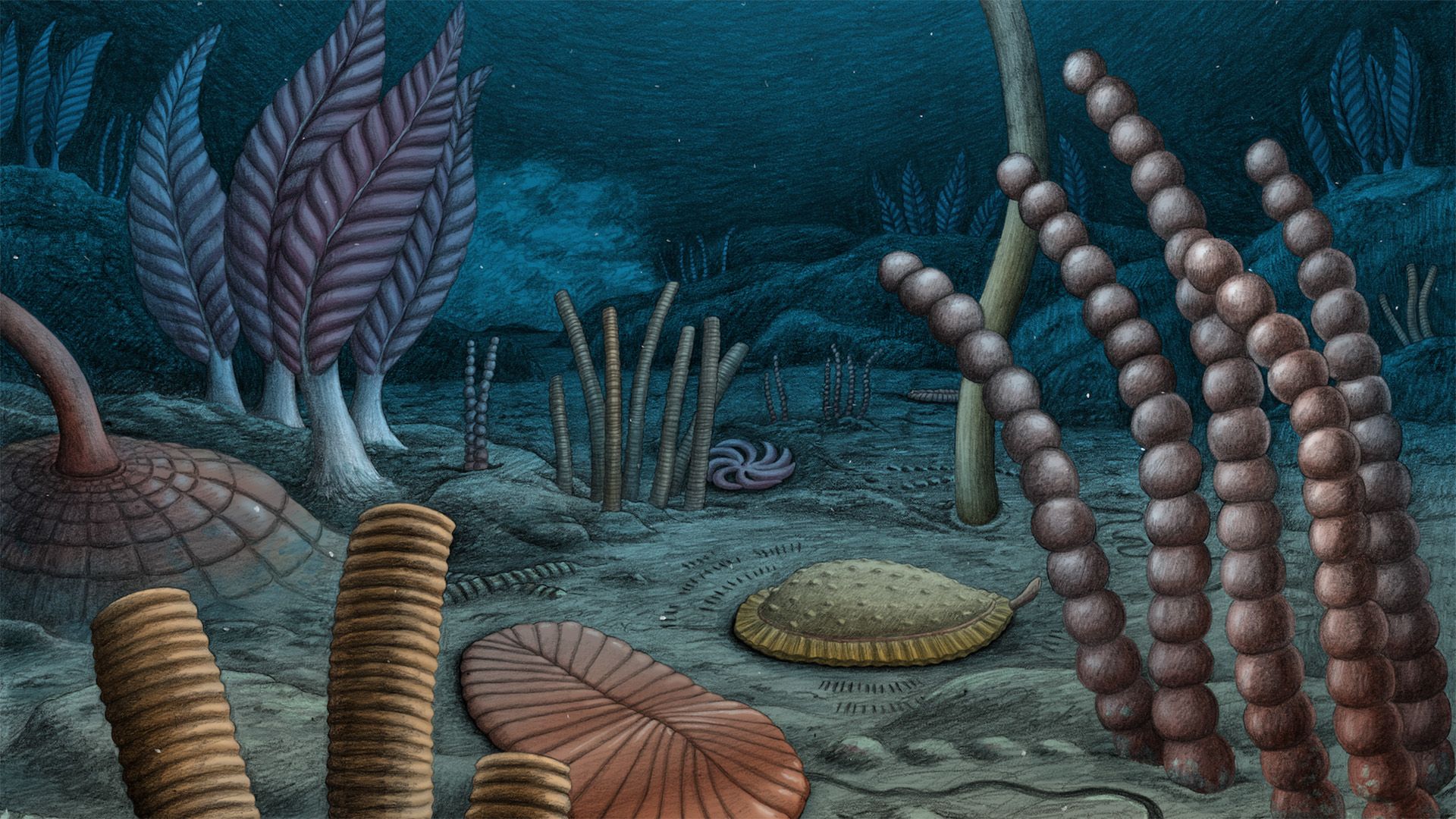
Complex, multicellular animals first evolved during the Ediacaran period (635 million to 541 million years ago). At this time, North America was part of the ancient continent Laurentia, which predated the supercontinent Pangaea.

Some of these early animals from the Ediacaran are linked to modern animals, like mollusks and jellyfish, while others look nothing like any species living today. Most, however, had soft bodies without shells or bones, so fossils from this period are rare.

A close up of a spiral-shaped fossil embedded in a gray rock against a dark background.

A close up of the fossil Eoandromeda, considered a comb jelly with eight arms.

(Image credit: Scott Evans / ©AMNH)

Scientists split the fossils that did form into three groups, or assemblages, based on when the animals lived. The Avalon assemblage (575 million to 559 million years ago) consisted of stationary animals that lived deep underwater. The White Sea assemblage (559 million to 550 million years ago) contained a more diverse group of animals that lived in shallower water, and the Nama assemblage (550 million to 538 million years ago) included the earliest animals that formed shells and bones.

In the new study, the researchers discovered several fossils of species known to belong to the White Sea assemblage for the first time in North America. These fossils date back 5 million to 10 million years earlier than White Sea assemblage fossils previously found in Europe, Asia and Australia.

Get the world’s most fascinating discoveries delivered straight to your inbox.

A close up of a fossil embedded in a rock against a dark background.

Two different Ediacaran organisms, the tubular Aulozoon on the left and Dickinsonia on the right are fossilized in this rock.

(Image credit: Scott Evans / ©AMNH)

Among the fossils were Dickinsonia, a flat, oval-shaped organism that absorbed algae through its entire bottom surface; Funisia, a tube-shaped creature that represents the oldest evidence of sexual reproduction among animals; and Kimberella, an early mollusk that may now be the oldest fossil species to exhibit bilateral symmetry.

“Not only is this new site highly diverse, but also it is from a part of the rock succession where we have previously lacked fossil remains,” study co-author Justin Strauss, an Earth scientist at Dartmouth College, said in the statement. “This is really exciting. Given our understanding of the regional geology in northwestern Canada, there is great potential here to revisit our understanding of Ediacaran Earth history.”

That potential may apply to the creatures’ evolutionary history. Based on the sediment patterns in the surrounding rock, the fossilized organisms found in Canada lived in deeper water than researchers previously thought creatures in the White Sea assemblage lived. That could suggest that the animals first evolved in deep water and gradually expanded their range into shallower water — the opposite of typical animal evolution.

“We think of the deep ocean as a dark, inhospitable place, but it is also relatively stable, with few fluctuations in things like temperature and oxygen essential to most animal life,” Evans said in the statement. “This stability may have provided key opportunities to support early animal life.”

Evans, S.D. et al. 2026 Discovery of White Sea Assemblage fossils from Laurentia. Science Advances 12, eaed9916. 10.1126/sciadv.aed9916

Source link

Share. Facebook Twitter Pinterest LinkedIn Tumblr Email
Previous ArticleScurvy-plagued whalers’ remains discovered at ‘Corpse Point’ on Arctic island
Next Article Physicists confirm ‘negative time’ is real in mind-bending quantum experiment
Editor
  • Website

Related Posts

Lifestyle

James Webb telescope may have discovered a mysterious, never-before-seen substance on Pluto and Titan

July 2, 2026
Lifestyle

Diagnostic dilemma: Improper use of a massage gun tore holes in a man’s retinas

July 2, 2026
Lifestyle

Study suggests life on Earth has around 1.8 billion years left — but the biosphere might evolve to survive even longer

July 2, 2026
Add A Comment

Comments are closed.

Categories
  • Entertainment
  • Lifestyle
  • News
  • Sports
  • Tech
  • Travel
Recent Posts
  • James Webb telescope may have discovered a mysterious, never-before-seen substance on Pluto and Titan
  • Diagnostic dilemma: Improper use of a massage gun tore holes in a man’s retinas
  • Study suggests life on Earth has around 1.8 billion years left — but the biosphere might evolve to survive even longer
  • Ancient-DNA analysis solves 500-year-old mystery of what killed 2 Medici brothers
  • Antarctica’s first dinosaur fossil belonged to a group of the largest land animals ever
calendar
July 2026
M T W T F S S
 12345
6789101112
13141516171819
20212223242526
2728293031  
« Jun    
Recent Posts
  • James Webb telescope may have discovered a mysterious, never-before-seen substance on Pluto and Titan
  • Diagnostic dilemma: Improper use of a massage gun tore holes in a man’s retinas
  • Study suggests life on Earth has around 1.8 billion years left — but the biosphere might evolve to survive even longer
About

Welcome to Baynard Media, your trusted source for a diverse range of news and insights. We are committed to delivering timely, reliable, and thought-provoking content that keeps you informed
and inspired

Categories
  • Entertainment
  • Lifestyle
  • News
  • Sports
  • Tech
  • Travel
Facebook X (Twitter) Pinterest WhatsApp
  • Contact Us
  • About Us
  • Privacy Policy
  • Disclaimer
  • UNSUBSCRIBE
© 2026 copyrights reserved

Type above and press Enter to search. Press Esc to cancel.