Close Menu
  • Home
  • UNSUBSCRIBE
  • News
  • Lifestyle
  • Tech
  • Entertainment
  • Sports
  • Travel
Facebook X (Twitter) WhatsApp
Trending
  • Scientists discover deadly, highly venomous box jellyfish near Singapore’s ‘Island of Death Behind’
  • Poll: What do you think of PMOS, the new name for PCOS?
  • Celestron Outland X 10×25 roof prism binocular review
  • Withings Body Scan review: Smart scale turned all-in-one health hub
  • World’s first ‘native’ color lidar will let robots and self-driving cars map the world in full color 3D
  • Bright-blue ‘potash ponds’ shine alongside a dark-green river in Utah — Earth from space
  • Deadly Ebola outbreak is a public health emergency of international concern, WHO declares
  • 1,200-year-old giant ‘death jar’ in Laos contains generations of human skeletons
Facebook X (Twitter) WhatsApp
Baynard Media
  • Home
  • UNSUBSCRIBE
  • News
  • Lifestyle
  • Tech
  • Entertainment
  • Sports
  • Travel
Baynard Media
Home»Lifestyle»Scientists discover deadly, highly venomous box jellyfish near Singapore’s ‘Island of Death Behind’
Lifestyle

Scientists discover deadly, highly venomous box jellyfish near Singapore’s ‘Island of Death Behind’

EditorBy EditorMay 19, 2026No Comments3 Mins Read
Share Facebook Twitter Pinterest LinkedIn Tumblr Reddit Telegram Email
Share
Facebook Twitter LinkedIn Pinterest Email

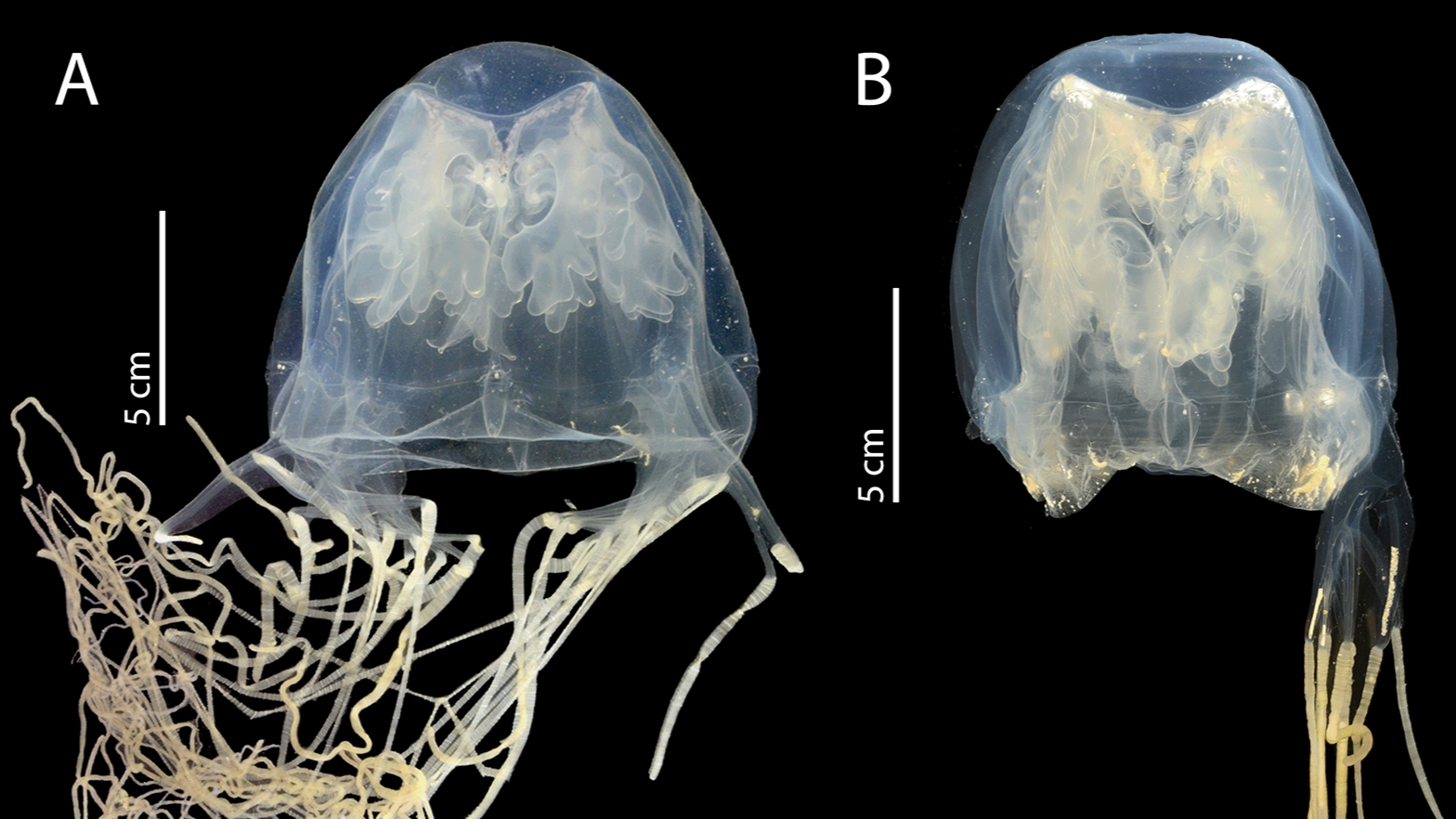
Scientists have described a new species of highly venomous box jellyfish based on specimens that were lurking near a Singaporean island formerly known as Pulau Blakang Mati, or the “Island of Death Behind,” in 2020 and 2021.

The newly described species, Chironex blakangmati, was named after the island’s original, ominous name in Malay, rather than its name since 1972, Sentosa, which means “peace and tranquility.” That’s fitting, given how dangerous the animal is.

C. blakangmati is one of four known species of Chironex box jellyfish, all of which are incredibly venomous. Their stings, delivered via special cells on their tentacles called nematocysts, are so powerful they can kill humans. And unlike most other jellyfish that simply ride on currents, Chironex box jellies can actively identify and swim toward prey thanks to their strong musculature and complex eyes.


You may like

Previously, scientists had mistaken C. blakangmati for another box jellyfish species, C. yamaguchii. However, it turns out that these box jellies are different, both genetically and morphologically, scientists reported in a new study, published May 15 in the journal Raffles Bulletin of Zoology.

“C. blakangmati looks remarkably like Chironex yamaguchii — a jellyfish species I first discovered in Okinawa while doing my master’s degree there,” study co-author Cheryl Ames, a professor of applied marine biology at Tohoku University in Japan and a research associate at the Smithsonian National Museum of Natural History in Washington, D.C., said in a statement. “But we realized they were completely distinct. I actually went back to dust off an old sample of C. yamaguchii I still had in storage in Okinawa to help with the comparisons!”

The researchers found that the newly identified species lacks branched canal structures at the bottom of its bell-shaped body that C. yamaguchii and the other two Chironex species, C. fleckeri and C. indrasaksajiae, exhibit. Specifically, these canals sit within the perradial lappets, which are flaps reinforcing the musculature that propels box jellyfish when they swim. Together with genetic discrepancies, this anatomical difference confirmed that C. blakangmati is a separate species, according to the statement.

“Our thorough review and analysis of all the Chironex species known to date reveal a lot about these box jellyfishes,” study co-author Danwei Huang, an associate professor in the National University of Singapore’s Department of Biological Sciences and the Lee Kong Chian Natural History Museum, said in the statement.

Get the world’s most fascinating discoveries delivered straight to your inbox.

A map of Singapore showing the locations of five Chironex box jellyfish sightings.

The analysis was based on jellyfish specimens that washed up on Singapore beaches in 2020 and 2021. The newfound species is marked in blue, while Thai sea wasps are shown in red.

The results also revealed for the first time that C. indrasaksajiae, which is typically found off the coast of Thailand, is present in Singapore’s waters. Nicknamed the Thai sea wasp, this species can be deadly.

“We were surprised to find C. indrasaksajiae so far away from Thailand,” Ames said. “Recording range expansions like these is really important, as we currently know so little about the biodiversity and spatial distribution of box jellyfish.”

A better understanding of the distribution of box jellies could help prevent severe injuries and deaths in humans, according to the statement.

Records suggest box jellyfish stings cause around 40 deaths per year globally, but some experts think that number is a huge underestimate.

Iesa, I., Ames, C. L., Yap, N. W. L. & Huang, D. (2026). Chironex box jellyfishes (Cnidaria: Cubozoa: Chirodropida) in Singapore: Chironex blakangmati, new species, and range extension of C. indrasaksajiae. Raffles Bulletin of Zoology. http://dx.doi.org/10.26107/RBZ-2026-0026

Source link

Share. Facebook Twitter Pinterest LinkedIn Tumblr Email
Previous ArticlePoll: What do you think of PMOS, the new name for PCOS?
Editor
  • Website

Related Posts

Lifestyle

Poll: What do you think of PMOS, the new name for PCOS?

May 19, 2026
Lifestyle

Celestron Outland X 10×25 roof prism binocular review

May 19, 2026
Lifestyle

Withings Body Scan review: Smart scale turned all-in-one health hub

May 19, 2026
Add A Comment

Comments are closed.

Categories
  • Entertainment
  • Lifestyle
  • News
  • Sports
  • Tech
  • Travel
Recent Posts
  • Scientists discover deadly, highly venomous box jellyfish near Singapore’s ‘Island of Death Behind’
  • Poll: What do you think of PMOS, the new name for PCOS?
  • Celestron Outland X 10×25 roof prism binocular review
  • Withings Body Scan review: Smart scale turned all-in-one health hub
  • World’s first ‘native’ color lidar will let robots and self-driving cars map the world in full color 3D
calendar
May 2026
M T W T F S S
 123
45678910
11121314151617
18192021222324
25262728293031
« Apr    
Recent Posts
  • Scientists discover deadly, highly venomous box jellyfish near Singapore’s ‘Island of Death Behind’
  • Poll: What do you think of PMOS, the new name for PCOS?
  • Celestron Outland X 10×25 roof prism binocular review
About

Welcome to Baynard Media, your trusted source for a diverse range of news and insights. We are committed to delivering timely, reliable, and thought-provoking content that keeps you informed
and inspired

Categories
  • Entertainment
  • Lifestyle
  • News
  • Sports
  • Tech
  • Travel
Facebook X (Twitter) Pinterest WhatsApp
  • Contact Us
  • About Us
  • Privacy Policy
  • Disclaimer
  • UNSUBSCRIBE
© 2026 copyrights reserved

Type above and press Enter to search. Press Esc to cancel.