Close Menu
  • Home
  • UNSUBSCRIBE
  • News
  • Lifestyle
  • Tech
  • Entertainment
  • Sports
  • Travel
Facebook X (Twitter) WhatsApp
Trending
  • New blood test aims to spot liver scarring when it’s still reversible and before it paves the way to cancer
  • ‘We’re the best servants anyone could dream of!’: AI superintelligence has no need to enslave humans because we’re already bowing to it
  • Glowing ring of plankton surrounding New Zealand islands linked to deadly underwater plateau — Earth from space
  • Omar files new financial form in response to Trump, GOP critics
  • New study confirms lobsters feel pain, driving scientists to call for a ban on boiling them alive
  • Ex-CENTCOM commanderwarns against ‘risky’ US ground op to seize Iran uranium
  • Santa Ana’s Upcoming Report on Police Firing on ICE Protesters Lacks Details
  • Stephen Hawking’s black hole information paradox could be solved — if the universe has 7 dimensions
Facebook X (Twitter) WhatsApp
Baynard Media
  • Home
  • UNSUBSCRIBE
  • News
  • Lifestyle
  • Tech
  • Entertainment
  • Sports
  • Travel
Baynard Media
Home»Lifestyle»4,000-year-old burial of elite woman with ostrich fan reveals world’s oldest known evidence of head straps
Lifestyle

4,000-year-old burial of elite woman with ostrich fan reveals world’s oldest known evidence of head straps

EditorBy EditorApril 6, 2025No Comments4 Mins Read
Share Facebook Twitter Pinterest LinkedIn Tumblr Reddit Telegram Email
Share
Facebook Twitter LinkedIn Pinterest Email

Marks on 4,000-year-old skeletons reveal that Bronze Age women in Nubia were carrying goods and young children on their heads using tumplines, a type of head strap that can hold a basket, a new study finds. The discovery reveals the oldest known use of head straps in the world.

Researchers made the finding in Sudan after analzying the remains of 30 people (14 females and 16 males) buried in a Nubian Bronze Age cemetery. One, an elite woman who was around 50 years old when she died, had the clearest marks indicative of head straps.

This is the “first clear evidence that women were using head straps — tumplines — to carry loads as early as the Bronze Age,” study lead author Jared Carballo-Pérez, a researcher of bioarchaeology at the Autonomous University of Barcelona, told Live Science in an email.

Carballo-Pérez and his colleagues investigated at the archaeological site of Abu Fatima which consists of a cemetery that is located by the third cataract of the Nile River, in what was once the ancient kingdom of Kush.

After analyzing the 30 people in the Abu Fatima cemetery, the team found that women tended to have more wear on their head and neck areas than the male skeletons did, indicating that the women were bearing loads with head straps.

“Women exhibited specific degenerative changes in the cervical vertebrae and skull areas associated with prolonged use of tumplines that transfer weight from the forehead to the upper back,” the team wrote in a statement.

Related: 3,500-year-old burial of Nubian woman reveals 1 of world’s earliest known cases of rheumatoid arthritis

Get the world’s most fascinating discoveries delivered straight to your inbox.

Two young Nepali women carry heavy baskets of stones on their backs up stairs using a tumpline

Modern-day Nepali women using tumplines to carry baskets. (Image credit: VW Pics via Getty Images)

The cemetery was only about 6 miles (10 kilometers) north of Kerma, the capital city of Kush. “The capital in Kerma was a densely populated urban center that featured various facilities such as storage buildings, ritual structures, breweries, bakeries, and defensive walls,” the researchers wrote in the study, which was published in the March issue of the Journal of Anthropological Archaeology.

Based on the skeletal analyses from the cemetery, it’s likely that women in Kerma and the surrounding area carried goods and young children using head straps, the new research suggests.

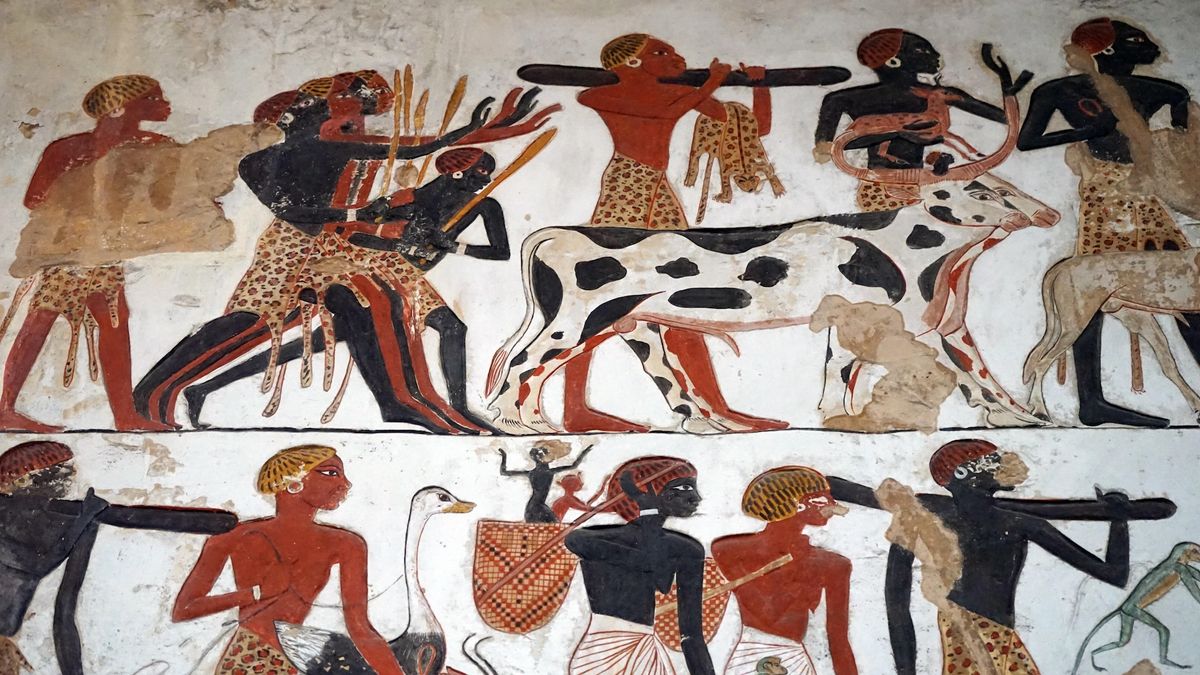
The team also analyzed ancient art from Egypt that depicts Nubians who lived around this time. They noticed that some of the Nubians featured appear to be carrying children using head straps.

“The forehead straps would be attached to the basket and placed over the top of the head. This is supported by various depictions of Nubian women found in tribute scenes from 18th Dynasty Theban tombs,” the team wrote in the paper.

Historical images of women using tumplines

An illustration (left) of an Ojibwe woman in North America using a head strap to carry a young child. Photos (right) of modern-day Kikuyu women in eastern Africa using head straps to carry goods. (Image credit: The Canadian Encyclopedia & Visual Photos)

Woman buried with ostrich fan

The elite woman’s remains showed the “clearest signs” of head strap use, the team wrote in the statement. She lived sometime between 2600 and 2000 B.C., study co-author Sarah Schrader, an associate professor of archaeology at Leiden University in the Netherlands who co-led excavations at Abu Fatima, told Live Science in an email. Her remains were buried with an ostrich feather fan and a leather pillow.

The elite woman’s identity is unknown, but the luxury items buried with her suggest that she had a different status to others in her community, Schrader said. It’s unclear exactly what her status was, but the signs of wear indicate she still had to carry heavy loads on her head. Additionally, isotopic analysis of her remains suggests that she is from outside the region, possibly the second cataract of the Nile. This is north of the cemetery but still within the kingdom of Kush.

People in modern times still use tumplines. The practice is “still alive today in rural regions of Africa, Asia, and Latin America,” the team wrote in the statement.

Source link

Share. Facebook Twitter Pinterest LinkedIn Tumblr Email
Previous ArticleWhat was the first alphabet in the world?
Next Article MIT’s ‘remote entanglement’ discovery lets QPUs to communicate at vast distances
Editor
  • Website

Related Posts

Lifestyle

New blood test aims to spot liver scarring when it’s still reversible and before it paves the way to cancer

April 21, 2026
Lifestyle

‘We’re the best servants anyone could dream of!’: AI superintelligence has no need to enslave humans because we’re already bowing to it

April 21, 2026
Lifestyle

Glowing ring of plankton surrounding New Zealand islands linked to deadly underwater plateau — Earth from space

April 21, 2026
Add A Comment

Comments are closed.

Categories
  • Entertainment
  • Lifestyle
  • News
  • Sports
  • Tech
  • Travel
Recent Posts
  • New blood test aims to spot liver scarring when it’s still reversible and before it paves the way to cancer
  • ‘We’re the best servants anyone could dream of!’: AI superintelligence has no need to enslave humans because we’re already bowing to it
  • Glowing ring of plankton surrounding New Zealand islands linked to deadly underwater plateau — Earth from space
  • Omar files new financial form in response to Trump, GOP critics
  • New study confirms lobsters feel pain, driving scientists to call for a ban on boiling them alive
calendar
April 2026
M T W T F S S
 12345
6789101112
13141516171819
20212223242526
27282930  
« Mar    
Recent Posts
  • New blood test aims to spot liver scarring when it’s still reversible and before it paves the way to cancer
  • ‘We’re the best servants anyone could dream of!’: AI superintelligence has no need to enslave humans because we’re already bowing to it
  • Glowing ring of plankton surrounding New Zealand islands linked to deadly underwater plateau — Earth from space
About

Welcome to Baynard Media, your trusted source for a diverse range of news and insights. We are committed to delivering timely, reliable, and thought-provoking content that keeps you informed
and inspired

Categories
  • Entertainment
  • Lifestyle
  • News
  • Sports
  • Tech
  • Travel
Facebook X (Twitter) Pinterest WhatsApp
  • Contact Us
  • About Us
  • Privacy Policy
  • Disclaimer
  • UNSUBSCRIBE
© 2026 copyrights reserved

Type above and press Enter to search. Press Esc to cancel.