
With so many ancient texts around the world, you might wonder which alphabet was the first to be developed. In other words, what is the oldest confirmed alphabet in the world?
Experts told Live Science it was probably the proto-Sinaitic script, which was invented about 4,000 years ago by Canaanite workers at an Egyptian turquoise mine in the Sinai region. The proto-Sinaitic script developed into the Phoenician alphabet, which, in turn, inspired the early Hebrew, Greek and Roman alphabets.
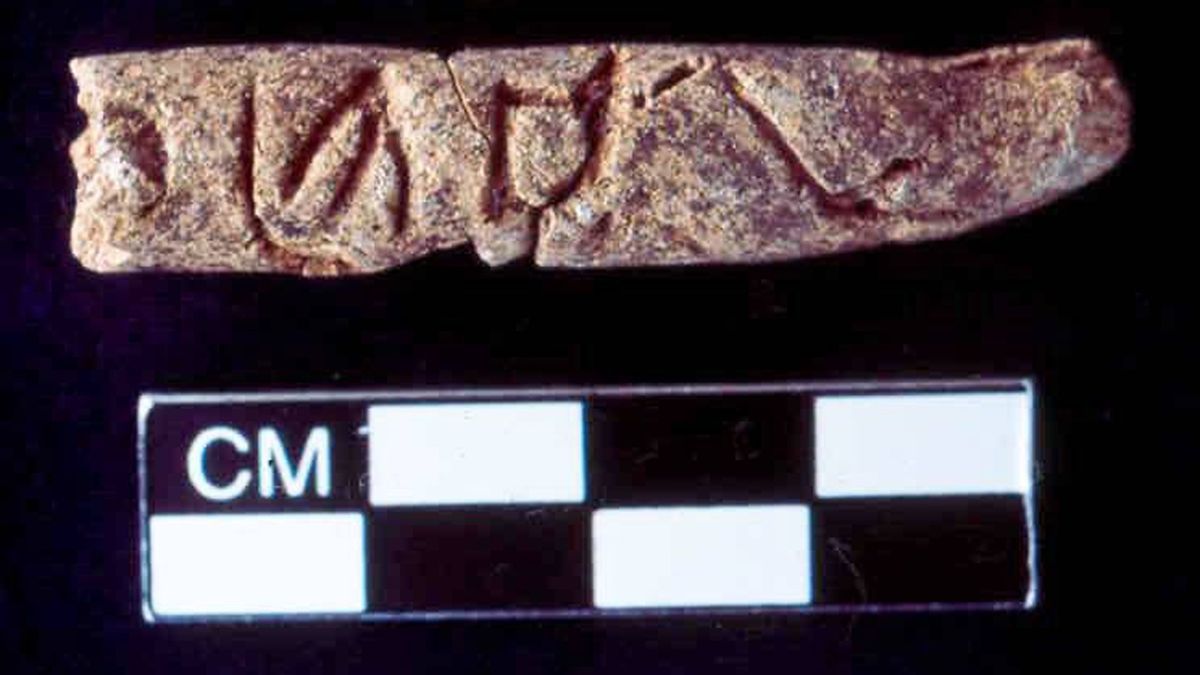
However, a November 2024 discovery by researchers at Johns Hopkins University suggested that an alphabetic script was being used hundreds of years earlier, in what is now northern Syria. Their evidence is four clay cylinders, each about as long as a finger, from a Bronze Age tomb at Umm el-Marra, near Aleppo.
Radiocarbon dating suggests symbols were inscribed on the cylinders in about 2400 B.C., about 500 years before the proto-Sinaitic script was developed.
Related: How do we decipher Egyptian hieroglyphics and other ancient languages?
But not everyone is convinced by the discovery, and maintain that proto-Sinaitic script is the oldest known alphabet, which is a specific kind of writing system. “I think [the Umm el-Marra inscriptions] clearly are some sort of writing system,” Philippa Steele, a philologist at the University of Cambridge, told Live Science in an email. But “what is more difficult is being sure that it is related to the alphabetic system.”

Ancient writing
Archaeologists think writing developed in several places in the ancient world independently of other writing systems. Egyptian hieroglyphs, for example, originated in about 3200 B.C., while Sumerian cuneiform seems to be from about the same time.
Ancient Chinese writing developed early in the second millennium B.C., while the earliest known writing system in the Americas is the Olmec script, from about 600 B.C.
But none of these early writing systems are classified as alphabets. Instead, they are either logographic writing systems — where each symbol represents a word or concept, such as “mountain” — or mixtures of logographies and syllabaries (where letters represent syllables) that added some characters to represent spoken sounds.
The letters in alphabets, in contrast, represent distinct sounds, or “phonemes,” that are used to make up the sounds of a spoken word, Steele said in an email.
The proto-Sinaitic script seems to have been influenced by ancient Egyptian hieroglyphs, but “the Proto-Sinaitic alphabet is clearly a very innovative creation,” she wrote; the general principle of writing may have come from hieroglyphs, but the concept of an alphabet and the values of the letters themselves were new ideas.
Steele is most interested in the Bronze Age scripts from Crete, other parts of Greece, and Cyprus — some of which have never been deciphered. “Cyprus kept its old Bronze Age system [of writing] for well over a thousand years, and used it for Greek,” she said. “So while Greek was being written in the alphabet everywhere else … in Cyprus they had this really distinctive syllabic writing system that became a symbol of cultural identity.”
Silvia Ferrara, a philologist at the University of Bologna in Italy who is not involved in the Syria find, said in an email that her favorite ancient writing systems are those yet undeciphered, including the proto-Elamite script from what is now southwestern Iran, which may have influenced Mesopotamian cuneiform.

Proto-Sinaitic script debate
The proto-Sinaitic script was widely thought to be the oldest alphabet, Steele said, but the new discovery at Umm el-Marra challenged this idea.
Glenn Schwartz, an archaeologist at Johns Hopkins University who discovered the clay cylinders and presented his research at an archaeological conference in 2024, said in a statement that the artifacts were older than any known proto-Sinaitic inscriptions and were found in northern Syria. That suggests “the alphabet may have an entirely different origin story than we thought,” he said.
Ferrara said she is not surprised to find that alphabets were already in use 500 years earlier than thought, although the location of the discovery is a revelation. “It is surprising to find these in Syria, but ideas and concepts traveled much more than the archaeological evidence lets on,” she told Live Science.
And Steele cautioned that the Umm el-Marra cylinders contain too few signs to establish that they formed an alphabetic system. “I’d like more evidence before labeling the system as alphabetic, because we don’t have enough evidence to analyze its structure,” she said.
While some of the signs in the Umm el-Marra inscriptions seemed to be parallels of some proto-Sinaitic signs, for others, “any relationship is less obvious,” she said.
“The main problem is that if you only have similarities in sign shape and no other way of assessing the system, then certainty is difficult to achieve,” she said. “I would really like more contemporary finds to help us understand what kind of writing traditions these inscriptions belong to.”
