Close Menu
  • Home
  • UNSUBSCRIBE
  • News
  • Lifestyle
  • Tech
  • Entertainment
  • Sports
  • Travel
Facebook X (Twitter) WhatsApp
Trending
  • Science news this week: PCOS has a new name, Neanderthals were the world’s oldest dentists, and the first nuclear bomb explosion spawned an ‘alien’ crystal
  • Newly discovered, blue-whale-size asteroid will fly super close to Earth Monday — and you can watch it live
  • Don Juan Pond: Antarctica’s salty, syrupy lake that never freezes, even when it’s minus 58 F
  • Withings ScanWatch 2 review: Style meets next-level health monitoring
  • AI Chatbots are turbo-charging violence against women and girls: We urgently need to regulate them | Yvonne McDermott Rees
  • ‘The biggest El Niño event since the 1870s’: ‘Super’ El Niño is now the most likely scenario by the end of this year ‪—‬ and the humanitarian cost could be huge
  • Antarctica’s sudden sea ice loss is one of the most extreme and confusing events in the modern climate record. Scientists now know why it’s happening.
  • ‘I heard gasps’: Artemis II astronauts reveal inside story of their mind-bending solar eclipse
Facebook X (Twitter) WhatsApp
Baynard Media
  • Home
  • UNSUBSCRIBE
  • News
  • Lifestyle
  • Tech
  • Entertainment
  • Sports
  • Travel
Baynard Media
Home»Lifestyle»World’s largest solar telescope turns on powerful new camera, revealing breathtaking image of a continent-size sunspot
Lifestyle

World’s largest solar telescope turns on powerful new camera, revealing breathtaking image of a continent-size sunspot

EditorBy EditorApril 24, 2025No Comments3 Mins Read
Share Facebook Twitter Pinterest LinkedIn Tumblr Reddit Telegram Email
Share
Facebook Twitter LinkedIn Pinterest Email

Weather on Earth can be wild, but it’s not the only kind of weather we have to deal with. Space weather — all the winds and particles streaming off the sun — can have major impacts on Earth and human infrastructure. In the worst cases, this can mean dangerous disruption to our power grids and communications satellites.

To help us predict these space storms, astronomers have a newly improved space weatherman — and it’s the best one to date. The Daniel K. Inouye Solar Telescope (DKIST), perched atop the Hawaiian mountain of Haleakalā, is the world’s largest telescope used for studying the sun and predicting these storms.

The team behind this technological marvel recently hit a major milestone, finally turning on one of DKIST’s most powerful cameras — known as the Visible Tunable Filter, or VTF — after more than a decade working on its creation.


You may like

This camera is the final piece of the puzzle for DKIST, and the VTF’s addition “will complete its initial arsenal of scientific instruments,” Carrie Black, director of the National Solar Observatory, said in a statement.

“The significance of the technological achievement is such that one could easily argue the VTF is the Inouye Solar Telescope’s heart, and it is finally beating at its forever place,” Matthias Schubert, project scientist for the VTF, said in the statement.

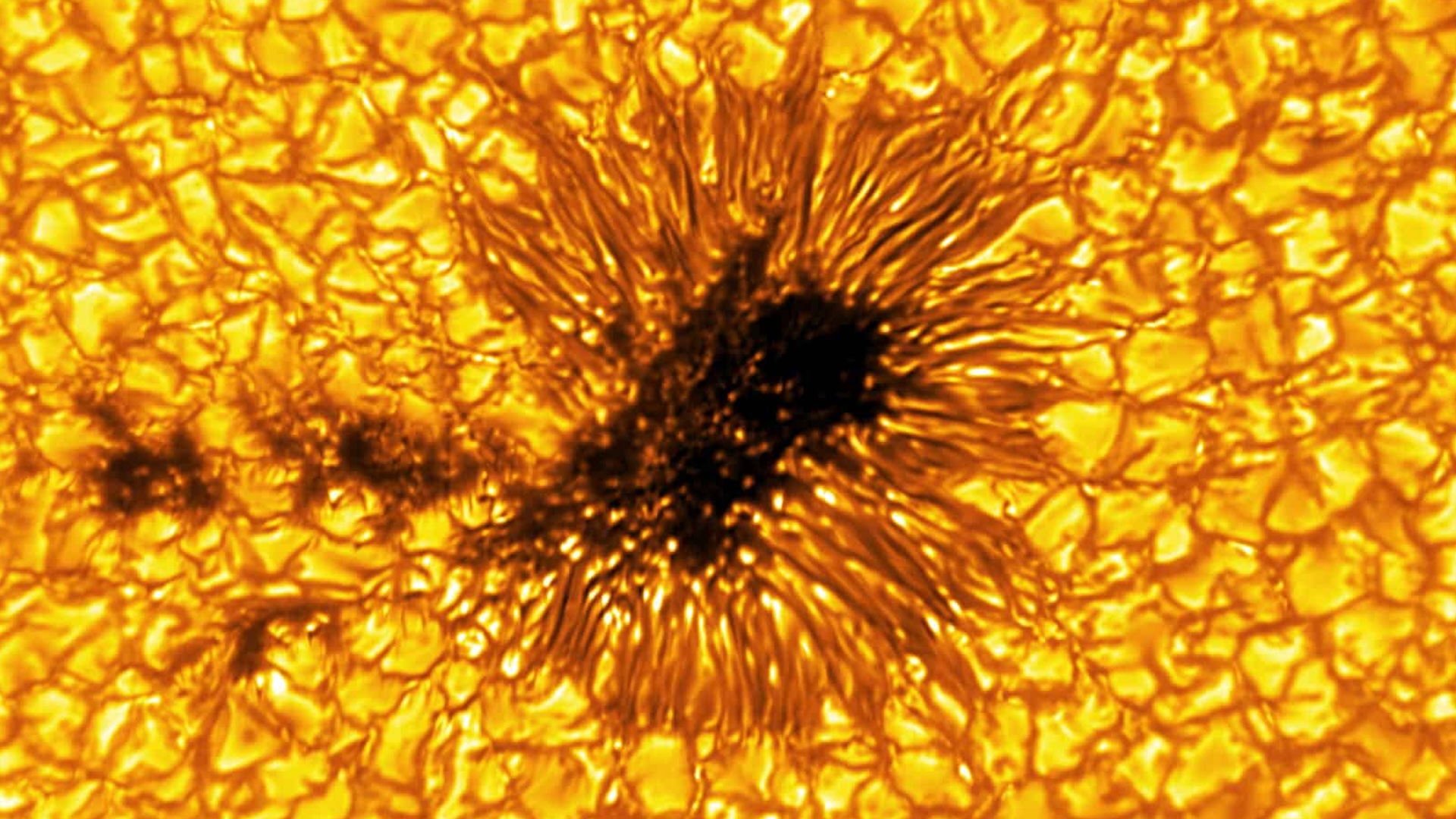
The debut image from the Inouye telescope's Visible Tunable Filter (VTF) camera shows a sunspot cluster many times larger than the continental United States

The debut image from the Inouye telescope’s Visible Tunable Filter (VTF) camera shows a sunspot cluster many times larger than the continental United States (Image credit: VTF/KIS/NSF/NSO/AURA)

VTF’s first image shows a major clump of sunspots, dark blobs on the sun’s surface caused by its intense magnetic field, each blob measuring wider than the continental United States. This impressive camera can see details down to a resolution of about 6.2 miles (10 kilometers) per pixel on the solar surface — an absolutely wild resolution given that the sun is tens of millions of miles away from us.

Related: A mysterious, 100-year solar cycle may have just restarted — and it could mean decades of dangerous space weather

Get the world’s most fascinating discoveries delivered straight to your inbox.

the DKIST telescope on a mountain over the clouds with the sun in the background

The Daniel K. Inouye Solar Telescope. (Image credit: NSO)

VTF provides more than just a simple snapshot. It captures images at multiple wavelengths of light to measure a spectrum, while also gathering information on how the light’s electric field is oriented (known as polarization). These extra perspectives on the sun help reveal details of the solar surface, magnetic field and plasma that are otherwise invisible, informing our predictions for space weather and solar flares.

During just one observation of the sun, this instrument can collect more than 10 million spectra — graphs of the light’s intensity over different wavelengths — which help scientists determine how hot the solar atmosphere is, how strong the sun’s magnetic field is and more.

Today’s news is only the beginning for the VTF and DKIST. The incredibly complex instrument still requires more testing and set-up, which is expected to be completed by next year.

But the newly released first images show great promise for how much we can learn about the sun, our nearest star. These images are “something no other instrument in the telescope can achieve in the same way,” said National Solar Observatory optical engineer Stacey Sueoka. “I’m excited to see what’s possible as we complete the system.”

Source link

Share. Facebook Twitter Pinterest LinkedIn Tumblr Email
Previous Article‘Hell ant’ with scythe-like jaws may be oldest ant fossil ever discovered
Next Article Saturn: Facts about the ringed planet
Editor
  • Website

Related Posts

Lifestyle

Science news this week: PCOS has a new name, Neanderthals were the world’s oldest dentists, and the first nuclear bomb explosion spawned an ‘alien’ crystal

May 16, 2026
Lifestyle

Newly discovered, blue-whale-size asteroid will fly super close to Earth Monday — and you can watch it live

May 16, 2026
Lifestyle

Don Juan Pond: Antarctica’s salty, syrupy lake that never freezes, even when it’s minus 58 F

May 16, 2026
Add A Comment

Comments are closed.

Categories
  • Entertainment
  • Lifestyle
  • News
  • Sports
  • Tech
  • Travel
Recent Posts
  • Science news this week: PCOS has a new name, Neanderthals were the world’s oldest dentists, and the first nuclear bomb explosion spawned an ‘alien’ crystal
  • Newly discovered, blue-whale-size asteroid will fly super close to Earth Monday — and you can watch it live
  • Don Juan Pond: Antarctica’s salty, syrupy lake that never freezes, even when it’s minus 58 F
  • Withings ScanWatch 2 review: Style meets next-level health monitoring
  • AI Chatbots are turbo-charging violence against women and girls: We urgently need to regulate them | Yvonne McDermott Rees
calendar
May 2026
M T W T F S S
 123
45678910
11121314151617
18192021222324
25262728293031
« Apr    
Recent Posts
  • Science news this week: PCOS has a new name, Neanderthals were the world’s oldest dentists, and the first nuclear bomb explosion spawned an ‘alien’ crystal
  • Newly discovered, blue-whale-size asteroid will fly super close to Earth Monday — and you can watch it live
  • Don Juan Pond: Antarctica’s salty, syrupy lake that never freezes, even when it’s minus 58 F
About

Welcome to Baynard Media, your trusted source for a diverse range of news and insights. We are committed to delivering timely, reliable, and thought-provoking content that keeps you informed
and inspired

Categories
  • Entertainment
  • Lifestyle
  • News
  • Sports
  • Tech
  • Travel
Facebook X (Twitter) Pinterest WhatsApp
  • Contact Us
  • About Us
  • Privacy Policy
  • Disclaimer
  • UNSUBSCRIBE
© 2026 copyrights reserved

Type above and press Enter to search. Press Esc to cancel.