
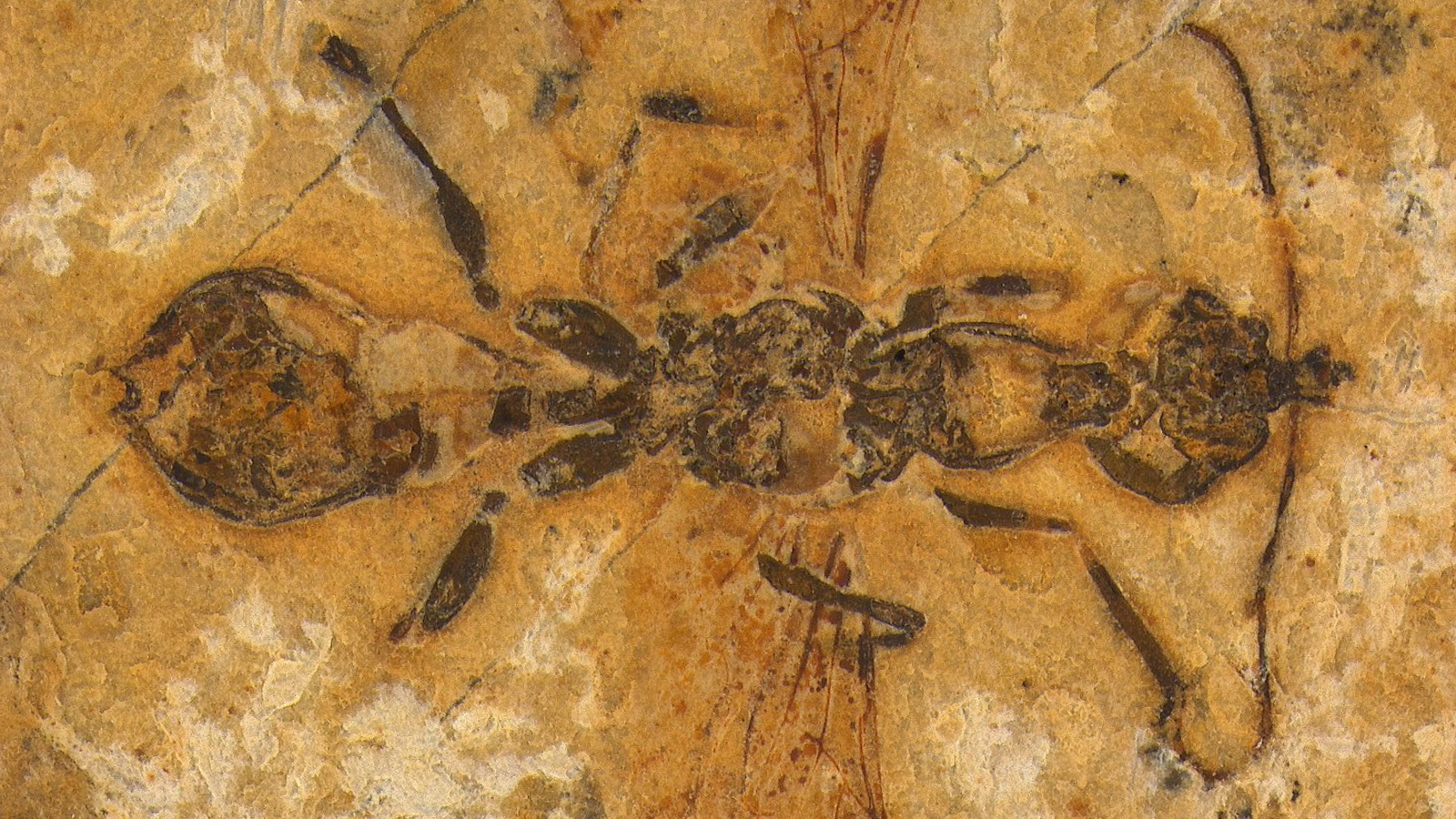
A newly discovered “hell ant” fossil may be the oldest ant ever found, scientists say.
This fossilized insect was unearthed in what is now northeastern Brazil and lived around 113 million years ago, during the Cretaceous period (145 million to 66 million years ago), according to a new study published April 24 in the journal Current Biology.
“Our team has discovered a new fossil ant species representing the earliest undisputable geological record of ants,” study co-author Anderson Lepeco, a researcher at the Zoological Museum of the University of São Paulo in Brazil, said in a statement. “What makes this discovery particularly interesting is that it belongs to the extinct ‘hell ant,’ known for their bizarre predatory adaptations.”
The newly discovered ancient ant species, which researchers have named Vulcanidris cratensis, had scythe-like, upward-facing jaws, which it may have used to seize and impale its prey. “Despite being part of an ancient lineage, this species already displayed highly specialized anatomical features, suggesting unique hunting behaviors,” Lepeco said.
There are more than 12,000 species of ants on Earth today, and they can be found in diverse environments, from rainforests to deserts. They belong to the family Formicidae, which is part of the order Hymenoptera (which also includes bees and wasps). Ants are thought to have evolved from wasp-like ancestors around 140 million years ago.
Haidomyrmecinae, also called “hell ants,” were an extinct subfamily of ancient ants that lived during this period. A handful of previous hell ant species have been discovered in amber fossils in Myanmar, France and Canada, dating back around 100 million years, which until now were the earliest known ant fossils.
These hell ants had a bizarre head and jaw structure unlike anything seen in modern ants, with upward-curved jaws instead of inward- or downward-curved jaws like modern ants, which could snap shut vertically. Many species also had horn-like projections above their mouths, which are thought to have clamped against the jaws to trap prey. One previously discovered 99 million-year-old fossil even captured a hell ant in the act of killing prey, frozen in amber mid-strike.

The newfound species of hell ant was preserved in limestone in the Crato Konservat-Lagerstätte geological formation in Brazil, which was once located in the north of the ancient supercontinent Gondwana. The fossil was then rediscovered by researchers among a collection housed at the Zoological Museum of the University of São Paulo.
“When I encountered this extraordinary specimen, we immediately recognized its significance, not only as a new species but as potentially the definitive evidence of ants in the Crato Formation,” Lepeco said. “This finding highlights the importance of thorough examination of existing collections — private or in museums — and brings a spotlight to Brazilian paleontology and the underexplored fossil insect fauna of the country.”
At 113 million years old, this ant is the earliest ant specimen ever discovered, and is also the first hell ant to be discovered preserved in rock, Lepeco noted.
Using micro-computed tomography imaging, a technique that uses X-rays to see inside an object, the researchers confirmed that the ant species was a hell ant, identifying the characteristic upward-facing jaws.
The fact that this ant is the earliest ant ever found and already possessed the same iconic scythe-like jaws as other hell ants, suggests that these traits evolved early after ants first appeared.
The researchers also discovered that this newfound species of ant was likely closely related to other hell ants found preserved in amber in Myanmar, meaning that ants were already widely distributed across the globe sooner than scientists had assumed.
“Finding such an anatomically specialized ant from 113 million years ago challenges our assumptions about how quickly these insects developed complex adaptations,” Lepeco said. “The intricate morphology suggests that even these earliest ants had already evolved sophisticated predatory strategies significantly different from their modern counterparts.”
