Close Menu
  • Home
  • UNSUBSCRIBE
  • News
  • Lifestyle
  • Tech
  • Entertainment
  • Sports
  • Travel
Facebook X (Twitter) WhatsApp
Trending
  • ‘The fate of Earth depends on a delicate balance’: Our planet may survive the death of the sun after all, new models hint
  • Bullseye! Enormous ‘bow and arrow’ galaxy is unlike anything radio astronomers have ever seen — Space photo of the week
  • IBM creates first sub-1nm computer chip — cramming 100 billion transistors into a tiny fingernail-sized space
  • New chip harnesses quantum computing’s biggest weakness — and tries to turn it into a strength
  • How did the Romans build such straight roads?
  • AI images are more convincing than ever — infiltrating journals and undermining trust in science
  • Climate change is driving capuchin monkey mothers to abandon their infants
  • ‘The Romans were probably never going to go away’: In new ‘Almost History’ podcast, listen to how history might have played out if Carthage had defeated the Roman Republic
Facebook X (Twitter) WhatsApp
Baynard Media
  • Home
  • UNSUBSCRIBE
  • News
  • Lifestyle
  • Tech
  • Entertainment
  • Sports
  • Travel
Baynard Media
Home»Lifestyle»Supercomputer runs largest and most complicated simulation of the universe ever
Lifestyle

Supercomputer runs largest and most complicated simulation of the universe ever

EditorBy EditorFebruary 13, 2025No Comments3 Mins Read
Share Facebook Twitter Pinterest LinkedIn Tumblr Reddit Telegram Email
Share
Facebook Twitter LinkedIn Pinterest Email

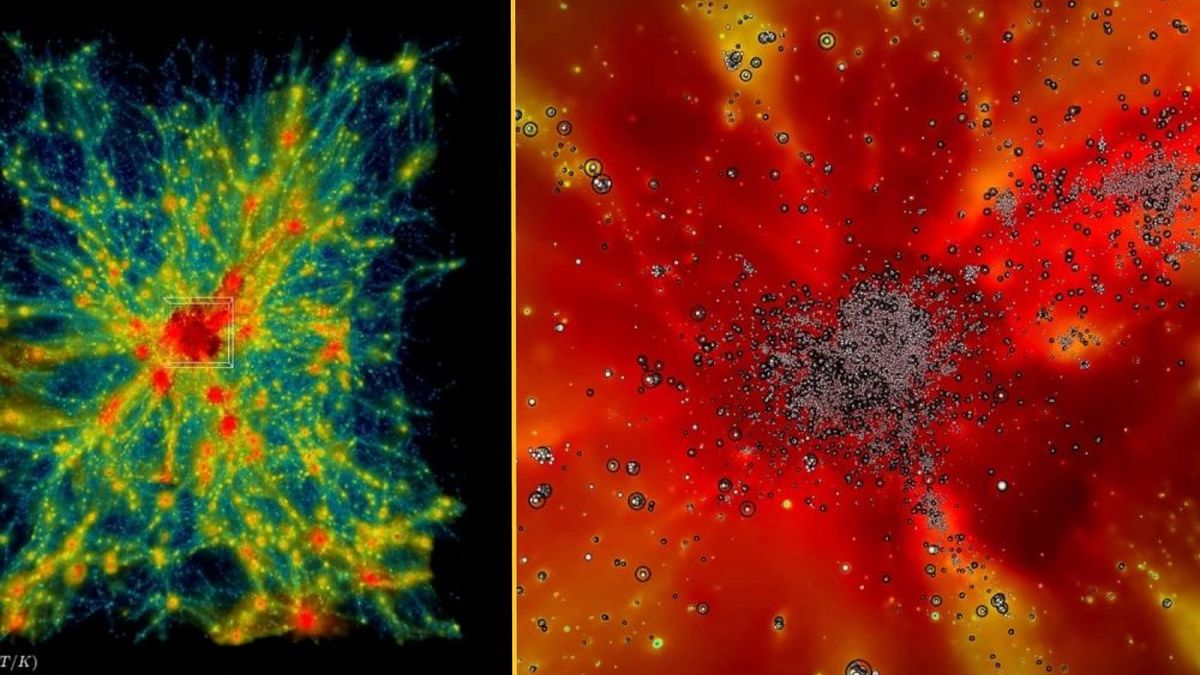
The potential for our understanding of the universe has taken a giant leap forward after Frontier, a supercomputer based in the Oak Ridge National Laboratory (ORNL), created a simulation of the universe at a scale never before achieved.

Frontier used a software platform called the Hardware/Hybrid Accelerated Cosmology Code (HACC) as part of ExaSky, a project that formed part of the U.S. Department of Energy’s (DOE) $1.8 billion Exascale Computing Project — the largest software R&D initiative backed by the DOE.

Under Exasky, scientific applications were required to run up to 50 times faster than previous benchmarks, but Frontier and HACC quickly raced ahead of expectations — running almost 300 times faster than similar simulations of Saturn’s moon Titan. The DoE/HACC team had spent seven years since the first simulation enhancing the capabilities on exascale supercomputers like Frontier.

This allowed for hydrodynamic cosmology simulations, a far more computationally intensive computer model that incorporates principles like the expansion of the universe and the influence of dark matter. Previous models only incorporated measures of gravity, gas or plasma.

The power of exascale computing

The simulation, which was conducted in November 2024, used around 9,000 of Frontier’s computing nodes, all fitted with AMD Instinct MI250X graphics cards.

Frontier is the second-fastest supercomputer in the world and can hit 1.4 exaFLOPS of power. The performance of supercomputers is measured in floating-point operations per second (FLOPS) — where one floating-point operation is a mathematical calculation.

Related: Nvidia’s mini ‘desktop supercomputer’ is 1,000 times more powerful than a laptop — and it can fit in your bag

Get the world’s most fascinating discoveries delivered straight to your inbox.

Anything capable of more than 999 petaFLOPS (0.9 exaFLOPS) is referred to as an “exascale” supercomputer. The only other machine more powerful than Frontier is El Capitan — which can reach 1.7 exaFLOPS of power.

Beyond simulating the universe, Frontier has been used in other crucial research. In April 2023, scientists built the Simple Cloud-Resolving E3SM Atmosphere Model (SCREAM) — a program that simulated an entire year of global climate data down to a resolution of just over 3km. One of the most complex climate models ever computed, it’s now a cornerstone in the analysis of complex interactions between the atmosphere, oceans and land to improve weather predictions and gather higher-fidelity data about climate change.

In materials, Frontier has let designers come up with new substrates and geometries for enhanced-property substances, making them stronger, lighter and corrosion-proof. Its exascale computing capabilities have allowed researchers to model chemical interaction at the molecular scale to predict material behavior. The supercomputer has also been pivotal in finding new materials for energy storage, transport, manufacturing and nuclear medicine.

However, scientists are particularly excited about how exascale computing can supercharge artificial intelligence (AI). The speed of these machines lets programmers iterate algorithms and analyze large datasets rapidly, especially in tasks like faster large language models or the application of supercomputers to climate models and climate change prediction.

Source link

Share. Facebook Twitter Pinterest LinkedIn Tumblr Email
Previous ArticleSpirobs shape-shifting robot moves like an octopus and grips like an elephant
Next Article Khloe Kardashian Helps Lamar Odom Walk Again in Uncovered Hospital Foo
Editor
  • Website

Related Posts

Lifestyle

‘The fate of Earth depends on a delicate balance’: Our planet may survive the death of the sun after all, new models hint

June 28, 2026
Lifestyle

Bullseye! Enormous ‘bow and arrow’ galaxy is unlike anything radio astronomers have ever seen — Space photo of the week

June 28, 2026
Lifestyle

IBM creates first sub-1nm computer chip — cramming 100 billion transistors into a tiny fingernail-sized space

June 28, 2026
Add A Comment

Comments are closed.

Categories
  • Entertainment
  • Lifestyle
  • News
  • Sports
  • Tech
  • Travel
Recent Posts
  • ‘The fate of Earth depends on a delicate balance’: Our planet may survive the death of the sun after all, new models hint
  • Bullseye! Enormous ‘bow and arrow’ galaxy is unlike anything radio astronomers have ever seen — Space photo of the week
  • IBM creates first sub-1nm computer chip — cramming 100 billion transistors into a tiny fingernail-sized space
  • New chip harnesses quantum computing’s biggest weakness — and tries to turn it into a strength
  • How did the Romans build such straight roads?
calendar
June 2026
M T W T F S S
1234567
891011121314
15161718192021
22232425262728
2930  
« May    
Recent Posts
  • ‘The fate of Earth depends on a delicate balance’: Our planet may survive the death of the sun after all, new models hint
  • Bullseye! Enormous ‘bow and arrow’ galaxy is unlike anything radio astronomers have ever seen — Space photo of the week
  • IBM creates first sub-1nm computer chip — cramming 100 billion transistors into a tiny fingernail-sized space
About

Welcome to Baynard Media, your trusted source for a diverse range of news and insights. We are committed to delivering timely, reliable, and thought-provoking content that keeps you informed
and inspired

Categories
  • Entertainment
  • Lifestyle
  • News
  • Sports
  • Tech
  • Travel
Facebook X (Twitter) Pinterest WhatsApp
  • Contact Us
  • About Us
  • Privacy Policy
  • Disclaimer
  • UNSUBSCRIBE
© 2026 copyrights reserved

Type above and press Enter to search. Press Esc to cancel.