Close Menu
  • Home
  • UNSUBSCRIBE
  • News
  • Lifestyle
  • Tech
  • Entertainment
  • Sports
  • Travel
Facebook X (Twitter) WhatsApp
Trending
  • Neanderthal toddlers grew faster than modern humans, probably because of the harsh environment they evolved in
  • NASA shuts off another Voyager 1 instrument as humanity’s most distant spacecraft prepares for risky ‘Big Bang’ maneuver to save power
  • Florida is facing its most intense drought in 15 years. Here’s how it got so bad and how long it will last.
  • New blood test aims to spot liver scarring when it’s still reversible and before it paves the way to cancer
  • ‘We’re the best servants anyone could dream of!’: AI superintelligence has no need to enslave humans because we’re already bowing to it
  • Glowing ring of plankton surrounding New Zealand islands linked to deadly underwater plateau — Earth from space
  • Omar files new financial form in response to Trump, GOP critics
  • New study confirms lobsters feel pain, driving scientists to call for a ban on boiling them alive
Facebook X (Twitter) WhatsApp
Baynard Media
  • Home
  • UNSUBSCRIBE
  • News
  • Lifestyle
  • Tech
  • Entertainment
  • Sports
  • Travel
Baynard Media
Home»Lifestyle»‘Stunning’ discovery reveals how the Maya rose up 4,000 years ago
Lifestyle

‘Stunning’ discovery reveals how the Maya rose up 4,000 years ago

EditorBy EditorNovember 27, 2024No Comments4 Mins Read
Share Facebook Twitter Pinterest LinkedIn Tumblr Reddit Telegram Email
Share
Facebook Twitter LinkedIn Pinterest Email

A vast array of ancient fish-trapping facilities created by the direct ancestors of the Maya has been discovered in Belize.

The facilities were capable of capturing enough fish to feed up to 15,000 people a year. They consisted of a network of canals and ponds that guided fish into areas where they could be easily caught.

Hunter-gatherers constructed these complex networks about 4,000 years ago, during the Archaic period, a time before people in the region were practicing agriculture on a large scale, scientists wrote in the study, published Nov. 22 in the journal Science Advances.

“This is the earliest large-scale Archaic fish-trapping facility recorded in ancient Mesoamerica,” the team wrote in the paper. The success of these hunter-gatherers appears to have helped lead to the formation of the Maya, a civilization that later came to dominate the Maya Lowlands in Central America and modern-day southern Mexico.

These fish-trapping facilities would have encouraged people to gather and develop permanent settlements and, later, cities. “It seems likely that the canals allowed for annual fish harvests and social gatherings, which would have encouraged people to return to this area year after year and congregate for longer periods of time,” study co-author Marieka Brouwer Burg, professor of anthropology at the University of Vermont who is co-director of the team, said in a statement.

“Such intensive investments in the landscape may have led ultimately to the development of the complex society characteristic of the pre-Columbian Maya civilization, which subsequently occurred in this area by around 1200 [B.C.],” Brouwer Burg said.

Related: Lasers reveal Maya city, including thousands of structures, hidden in Mexico

Get the world’s most fascinating discoveries delivered straight to your inbox.

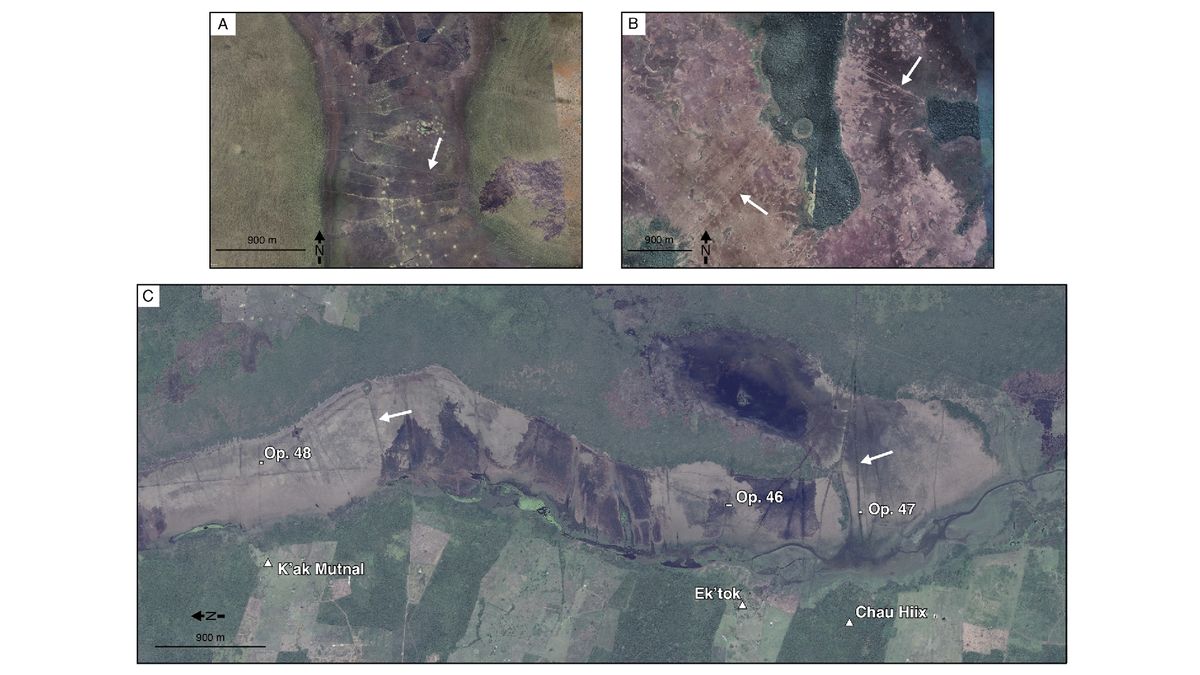
A map showing the Maya lowlands

Remote sensing data revealed wetland features as likely fish-trapping facilities in the Maya Lowlands (present-day Belize). (Image credit: All images courtesy of the BREA project. Harrison-Buck et al., Sci. Adv. 10, eadq1444 (2024))

At the time the fish-trapping facilities were built, the region was becoming drier and people may have been dealing with droughts, the team wrote in the study. This may have encouraged people to come together and build the facilities to ensure they had enough to eat.

The team used satellite images and aerial images taken by drones to detect the canals and ponds. They also conducted excavations and radiocarbon dated organic sediments and charcoal to determine when the fish trapping facilities were built.

The Maya continued to use these fishing facilities in Formative times (circa 2000 B.C. to A.D. 200), the researchers wrote in the study.

“Honestly, this discovery is stunning,” Thomas Guderjan, an anthropology professor at the University of Texas at Tyler, told Live Science in an email. “We have always thought of large-scale land modification projects as being something that occurred in the Maya classic period,” or roughly A.D. 250 to 900, Guderjan said.

An elevation map of a pond

A digital model of a pond feature in the Western Lagoon. The ancestors of the Maya made these features so they could more easily catch fish. (Image credit: Harrison-Buck et al., Sci. Adv. 10, eadq1444 (2024))

The research may encourage scholars to reconsider what the Maya were like around 4,000 years ago, Guderjan, who was not involved in the study, added.

Nicholas Dunning, a geography professor at the University of Cincinnati who has studied the Maya extensively, also praised the research.

“Over the past several decades, quite a few scholars of the ancient Maya, including myself, have suggested that aquaculture may have played an important role in the development of Maya civilization,” Dunning told Live Science in an email. “However, the present study is the first that I know of to specifically attempt to test this hypothesis.” The study “is an important work in helping scholars of the ancient Maya understand the origins of sedentary society in the region,” he added.

Live Science contacted the research team but has not heard back at time of publication. In their paper, the scientists said they plan to continue their research in the region.

Source link

Share. Facebook Twitter Pinterest LinkedIn Tumblr Email
Previous ArticleHow to watch, what time it starts, channel, who’s performing and more
Next Article Best Black Friday PS5 bundle deal: Get $75 off ‘Fortnite Cobalt Star’ bundle
Editor
  • Website

Related Posts

Lifestyle

Neanderthal toddlers grew faster than modern humans, probably because of the harsh environment they evolved in

April 21, 2026
Lifestyle

NASA shuts off another Voyager 1 instrument as humanity’s most distant spacecraft prepares for risky ‘Big Bang’ maneuver to save power

April 21, 2026
Lifestyle

Florida is facing its most intense drought in 15 years. Here’s how it got so bad and how long it will last.

April 21, 2026
Add A Comment

Comments are closed.

Categories
  • Entertainment
  • Lifestyle
  • News
  • Sports
  • Tech
  • Travel
Recent Posts
  • Neanderthal toddlers grew faster than modern humans, probably because of the harsh environment they evolved in
  • NASA shuts off another Voyager 1 instrument as humanity’s most distant spacecraft prepares for risky ‘Big Bang’ maneuver to save power
  • Florida is facing its most intense drought in 15 years. Here’s how it got so bad and how long it will last.
  • New blood test aims to spot liver scarring when it’s still reversible and before it paves the way to cancer
  • ‘We’re the best servants anyone could dream of!’: AI superintelligence has no need to enslave humans because we’re already bowing to it
calendar
April 2026
M T W T F S S
 12345
6789101112
13141516171819
20212223242526
27282930  
« Mar    
Recent Posts
  • Neanderthal toddlers grew faster than modern humans, probably because of the harsh environment they evolved in
  • NASA shuts off another Voyager 1 instrument as humanity’s most distant spacecraft prepares for risky ‘Big Bang’ maneuver to save power
  • Florida is facing its most intense drought in 15 years. Here’s how it got so bad and how long it will last.
About

Welcome to Baynard Media, your trusted source for a diverse range of news and insights. We are committed to delivering timely, reliable, and thought-provoking content that keeps you informed
and inspired

Categories
  • Entertainment
  • Lifestyle
  • News
  • Sports
  • Tech
  • Travel
Facebook X (Twitter) Pinterest WhatsApp
  • Contact Us
  • About Us
  • Privacy Policy
  • Disclaimer
  • UNSUBSCRIBE
© 2026 copyrights reserved

Type above and press Enter to search. Press Esc to cancel.