Close Menu
  • Home
  • UNSUBSCRIBE
  • News
  • Lifestyle
  • Tech
  • Entertainment
  • Sports
  • Travel
Facebook X (Twitter) WhatsApp
Trending
  • Artemis moon landing could face long delay while NASA waits for next-generation spacesuits
  • NASA’s Curiosity rover finds a surprising number of giant ‘dragon scales’ littered across Mars
  • Diagnostic dilemma: A teen’s classic diabetes symptoms didn’t improve with treatment — revealing she also had a much rarer syndrome
  • Strange mammal ancestor laid huge, leathery eggs —‬ and it was key to surviving the world’s worst mass extinction
  • Ancient process that created rare earth elements discovered — and it could help us locate desperately needed deposits
  • This humanoid robot does all your housework for you ‪—‬ and its makers say it’s ready for your home
  • ‘Nations need to prepare now’: Key Atlantic ocean current is much closer to collapse than scientists thought
  • Neanderthal toddlers grew faster than modern humans, probably because of the harsh environment they evolved in
Facebook X (Twitter) WhatsApp
Baynard Media
  • Home
  • UNSUBSCRIBE
  • News
  • Lifestyle
  • Tech
  • Entertainment
  • Sports
  • Travel
Baynard Media
Home»Lifestyle»Space photo of the week: James Webb telescope reveals mysterious ‘light echo’ in the broken heart of Cassiopeia
Lifestyle

Space photo of the week: James Webb telescope reveals mysterious ‘light echo’ in the broken heart of Cassiopeia

EditorBy EditorFebruary 23, 2025No Comments3 Mins Read
Share Facebook Twitter Pinterest LinkedIn Tumblr Reddit Telegram Email
Share
Facebook Twitter LinkedIn Pinterest Email

What it is: Interstellar medium near the supernova remnant Cassiopeia A

Where it is: About 11,000 light-years away, in the constellation Cassiopeia

When it was shared: Jan. 14, 2025

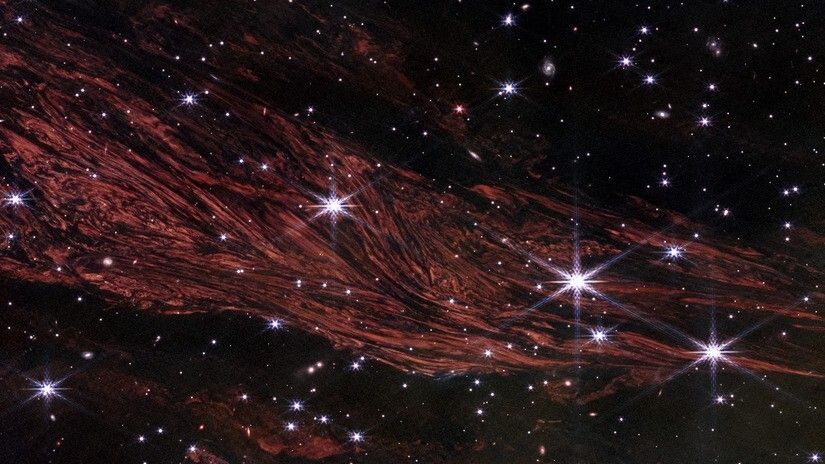
Why it’s so special: This set of stunning pictures from the James Webb Space Telescope (JWST) shows glowing interstellar medium — gas and dust that fill up the space between stars — near the supernova remnant Cassiopeia A. The light from this supernova is believed to have reached Earth in the 1660s. More than 350 years later, its intense light has exposed intricate layers of glowing material around the long-dead star.

These images reveal a fascinating phenomenon known as a light echo — faint reflections of the light emitted during a supernova explosion. When a star reaches the end of its lifespan and explodes, it emits intense radiation that lights up the surrounding gas and dust, producing an “echo” that can be seen in visible wavelengths. Sometimes the energetic supernova radiation also warms the nearby gas and dust of the interstellar medium, causing it to emit its own glow, resulting in a rare type of light echo observed at infrared wavelengths — the kind of light that JWST excels at spotting. According to NASA, the infrared light echo in these images actually comes from the material behind Cassiopeia A, not from the material expelled during the explosion.

Related: 42 jaw-dropping James Webb Space Telescope images

a six-paneled image showing six different views of the swirling cloud of dust in Cassiopeia A

JWST took three separate exposures of the Cassiopeia A supernova remnant, showing how the constituent gas and dust changed over time. Note, the bottom two images are rotated slightly compared to the others, due to the roll angle of the JWST telescope at the time. (Image credit: NASA, ESA, CSA, STScI, J. Jencson (Caltech/IPAC))

The images showcase the tightly packed, sheet-like nature of the interstellar medium, looking a bit like layers of an onion. These filamentary structures were observed in unprecedented detail, with measurements taken on scales of approximately 400 astronomical units (AU), which is 400 times the average distance between Earth and the sun. Previously, astronomers have identified structures in the interstellar medium on scales of parsecs (1 parsec is roughly 206,000 AU, or 3.2 light-years). Discovering that these structures exist on much smaller scales was new to the researchers.

Get the world’s most fascinating discoveries delivered straight to your inbox.

These glittering curtains come from observations of the same patch of dust taken on three different days — Aug. 19, Sept. 16, and Sept. 30, 2024 — using JWST’s Near-Infrared Camera. The three views, once combined, reveal how a light echo changes over time. (In the above images, the field of view in the top row is rotated clockwise just a little bit compared to the middle and bottom rows due to the tilt of the telescope while taking those observations.)

Astronomers plan to further study the scene using JWST’s Mid-Infrared Instrument, hoping to watch the light echo change over weeks or months. This will help them identify changes in the composition of the dust patch and check whether molecules or dust grains get destroyed in the process.

Source link

Share. Facebook Twitter Pinterest LinkedIn Tumblr Email
Previous ArticleSyria’s new president appears to receive a warm welcome in former Assad strongholds 
Next Article Jennifer Aniston & Brad Pitt Set the Bar High for SAG Awards Reunions
Editor
  • Website

Related Posts

Lifestyle

Artemis moon landing could face long delay while NASA waits for next-generation spacesuits

April 22, 2026
Lifestyle

NASA’s Curiosity rover finds a surprising number of giant ‘dragon scales’ littered across Mars

April 22, 2026
Lifestyle

Diagnostic dilemma: A teen’s classic diabetes symptoms didn’t improve with treatment — revealing she also had a much rarer syndrome

April 22, 2026
Add A Comment

Comments are closed.

Categories
  • Entertainment
  • Lifestyle
  • News
  • Sports
  • Tech
  • Travel
Recent Posts
  • Artemis moon landing could face long delay while NASA waits for next-generation spacesuits
  • NASA’s Curiosity rover finds a surprising number of giant ‘dragon scales’ littered across Mars
  • Diagnostic dilemma: A teen’s classic diabetes symptoms didn’t improve with treatment — revealing she also had a much rarer syndrome
  • Strange mammal ancestor laid huge, leathery eggs —‬ and it was key to surviving the world’s worst mass extinction
  • Ancient process that created rare earth elements discovered — and it could help us locate desperately needed deposits
calendar
April 2026
M T W T F S S
 12345
6789101112
13141516171819
20212223242526
27282930  
« Mar    
Recent Posts
  • Artemis moon landing could face long delay while NASA waits for next-generation spacesuits
  • NASA’s Curiosity rover finds a surprising number of giant ‘dragon scales’ littered across Mars
  • Diagnostic dilemma: A teen’s classic diabetes symptoms didn’t improve with treatment — revealing she also had a much rarer syndrome
About

Welcome to Baynard Media, your trusted source for a diverse range of news and insights. We are committed to delivering timely, reliable, and thought-provoking content that keeps you informed
and inspired

Categories
  • Entertainment
  • Lifestyle
  • News
  • Sports
  • Tech
  • Travel
Facebook X (Twitter) Pinterest WhatsApp
  • Contact Us
  • About Us
  • Privacy Policy
  • Disclaimer
  • UNSUBSCRIBE
© 2026 copyrights reserved

Type above and press Enter to search. Press Esc to cancel.