Close Menu
  • Home
  • UNSUBSCRIBE
  • News
  • Lifestyle
  • Tech
  • Entertainment
  • Sports
  • Travel
Facebook X (Twitter) WhatsApp
Trending
  • Lake Forest Looks to Develop Vacant Site As Affordable Housing
  • Can the US be trusted with the moon? A law scholar raises concerns after Artemis II’s success.
  • 404 | Fox News
  • Hungary’s new leader takes on the authoritarian state
  • Largest-ever 3D map of the universe shows 47 million galaxies, from the Milky Way to ‘cosmic noon’ — Space photo of the week
  • WWE star Trick Williams ready for WrestleMania debut vs Sami Zayn
  • Black parents are not ‘safety stories.’ We deserve real change
  • Science news this week: Physicists witness faster-than-light darkness pinpricks, humans are still evolving, and some polar bears are getting fatter than ever
Facebook X (Twitter) WhatsApp
Baynard Media
  • Home
  • UNSUBSCRIBE
  • News
  • Lifestyle
  • Tech
  • Entertainment
  • Sports
  • Travel
Baynard Media
Home»Lifestyle»Space photo of the week: Dry ice ‘geysers’ erupt on Mars as spring hits the Red Planet
Lifestyle

Space photo of the week: Dry ice ‘geysers’ erupt on Mars as spring hits the Red Planet

EditorBy EditorFebruary 9, 2025No Comments2 Mins Read
Share Facebook Twitter Pinterest LinkedIn Tumblr Reddit Telegram Email
Share
Facebook Twitter LinkedIn Pinterest Email

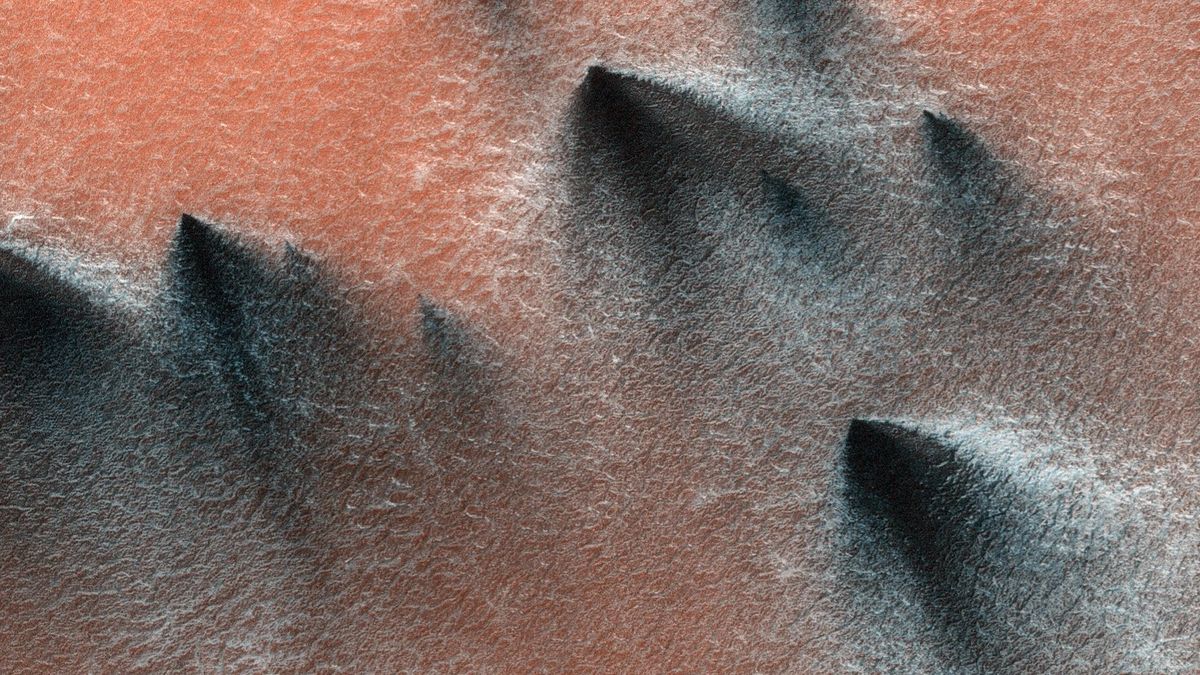
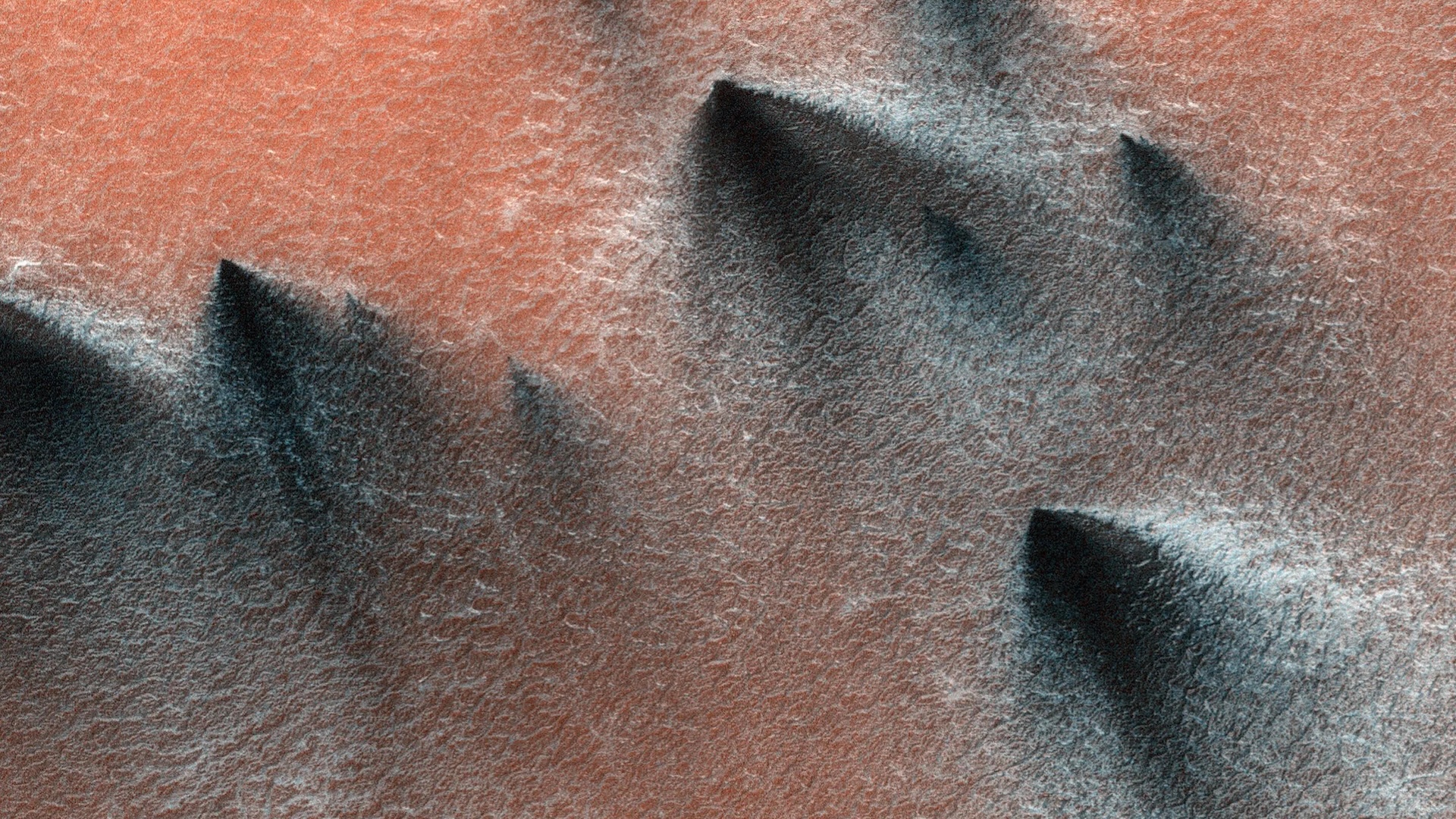
What it is: Geysers of gas and dust on Mars

Where it is: The south polar region of Mars

When it was shared: Jan. 29, 2025

Why it’s so special: These odd, fan-like features on the surface of Mars are geysers of gas and dust near the planet’s south pole that are visible only in springtime on the Red Planet. This image was taken by the Mars Reconnaissance Orbiter (MRO) in 2018 and was reshared by NASA recently.

During winter on Mars, carbon dioxide ice accumulates near the surface. According to NASA, carbon dioxide ice is transparent, and sunlight that gets through it is absorbed at the base of the icy layer. As the sun rises higher into the sky and spring begins, carbon dioxide ice begins to warm and turn to vapor. That vapor then escapes through weaknesses in the ice and erupts in the form of geysers. These eruptions sometimes leave dusty, jagged streaks, nicknamed “spiders on Mars.”

Related: Hundreds of black ‘spiders’ spotted in mysterious ‘Inca City’ on Mars in new satellite photos

Mars has four seasons similar to those on Earth. That’s because Mars’ orbit spins on an axis tilted by 25.2 degrees (similar to Earth’s 23.5 degrees), meaning different parts of Mars get differing amounts of sunlight as the planet orbits the sun. However, because Mars takes 687 Earth days to orbit the sun, the seasons last around twice as long as they do on our planet.

Get the world’s most fascinating discoveries delivered straight to your inbox.

There’s something else about Mars’ orbit that makes the seasons different. Because the planet’s orbit of the sun is slightly elliptical, there’s a significant difference between Mars’ closest and farthest point to the sun.

According to the European Space Agency, Mars is closest to the sun during summer in its southern hemisphere, making that season shorter and hotter than summer in the North. Conversely, winter in the southern hemisphere occurs when Mars travels at its slowest and farthest from the sun, making it longer and colder than winter in the North.

This stunning image comes from the High Resolution Imaging Science Experiment camera on the MRO, which launched on Aug. 12, 2005, and began orbiting Mars on March 12, 2006.

For more sublime space images, check out our Space Photo of the Week archives.


Mars quiz: Is your knowledge of the Red Planet out of this world?

Source link

Share. Facebook Twitter Pinterest LinkedIn Tumblr Email
Previous ArticleThis AI tool turns Google Sheets data into visuals instantly.
Next Article Inside Saquon Barkley's Winning Romance With Fiancée Anna Congdon
Editor
  • Website

Related Posts

Lifestyle

Can the US be trusted with the moon? A law scholar raises concerns after Artemis II’s success.

April 19, 2026
Lifestyle

Largest-ever 3D map of the universe shows 47 million galaxies, from the Milky Way to ‘cosmic noon’ — Space photo of the week

April 19, 2026
Lifestyle

Science news this week: Physicists witness faster-than-light darkness pinpricks, humans are still evolving, and some polar bears are getting fatter than ever

April 19, 2026
Add A Comment

Comments are closed.

Categories
  • Entertainment
  • Lifestyle
  • News
  • Sports
  • Tech
  • Travel
Recent Posts
  • Lake Forest Looks to Develop Vacant Site As Affordable Housing
  • Can the US be trusted with the moon? A law scholar raises concerns after Artemis II’s success.
  • 404 | Fox News
  • Hungary’s new leader takes on the authoritarian state
  • Largest-ever 3D map of the universe shows 47 million galaxies, from the Milky Way to ‘cosmic noon’ — Space photo of the week
calendar
April 2026
M T W T F S S
 12345
6789101112
13141516171819
20212223242526
27282930  
« Mar    
Recent Posts
  • Lake Forest Looks to Develop Vacant Site As Affordable Housing
  • Can the US be trusted with the moon? A law scholar raises concerns after Artemis II’s success.
  • 404 | Fox News
About

Welcome to Baynard Media, your trusted source for a diverse range of news and insights. We are committed to delivering timely, reliable, and thought-provoking content that keeps you informed
and inspired

Categories
  • Entertainment
  • Lifestyle
  • News
  • Sports
  • Tech
  • Travel
Facebook X (Twitter) Pinterest WhatsApp
  • Contact Us
  • About Us
  • Privacy Policy
  • Disclaimer
  • UNSUBSCRIBE
© 2026 copyrights reserved

Type above and press Enter to search. Press Esc to cancel.