Close Menu
  • Home
  • UNSUBSCRIBE
  • News
  • Lifestyle
  • Tech
  • Entertainment
  • Sports
  • Travel
Facebook X (Twitter) WhatsApp
Trending
  • New 2D memory device stores data on just a single electron
  • Before we ban kids from social media completely, here’s what we should try first | Jonathan Bellack and Mariana Olaizola Rosenblat
  • Scientists uncover a better way to beat ‘the bends’ — using deep-diving pigs
  • Mars may have been losing its water more than 4 billion years ago, oldest-known Martian meteorite suggests
  • ‘The lance head was still inside the pelvis’: Mass grave found in Austria may hold casualties of unknown ancient Roman battle
  • ‘Full-on berserker mode’: Archaeologists solve mystery of medieval soldiers with gruesome square holes in their skull
  • Rare belching disorder could be treated with singing, study hints — but not everyone is convinced
  • ‘If this is the new normal, then we are in very deep trouble’: Brazil’s drying aquifers could have ripple effects across the world
Facebook X (Twitter) WhatsApp
Baynard Media
  • Home
  • UNSUBSCRIBE
  • News
  • Lifestyle
  • Tech
  • Entertainment
  • Sports
  • Travel
Baynard Media
Home»Lifestyle»Scientists unveil new type of ‘time crystal’ that defies our traditional understanding of time and motion
Lifestyle

Scientists unveil new type of ‘time crystal’ that defies our traditional understanding of time and motion

EditorBy EditorMarch 26, 2025No Comments3 Mins Read
Share Facebook Twitter Pinterest LinkedIn Tumblr Reddit Telegram Email
Share
Facebook Twitter LinkedIn Pinterest Email

Physicists have created a new type of time crystal that may help confirm some fundamental theories about quantum interactions.

A standard time crystal is a new phase of matter that features perpetual motion without expending energy. According to Chong Zu, an assistant professor of physics at Washington University in St. Louis and one of the team’s lead researchers, a time crystal resembles a traditional crystal.

However, unlike a traditional crystal, which repeats a pattern across the physical dimension of space, a time crystal repeats a pattern of motion, rearranging its atoms in the same way over time, Zu said. This causes the time crystal to vibrate at a set frequency.

A time crystal is theoretically capable of cycling through the same pattern infinitely without requiring any additional power — like a watch that never needs to be wound. The reality, however, is that time crystals are incredibly fragile and thus succumb to environmental pressures fairly easily.

Although time crystals have been around since 2016, a team has achieved something unprecedented: They’ve created a novel type of time crystal called a time quasicrystal. A quasicrystal is a solid that, like a regular crystal, has atoms arranged in a specific, nonrandom way, but without a repeating pattern.

Related: Scientists create weird ‘time crystal’ from atoms inflated to be hundreds of times bigger than normal

This means that, unlike a standard time crystal that repeats the same pattern over and over, a time quasicrystal never repeats the way it arranges its atoms. Because there’s no repetition, the crystal vibrates at different frequencies. As the researchers state in their findings, published in the journal Physical Review X, time quasicrystals “are ordered but apparently not periodic.”

Get the world’s most fascinating discoveries delivered straight to your inbox.

How to build a quasicrystal

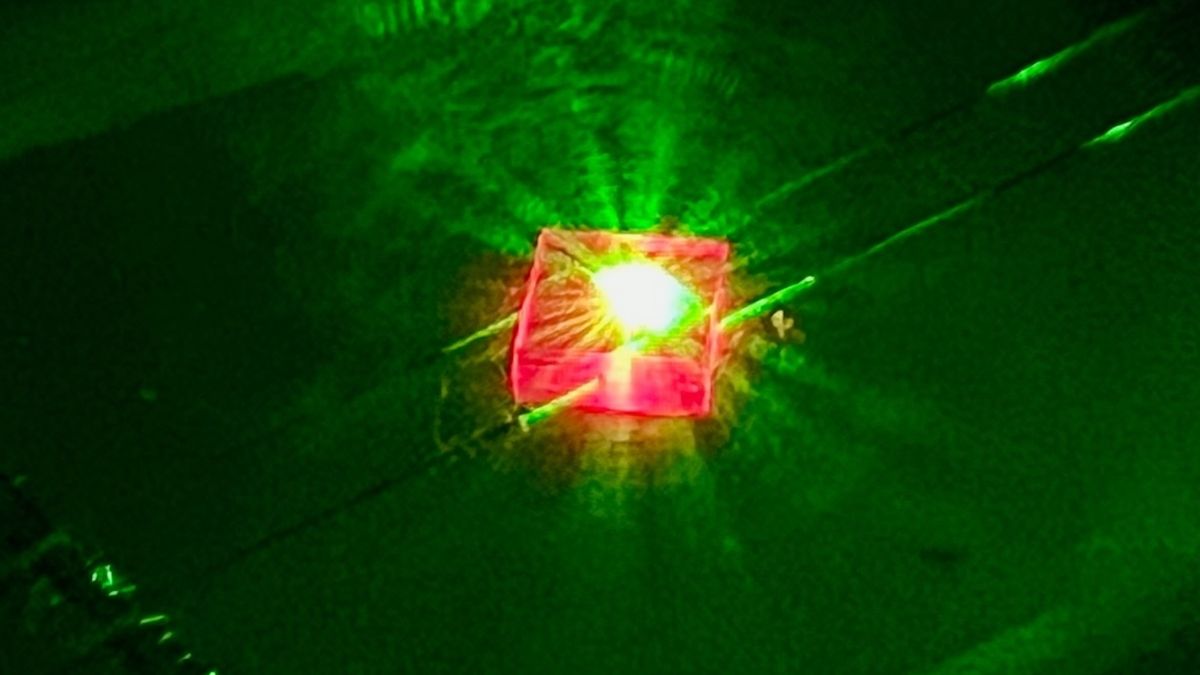
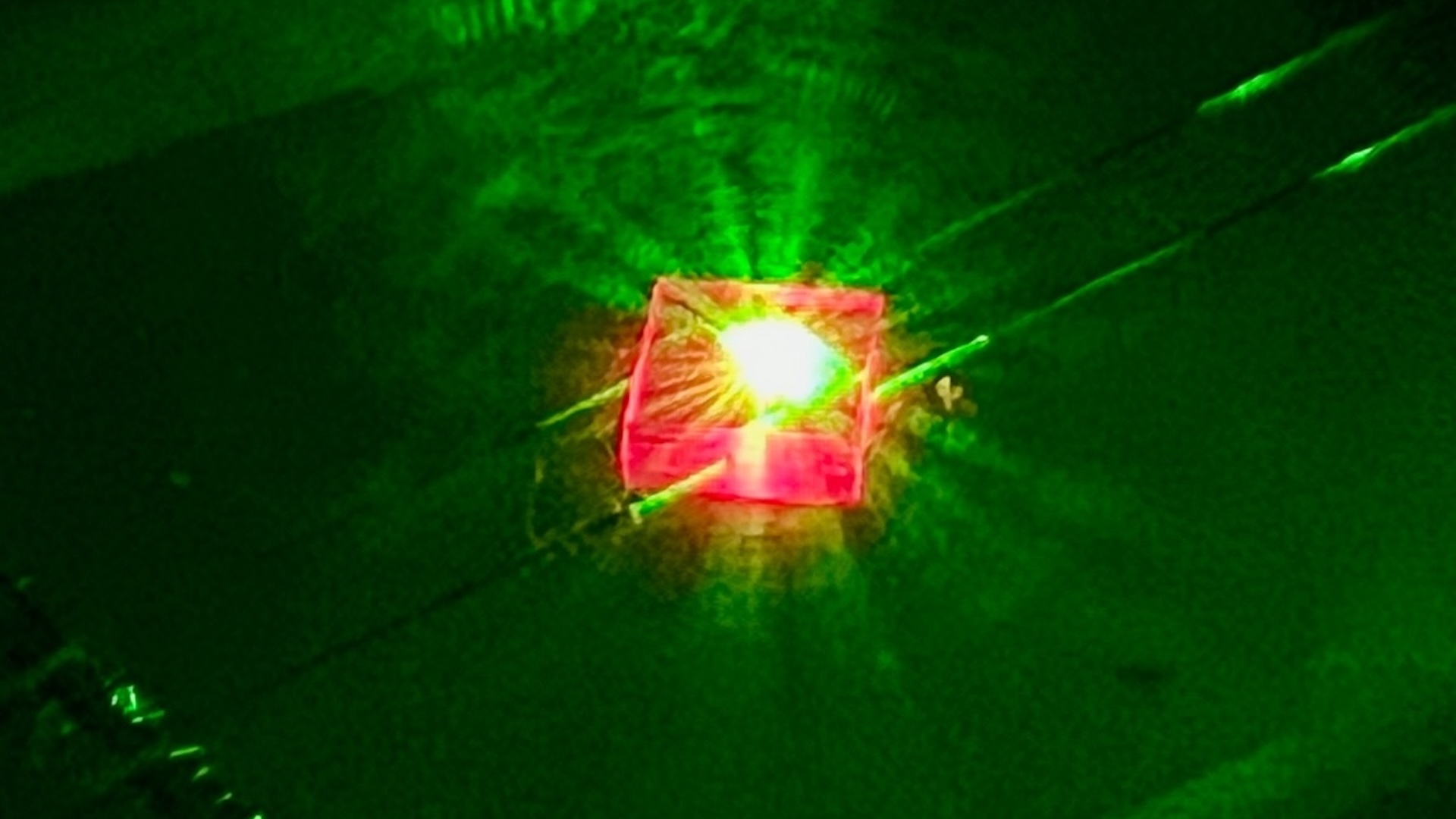
To create these new time quasicrystals, the researchers started with a millimeter-sized piece of diamond. Then, they created spaces inside the diamond’s structure by bombarding it with powerful beams of nitrogen. The nitrogen displaced carbon atoms within the diamond’s interior, leaving behind empty atomic chambers.

Nature abhors a vacuum, so electrons quickly flowed into these empty spaces and immediately began to interact with neighboring particles on a quantum level. Each time quasicrystal represents a network of more than a million of these empty spaces inside the diamond, though each measures just one micrometer (one-millionth of a meter).

“We used microwave pulses to start the rhythms in the time quasicrystals,” Bingtian Ye, a researcher at MIT and a co-author of the paper, said in a statement. “The microwaves help create order in time.”

Potential applications

One of the most important outcomes of the team’s research is that it confirms some basic theories of quantum mechanics, according to Zu. However, time quasicrystals may have practical applications in fields such as precision timekeeping, quantum computing, and quantum sensor technology.

For sensors, the crystal’s fragility and sensitivity are actually a boon; because they’re so sensitive to environmental factors like magnetism, they can be used to create extremely precise sensors.

For quantum computing, the material’s potential perpetual motion quality is the key.

“They could store quantum memory over long periods of time, essentially like a quantum analog of RAM,” Zu said. “We’re a long way from that sort of technology, but creating a time quasicrystal is a crucial first step.”

Source link

Share. Facebook Twitter Pinterest LinkedIn Tumblr Email
Previous ArticleTrump expected to announce new auto tariffs this afternoon
Next Article Appeals court denies Trump challenge in Alien Enemies Act case
Editor
  • Website

Related Posts

Lifestyle

New 2D memory device stores data on just a single electron

August 15, 2026
Lifestyle

Before we ban kids from social media completely, here’s what we should try first | Jonathan Bellack and Mariana Olaizola Rosenblat

August 15, 2026
Lifestyle

Scientists uncover a better way to beat ‘the bends’ — using deep-diving pigs

August 15, 2026
Add A Comment

Comments are closed.

Categories
  • Entertainment
  • Lifestyle
  • News
  • Sports
  • Tech
  • Travel
Recent Posts
  • New 2D memory device stores data on just a single electron
  • Before we ban kids from social media completely, here’s what we should try first | Jonathan Bellack and Mariana Olaizola Rosenblat
  • Scientists uncover a better way to beat ‘the bends’ — using deep-diving pigs
  • Mars may have been losing its water more than 4 billion years ago, oldest-known Martian meteorite suggests
  • ‘The lance head was still inside the pelvis’: Mass grave found in Austria may hold casualties of unknown ancient Roman battle
calendar
August 2026
M T W T F S S
 12
3456789
10111213141516
17181920212223
24252627282930
31  
« Jul    
Recent Posts
  • New 2D memory device stores data on just a single electron
  • Before we ban kids from social media completely, here’s what we should try first | Jonathan Bellack and Mariana Olaizola Rosenblat
  • Scientists uncover a better way to beat ‘the bends’ — using deep-diving pigs
About

Welcome to Baynard Media, your trusted source for a diverse range of news and insights. We are committed to delivering timely, reliable, and thought-provoking content that keeps you informed
and inspired

Categories
  • Entertainment
  • Lifestyle
  • News
  • Sports
  • Tech
  • Travel
Facebook X (Twitter) Pinterest WhatsApp
  • Contact Us
  • About Us
  • Privacy Policy
  • Disclaimer
  • UNSUBSCRIBE
© 2026 copyrights reserved

Type above and press Enter to search. Press Esc to cancel.