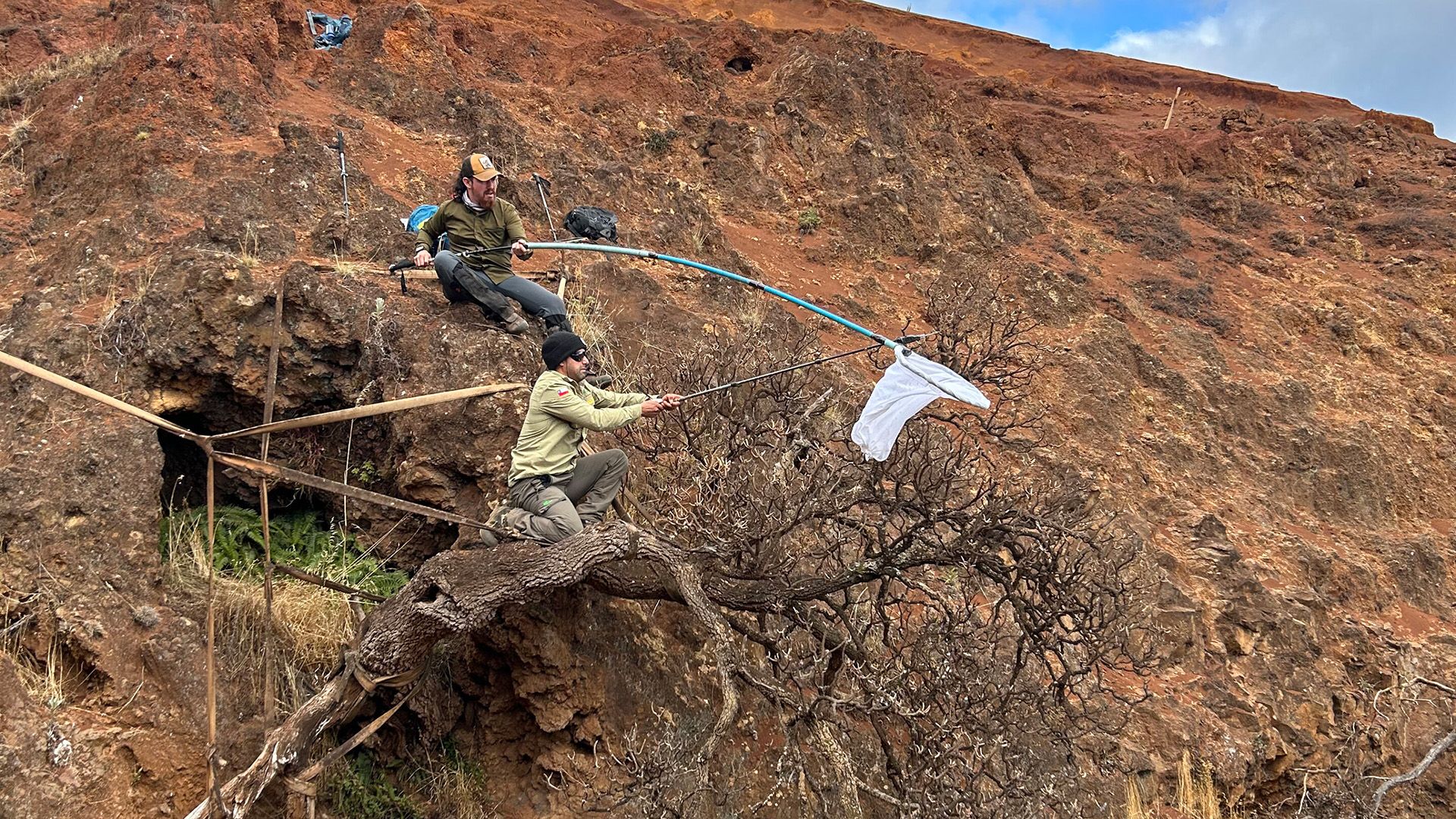
One of the world’s rarest trees, a cliffside plant with just one known individual left in the wild, may have a new chance at survival after scientists collected hundreds of seeds from the lone survivor’s precarious home on Chile’s Robinson Crusoe Island.
The tree, Dendroseris neriifolia, is native to the Juan Fernández Islands, a remote chain of volcanic islands about 420 miles (673 kilometers), from mainland Chile. Once found in lowland areas of Robinson Crusoe island, D. neriifolia has been pushed to the brink by habitat loss, erosion, invasive species, grazing animals, fires and historic forest clearing.
The genus Dendroseris has 11 species, with all populations, not just D. neriifolia in decline, Paulina Hechenleitner V., a plant taxonomist at the Royal Botanic Garden Edinburgh in Scotland, told Live Science via email. She added that no seeds from this genus had been stored in any seed back, until now.
Seeds from the last remaining wild tree were recently sent to the Millennium Seed Bank at Kew Wakehurst, a botanic garden in West Sussex, England, where scientists are conducting germination trials and storing material for long term conservation. X-ray analysis found 25 of the 29 seeds sent to Kew were potentially viable, and seven seedlings are now putting down roots inside the gardens, according to the Royal Botanic Gardens, Kew.
“Through this project, we hope to be able to produce more seed from the plants which we have growing now once they reach flowering age,” Alice Hudson, the Millennium Seed Bank partnerships officer at Kew Wakehurst, told Live Science in an email.
The vanishing of an island tree
Hechenleitner said D. neriifolia‘s population has been declining for more than a century. The species was first described from material collected in the 1830s by Italian botanist Carlo Bertero, one of the early botanic explorers of the Juan Fernández Islands.
“Historical accounts indicate that the species was still relatively common in parts of its range in the late 19th century, although local extinctions were already being reported,” Hechenleitner said.
Get the world’s most fascinating discoveries delivered straight to your inbox.
While a field expedition in 1980 found seven trees, each up to16 feet (5 meters) tall, only one tree remains today, monitored by Chilean park rangers with CONAF, Chile’s national forest agency.
Climbing the cliffside
Collecting seeds from the tree is dangerous, highly specialized work. Simply getting to the tree is a challenge.
“It is a rocky volcanic island with no car [accessible] road,” Hechenleitner said. “The only access is by taking a 4 hour journey and afterwards, a 2 hour climb.”
The last known wild D. nerifolia clings to a steep cliff and is supported by ropes to keep it from falling. Each March, when the seeds mature, park rangers climb along the trunk to reach the flowering branches to catch mature seeds in nets. However, this is the first time the seeds have gone to a bank.”There are lots of different ways you can collect seeds from a tree, the best method depends on many factors including the height of the tree,” Hudson said. “Seeds should be collected at the point at which they naturally release from the tree, this means you can often use methods like getting a throw line over a branch and gently shaking the tree to release the seeds for collection.”
Drones could be the future of seed collection for some cliffside plants.
(Image credit: Richard Newstead via Getty Images)
Overcoming biological barriers
Even with seeds looking viable, conservationists are worried about genetic bottlenecks, low fertility and inbreeding in the wild. Although D. neriifolia can self-fertilize, seed production may remain limited if flowering branches are sparse.
Seed banks also allow scientists to study the germination process up close and in a controlled environment.
“Many species can have complex dormancy or germination requirements so it means that we can research the best ways to germinate seeds, sharing our knowledge to help others to reintroduce plants back into the wild or use them for scientific research finding future foods or medicines,” Hudson said.
Now, scientists hope the young D. neriifolia plants at Kew Wakehurst will eventually flower and produce even more seeds to store. The knowledge gained from growing them could help Chilean conservationists develop protocols for future restoration.
“These will be able to be used in Chile with future seed produced from the remaining tree to hopefully produce plants for restoration efforts or other ex-situ living collections in Chile,” Hudson said.
Do you know where pumpkins and blueberries come from? Find out with our fruits and vegetables quiz!