Close Menu
  • Home
  • UNSUBSCRIBE
  • News
  • Lifestyle
  • Tech
  • Entertainment
  • Sports
  • Travel
Facebook X (Twitter) WhatsApp
Trending
  • Kaleidoscopic meteorite could be a piece of a ‘lost world’ from the early solar system — Space photo of the week
  • Some ‘extinct’ volcanoes may just be going through a growth spurt, before they ‘wake up in this catastrophic stage,’ emerging research suggests
  • Jupiter and Venus conjunction 2026: See two bright planets at the same time this weekend
  • Flu drugs might fight cognitive decline seen in HIV, early study hints
  • NASA astronauts briefly shelter in ‘safe haven’ procedure following worsening leaks on International Space Station
  • Why can’t we figure out how strong gravity is?
  • Stupid hot: Heat waves cause cognitive changes in animals, making them more aggressive and unable to complete basic tasks
  • Tump administration to remove 900 deep sea monitoring instruments that would have studied the collapsing Atlantic current
Facebook X (Twitter) WhatsApp
Baynard Media
  • Home
  • UNSUBSCRIBE
  • News
  • Lifestyle
  • Tech
  • Entertainment
  • Sports
  • Travel
Baynard Media
Home»Lifestyle»Kaleidoscopic meteorite could be a piece of a ‘lost world’ from the early solar system — Space photo of the week
Lifestyle

Kaleidoscopic meteorite could be a piece of a ‘lost world’ from the early solar system — Space photo of the week

EditorBy EditorJune 7, 2026No Comments4 Mins Read
Share Facebook Twitter Pinterest LinkedIn Tumblr Reddit Telegram Email
Share
Facebook Twitter LinkedIn Pinterest Email

Quick facts

What it is: NWA 12774, a 16-ounce (454 grams) angrite meteorite

Where it was found: The Sahara Desert, Northwest Africa

When it was shared: June 1, 2026

Throughout its history, Earth has been bombarded with countless meteorites. About 80,000 have been found so far, but one specific group is exceedingly rare — and scientists now think they could be evidence for a long-dead proto-world that used to orbit the sun.

That rare group is the “angrites,” which account for just 0.09% of all meteorites. They’re among the oldest known rocks in the solar system, forming within just a few million years after the solar system began 4.56 billion years ago. They also contain exceptionally low levels of silica (silicon dioxide), which is a key ingredient of most asteroids and rocky planets.

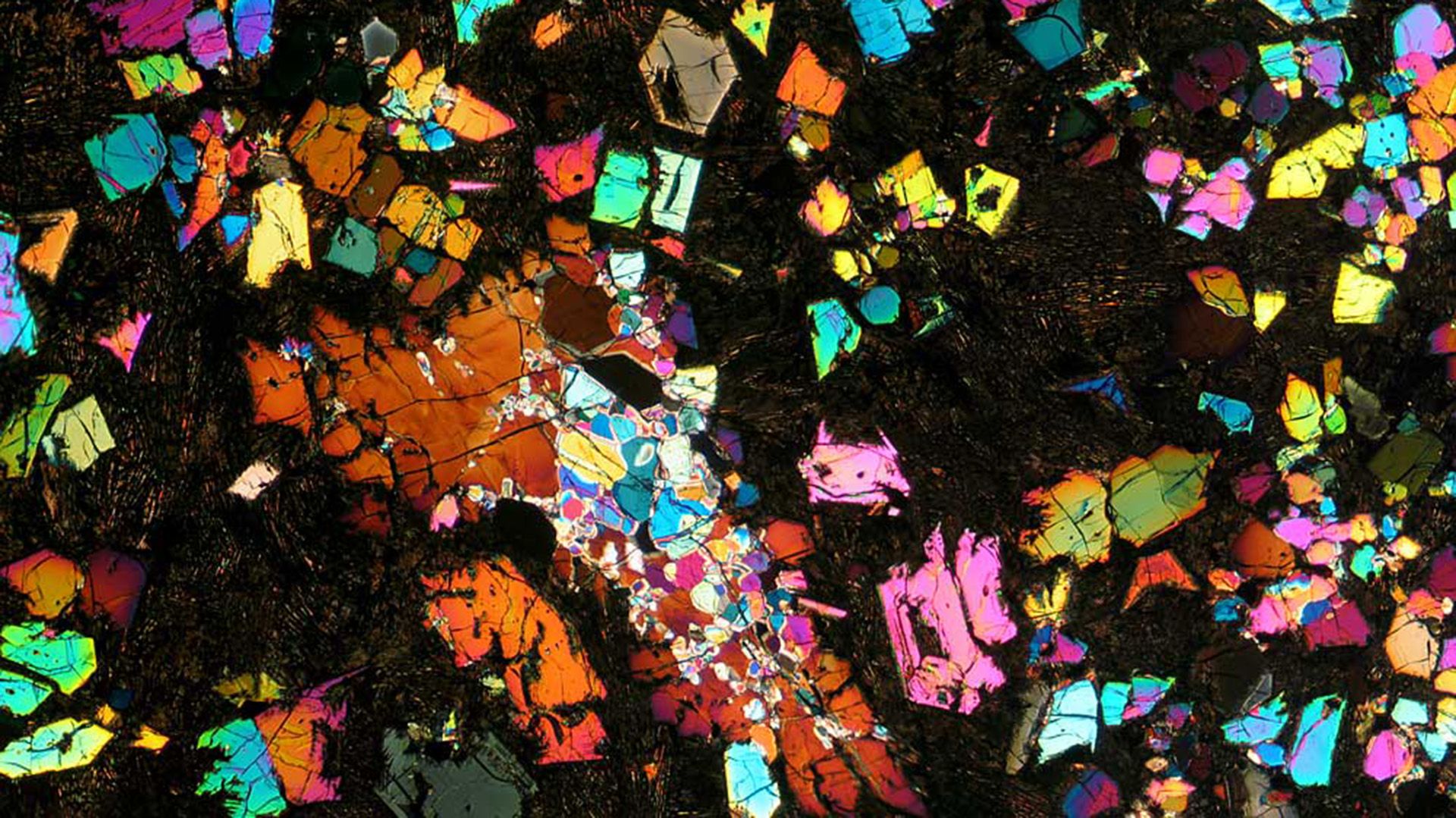
One angrite meteorite, dubbed NWA 12774, (pictured here in cross-polarized light) was discovered in the Sahara Desert in 2019. And a new study into this space rock suggests that it could be the first definitive evidence of a long-lost protoplanet that once existed in the early solar system. (NWA stands for Northwest Africa, a designation given to every meteorite found in this region.)

The findings, published July 1 in the journal Earth and Planetary Science Letters, hint that this “planetary embryo” — if it existed — was made of angrite and may have been as big as the moon or even Mars. It’s thought to have orbited the sun before crashing into another celestial body and shattering into rubble billions of years ago; cue angrite meteorites falling to Earth.

In addition to its low silica content, NWA 12774 contains clinopyroxene, a mineral commonly found in Earth’s crust and mantle. This clinopyroxene is also unusually rich in aluminum, indicating that it formed under extremely high pressure — possibly a high-energy collision.


You may like

Such pressures could not have existed inside a small asteroid, hinting that the parent body of the angrites must have had a radius of at least 621 miles (1,000 kilometers), the researchers wrote. The sharp edges on NWA 12774 further suggest it formed near the surface, implying the parent body was even larger — with a radius of up to 1,118 miles (1,800 km). For comparison, Earth’s moon has a radius of 1,080 miles (1,737 km), and Mars has 2,106 miles (3,390 km).

A kaleidoscope of colors is seen against a black background

Another view of the angrite meteorite NWA 12774.

(Image credit: CU Boulder/John Kashuba)

“It’s incredible to think there was once [another] world this large,” study first author Aaron Bell, a petrologist at the University of Colorado Boulder, said in a statement. “We only know it existed because a few fragments of it happened to land on Earth. These meteorites preserved evidence of a completely different pathway through which early planets developed.”

Get the world’s most fascinating discoveries delivered straight to your inbox.

Due to the lack of silica in the angrites, scientists had previously theorized that these meteorites originated from small asteroids. But the new findings challenge that view.

If they did originate from a protoplanet, then the world that could have formed from this “embryo” would have likely looked much different than the rocky planets we see today.

“The materials that formed the angrite parent body are fundamentally different from the ingredients of Earth and Mars,” said Bell. “It points to a distinct and separate evolutionary path in planetary formation in the early history of our solar system.”

It is unclear exactly what happened to the lost protoplanet. However, the researchers speculate that some of its fragments may have become the building blocks of other terrestrial planets, including Earth.

Bell, A. S., Waters, L., & Ghiorso, M. (2026). High-pressure clinopyroxene in Northwest Africa 12774 and new geobarometric evidence for a planetary embryo-sized angrite parent body. Earth and Planetary Science Letters, 685, 120029. https://doi.org/10.1016/j.epsl.2026.120029


TOPICS


space photo of the week

Source link

Share. Facebook Twitter Pinterest LinkedIn Tumblr Email
Previous ArticleSome ‘extinct’ volcanoes may just be going through a growth spurt, before they ‘wake up in this catastrophic stage,’ emerging research suggests
Editor
  • Website

Related Posts

Lifestyle

Some ‘extinct’ volcanoes may just be going through a growth spurt, before they ‘wake up in this catastrophic stage,’ emerging research suggests

June 7, 2026
Lifestyle

Jupiter and Venus conjunction 2026: See two bright planets at the same time this weekend

June 7, 2026
Lifestyle

Flu drugs might fight cognitive decline seen in HIV, early study hints

June 7, 2026
Add A Comment

Comments are closed.

Categories
  • Entertainment
  • Lifestyle
  • News
  • Sports
  • Tech
  • Travel
Recent Posts
  • Kaleidoscopic meteorite could be a piece of a ‘lost world’ from the early solar system — Space photo of the week
  • Some ‘extinct’ volcanoes may just be going through a growth spurt, before they ‘wake up in this catastrophic stage,’ emerging research suggests
  • Jupiter and Venus conjunction 2026: See two bright planets at the same time this weekend
  • Flu drugs might fight cognitive decline seen in HIV, early study hints
  • NASA astronauts briefly shelter in ‘safe haven’ procedure following worsening leaks on International Space Station
calendar
June 2026
M T W T F S S
1234567
891011121314
15161718192021
22232425262728
2930  
« May    
Recent Posts
  • Kaleidoscopic meteorite could be a piece of a ‘lost world’ from the early solar system — Space photo of the week
  • Some ‘extinct’ volcanoes may just be going through a growth spurt, before they ‘wake up in this catastrophic stage,’ emerging research suggests
  • Jupiter and Venus conjunction 2026: See two bright planets at the same time this weekend
About

Welcome to Baynard Media, your trusted source for a diverse range of news and insights. We are committed to delivering timely, reliable, and thought-provoking content that keeps you informed
and inspired

Categories
  • Entertainment
  • Lifestyle
  • News
  • Sports
  • Tech
  • Travel
Facebook X (Twitter) Pinterest WhatsApp
  • Contact Us
  • About Us
  • Privacy Policy
  • Disclaimer
  • UNSUBSCRIBE
© 2026 copyrights reserved

Type above and press Enter to search. Press Esc to cancel.