Close Menu
  • Home
  • UNSUBSCRIBE
  • News
  • Lifestyle
  • Tech
  • Entertainment
  • Sports
  • Travel
Facebook X (Twitter) WhatsApp
Trending
  • Antarctica’s sudden sea ice loss is one of the most extreme and confusing events in the modern climate record. Scientists now know why it’s happening.
  • ‘I heard gasps’: Artemis II astronauts reveal inside story of their mind-bending solar eclipse
  • A pill can stop people from developing COVID after being exposed to the virus, trial finds
  • ‘There are 4 people in those pixels’: Earth-based telescope snapped Artemis II crew orbiting the moon
  • High-status Roman woman was buried in a lead coffin with jet hairpins and exotic resins, archaeologists find
  • Dreame FP10 Air Purifier review: Pet-friendly and low-maintenance
  • ‘Extreme’ crystal that formed in 1945 nuclear bomb test is unlike anything scientists have seen
  • New analysis finds ‘deep genetic links’ between Homo erectus and modern humans, raising the ‘question of whether we know what Homo erectus even is’
Facebook X (Twitter) WhatsApp
Baynard Media
  • Home
  • UNSUBSCRIBE
  • News
  • Lifestyle
  • Tech
  • Entertainment
  • Sports
  • Travel
Baynard Media
Home»Lifestyle»Samples of ‘alien’ asteroid Ryugu are crawling with life — from Earth
Lifestyle

Samples of ‘alien’ asteroid Ryugu are crawling with life — from Earth

EditorBy EditorNovember 27, 2024No Comments3 Mins Read
Share Facebook Twitter Pinterest LinkedIn Tumblr Reddit Telegram Email
Share
Facebook Twitter LinkedIn Pinterest Email

A rock retrieved from a near-Earth asteroid is crawling with microbial life, scientists have discovered. But the bacteria on its surface almost certainly came from Earth.

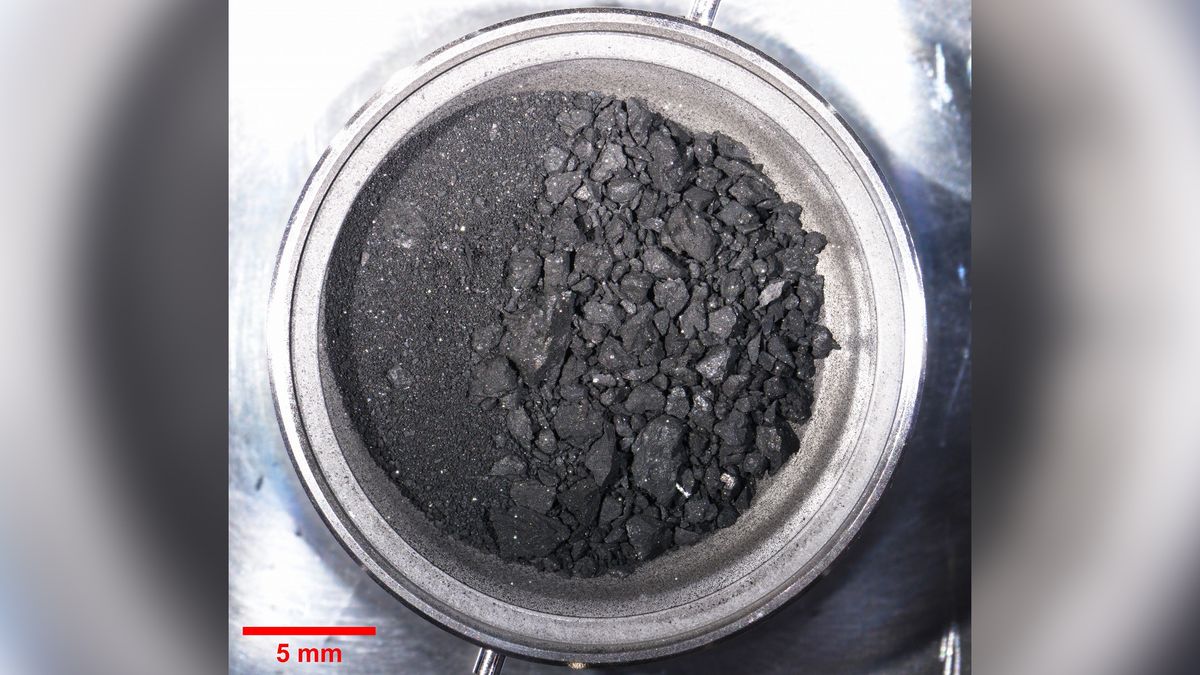
The sample is part of a 0.2-ounce (5.4 grams) chunk of rock that Japan’s Hayabusa2 spacecraft scraped from the surface of the asteroid Ryugu and brought back to our planet in 2020.

After the spacecraft landed back on Earth, researchers opened the rock in a vacuum room located inside a clean room to prevent contamination, before storing it in a room flooded with pressurized nitrogen. Then, samples were placed inside nitrogen-filled canisters to be shipped around the world for analysis.

But it seems that somewhere along the way, for one sample of this rock, these preventative measures were not enough. The scientists behind a new study found that one sample, which was embedded in a resin at Imperial College London in the U.K., had filamentous microorganisms, closely matching terrestrial prokaryotic bacteria, crisscrossing its surface. They published their findings Nov. 13 in the journal Meteorics and Planetary Science.

Related: NASA’s OSIRIS-REx mission almost bit the dust — then Queen guitarist Brian May stepped in

“The presence of microorganisms within meteorites has been used as evidence for extraterrestrial life, however, the potential for terrestrial contamination makes their interpretation highly controversial,” the researchers wrote in the study. “The discovery emphasizes that terrestrial biota can rapidly colonize extraterrestrial specimens even given contamination control precautions.”

Scientists have long debated whether the blueprints for life on our planet originated here or came from the heavens. Previous analyses of meteorites found on Earth have revealed that some of these space rocks contain the five nucleobases essential for organic life.

Get the world’s most fascinating discoveries delivered straight to your inbox.

An animation of asteroid Ryugu made with images from JAXA's Hayabusa2 mission.

A view of the C-type asteroid 162173 Ryugu, seen by the ONC-T camera on board of Hayabusa2. (Image credit: JAXA/University of Tokyo/Kochi University/Rikkyo University/Nagoya University/Chiba Institute of Technology/Meiji University/University of Aizu/AIST)

But whether the compounds came from space aboard the rocks or contaminated the meteorites after their arrival on Earth has long been an open question. The Hayabusa2 mission was one attempt to address this, and with some success — parts of its sample contained amino acids and even the nucleobase uracil.

After receiving their sample, which was shipped from Japan to the U.K. inside its container, the researchers scanned the space rock using X-rays and found no signs of bacteria on its surface. Then, after three weeks, they moved the sample into a resin, studying it more closely after a subsequent week using a scanning electron microscope (SEM).

Surprisingly, their results revealed rods and filaments of organic matter teeming over the sample’s surface.

Yet to the researchers’ disappointment, the growth rates, shapes and sudden appearance of the bacteria all matched closely with microbes found on Earth, suggesting that the sample became contaminated sometime after being placed inside the resin.

This means the chunk of asteroid is unlikely to reveal any unambiguous insights into the contents of Ryugu’s surface, but it doesn’t mean it has nothing to teach us. Beyond flagging the importance of extremely stringent decontamination procedures for samples retrieved from space, the researchers said their study also highlights the incredible adaptability of microbes — which rapidly consume organic material from anywhere, no matter the planet.

“The presence of terrestrial microorganism[s] within a sample of Ryugu underlines that microorganisms are the world’s greatest colonizers and adept at circumventing contamination controls,” they wrote. “The presence of microorganisms within space-returned samples, even those subject to stringent contamination controls, is, therefore, not necessarily evidence of an extraterrestrial origin.”

Source link

Share. Facebook Twitter Pinterest LinkedIn Tumblr Email
Previous Article‘Brady Bunch’ actors talk co-star hookups, first kisses, fake weddings
Next Article Game of Throws – watch trailer for behind-the-scenes World Darts doc
Editor
  • Website

Related Posts

Lifestyle

Antarctica’s sudden sea ice loss is one of the most extreme and confusing events in the modern climate record. Scientists now know why it’s happening.

May 15, 2026
Lifestyle

‘I heard gasps’: Artemis II astronauts reveal inside story of their mind-bending solar eclipse

May 15, 2026
Lifestyle

A pill can stop people from developing COVID after being exposed to the virus, trial finds

May 14, 2026
Add A Comment

Comments are closed.

Categories
  • Entertainment
  • Lifestyle
  • News
  • Sports
  • Tech
  • Travel
Recent Posts
  • Antarctica’s sudden sea ice loss is one of the most extreme and confusing events in the modern climate record. Scientists now know why it’s happening.
  • ‘I heard gasps’: Artemis II astronauts reveal inside story of their mind-bending solar eclipse
  • A pill can stop people from developing COVID after being exposed to the virus, trial finds
  • ‘There are 4 people in those pixels’: Earth-based telescope snapped Artemis II crew orbiting the moon
  • High-status Roman woman was buried in a lead coffin with jet hairpins and exotic resins, archaeologists find
calendar
May 2026
M T W T F S S
 123
45678910
11121314151617
18192021222324
25262728293031
« Apr    
Recent Posts
  • Antarctica’s sudden sea ice loss is one of the most extreme and confusing events in the modern climate record. Scientists now know why it’s happening.
  • ‘I heard gasps’: Artemis II astronauts reveal inside story of their mind-bending solar eclipse
  • A pill can stop people from developing COVID after being exposed to the virus, trial finds
About

Welcome to Baynard Media, your trusted source for a diverse range of news and insights. We are committed to delivering timely, reliable, and thought-provoking content that keeps you informed
and inspired

Categories
  • Entertainment
  • Lifestyle
  • News
  • Sports
  • Tech
  • Travel
Facebook X (Twitter) Pinterest WhatsApp
  • Contact Us
  • About Us
  • Privacy Policy
  • Disclaimer
  • UNSUBSCRIBE
© 2026 copyrights reserved

Type above and press Enter to search. Press Esc to cancel.