Close Menu
  • Home
  • UNSUBSCRIBE
  • News
  • Lifestyle
  • Tech
  • Entertainment
  • Sports
  • Travel
Facebook X (Twitter) WhatsApp
Trending
  • Scientists uncover a better way to beat ‘the bends’ — using deep-diving pigs
  • Mars may have been losing its water more than 4 billion years ago, oldest-known Martian meteorite suggests
  • ‘The lance head was still inside the pelvis’: Mass grave found in Austria may hold casualties of unknown ancient Roman battle
  • ‘Full-on berserker mode’: Archaeologists solve mystery of medieval soldiers with gruesome square holes in their skull
  • Rare belching disorder could be treated with singing, study hints — but not everyone is convinced
  • ‘If this is the new normal, then we are in very deep trouble’: Brazil’s drying aquifers could have ripple effects across the world
  • Foodborne illnesses: Is the US really being hit harder this year?
  • James Webb telescope just spotted the oldest, closest pair of black holes in the early universe
Facebook X (Twitter) WhatsApp
Baynard Media
  • Home
  • UNSUBSCRIBE
  • News
  • Lifestyle
  • Tech
  • Entertainment
  • Sports
  • Travel
Baynard Media
Home»Lifestyle»Ritually bent Bronze Age sword unearthed in Danish bog is ‘very rare find’
Lifestyle

Ritually bent Bronze Age sword unearthed in Danish bog is ‘very rare find’

EditorBy EditorDecember 10, 2024No Comments3 Mins Read
Share Facebook Twitter Pinterest LinkedIn Tumblr Reddit Telegram Email
Share
Facebook Twitter LinkedIn Pinterest Email

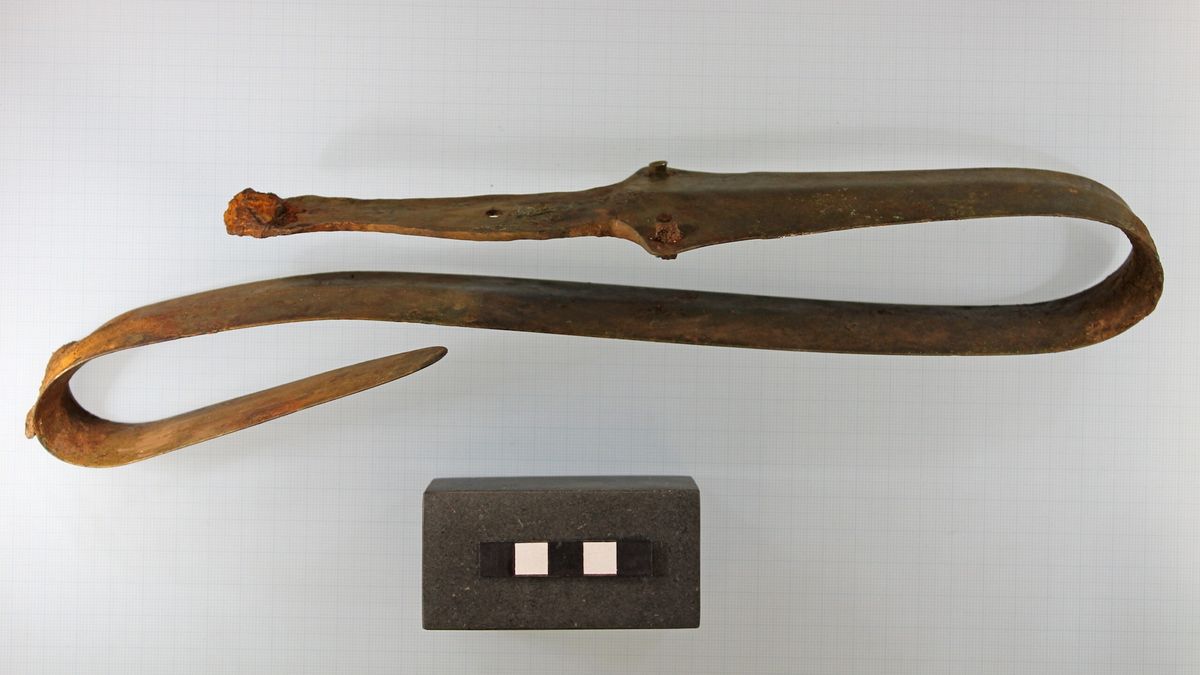
A metal detectorist has unearthed a long, bronze sword that was bent into an S shape during an ancient ritual in what is now Denmark.

The sword and other artifacts — which were found in a bog near Veksø, northwest of Copenhagen — date to about 2,500 years ago, during the late Bronze Age. They are thought to have been part of a ritual sacrifice, although this practice was no longer common at that time. Upon discovering the artifacts, the metal detectorist notified the Danish museum group ROMU.

“It’s what I would describe as a very rare find,” excavation leader Emil Winther Struve, an archaeologist and curator with ROMU, said in a translated statement.

Although such items were often deposited in bogs as sacrifices during the early and middle Bronze Age in northern Europe, “We don’t know that many from the latter part of the Bronze Age,” he said. However, the practice of sacrificing or killing people in bogs — leaving behind remains known as “bog bodies” — spans a longer period, from the Stone Age to the 19th century.

Related: Broken pieces of rare Viking sword reunited after 1,200 years apart

a greenish metal ring in the dirt

A few days after the sword’s discovery, this large bronze neck ring was found nearby. Archaeologists think it was imported into the region from what’s now the Baltic coast of Poland. (Image credit: Palle Østergaard Sørensen/ROMU)

Ritual sacrifice

In addition to the bent sword, archaeologists found other Bronze Age artifacts, including two small, bronze axes; several large, bronze “ankle rings”; and what may be a fragment of a needle, according to the statement.

A few days later, the archaeologists also discovered a large, bronze “neck ring” just 230 feet (70 meters) away. The neck ring is only the second of its kind found in Denmark, and the archaeologists think from its style that it was imported from what’s now the Baltic coast of Poland.

Get the world’s most fascinating discoveries delivered straight to your inbox.

The bronze sword’s handle contains two iron rivets that may be the earliest iron ever found in Denmark. The ROMU statement described the sword as “almost a physical manifestation of the transition from the Bronze Age to the Iron Age.”

The sword’s design suggests it was not made in Denmark but rather in more southern parts of Europe that were dominated by the Hallstatt culture during the Bronze Age, the statement said. The Hallstatt culture thrived from about the eighth to the sixth centuries B.C. and was influenced by Europe’s early Celtic culture.

The ritually bent sword was a genuine weapon and indicated a transition from more lightweight swords used mainly for stabbing, Struve said, “but now they are becoming tougher, more solid and have a different weight, so you can use them more violently and for chopping.”

The Hallstatt culture had a warrior ideal that demanded conquest, war and conflict. “The sword is perhaps an image of that,” Struve said.

Source link

Share. Facebook Twitter Pinterest LinkedIn Tumblr Email
Previous ArticleLeeds 3-1 Middlesbrough | Hosts go top of league
Next Article Best headphones deal: Get the Sony WH-1000XM5 for $101.99 off at Amazon
Editor
  • Website

Related Posts

Lifestyle

Scientists uncover a better way to beat ‘the bends’ — using deep-diving pigs

August 15, 2026
Lifestyle

Mars may have been losing its water more than 4 billion years ago, oldest-known Martian meteorite suggests

August 14, 2026
Lifestyle

‘The lance head was still inside the pelvis’: Mass grave found in Austria may hold casualties of unknown ancient Roman battle

August 14, 2026
Add A Comment

Comments are closed.

Categories
  • Entertainment
  • Lifestyle
  • News
  • Sports
  • Tech
  • Travel
Recent Posts
  • Scientists uncover a better way to beat ‘the bends’ — using deep-diving pigs
  • Mars may have been losing its water more than 4 billion years ago, oldest-known Martian meteorite suggests
  • ‘The lance head was still inside the pelvis’: Mass grave found in Austria may hold casualties of unknown ancient Roman battle
  • ‘Full-on berserker mode’: Archaeologists solve mystery of medieval soldiers with gruesome square holes in their skull
  • Rare belching disorder could be treated with singing, study hints — but not everyone is convinced
calendar
August 2026
M T W T F S S
 12
3456789
10111213141516
17181920212223
24252627282930
31  
« Jul    
Recent Posts
  • Scientists uncover a better way to beat ‘the bends’ — using deep-diving pigs
  • Mars may have been losing its water more than 4 billion years ago, oldest-known Martian meteorite suggests
  • ‘The lance head was still inside the pelvis’: Mass grave found in Austria may hold casualties of unknown ancient Roman battle
About

Welcome to Baynard Media, your trusted source for a diverse range of news and insights. We are committed to delivering timely, reliable, and thought-provoking content that keeps you informed
and inspired

Categories
  • Entertainment
  • Lifestyle
  • News
  • Sports
  • Tech
  • Travel
Facebook X (Twitter) Pinterest WhatsApp
  • Contact Us
  • About Us
  • Privacy Policy
  • Disclaimer
  • UNSUBSCRIBE
© 2026 copyrights reserved

Type above and press Enter to search. Press Esc to cancel.