Close Menu
  • Home
  • UNSUBSCRIBE
  • News
  • Lifestyle
  • Tech
  • Entertainment
  • Sports
  • Travel
Facebook X (Twitter) WhatsApp
Trending
  • Don Juan Pond: Antarctica’s salty, syrupy lake that never freezes, even when it’s minus 58 F
  • Withings ScanWatch 2 review: Style meets next-level health monitoring
  • AI Chatbots are turbo-charging violence against women and girls: We urgently need to regulate them | Yvonne McDermott Rees
  • ‘The biggest El Niño event since the 1870s’: ‘Super’ El Niño is now the most likely scenario by the end of this year ‪—‬ and the humanitarian cost could be huge
  • Antarctica’s sudden sea ice loss is one of the most extreme and confusing events in the modern climate record. Scientists now know why it’s happening.
  • ‘I heard gasps’: Artemis II astronauts reveal inside story of their mind-bending solar eclipse
  • A pill can stop people from developing COVID after being exposed to the virus, trial finds
  • ‘There are 4 people in those pixels’: Earth-based telescope snapped Artemis II crew orbiting the moon
Facebook X (Twitter) WhatsApp
Baynard Media
  • Home
  • UNSUBSCRIBE
  • News
  • Lifestyle
  • Tech
  • Entertainment
  • Sports
  • Travel
Baynard Media
Home»Lifestyle»Extremely rare, black ‘anti-auroras’ paint luminous ‘letter E’ above Alaska
Lifestyle

Extremely rare, black ‘anti-auroras’ paint luminous ‘letter E’ above Alaska

EditorBy EditorDecember 5, 2024No Comments3 Mins Read
Share Facebook Twitter Pinterest LinkedIn Tumblr Reddit Telegram Email
Share
Facebook Twitter LinkedIn Pinterest Email

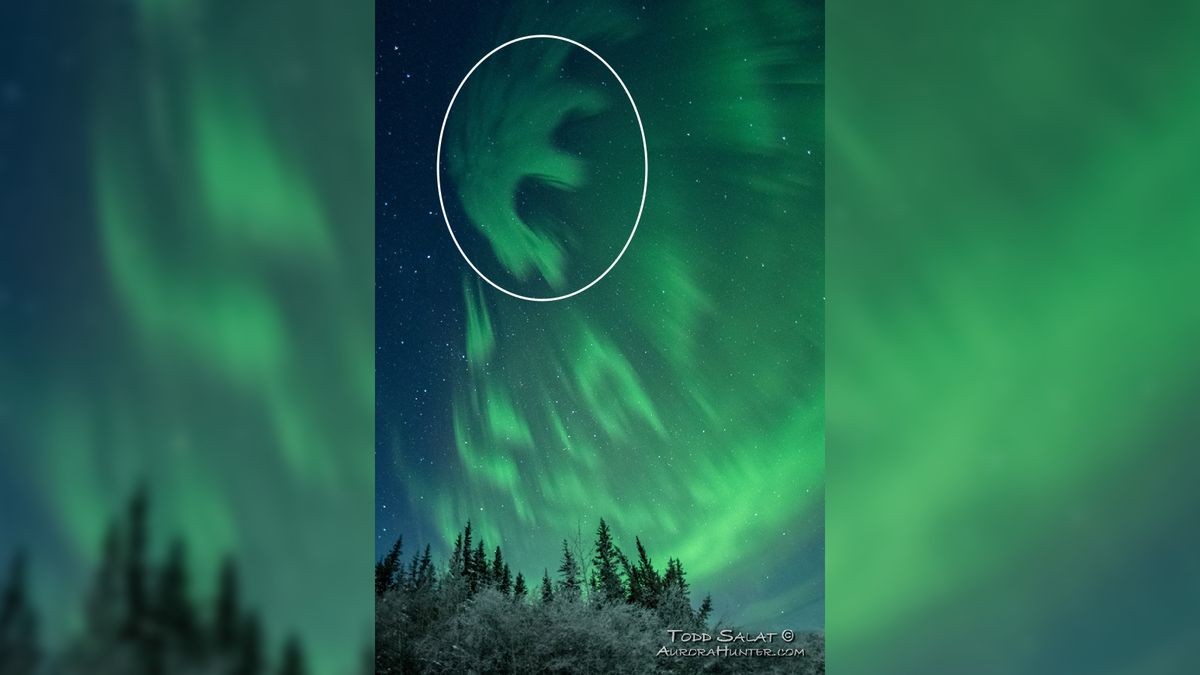
Extremely rare, black “anti-auroras” helped create a peculiar E-shaped swirl of green light recently photographed over Alaska, experts say.

Aurora hunter Todd Salat spotted the unusual aurora on Nov. 22 above an unspecified location in southcentral Alaska at around 4 a.m. local time (8 a.m. EST). The luminous letter appeared seemingly out of nowhere and lasted for a few minutes while cycling through several shapes, all of which contained strange dark patches not seen in most auroras.

“It came up from the northwest and I was like, ‘whoa!’ It looked like the letter E to me,” Salat told Spaceweather.com. “Within just a few minutes it sailed overhead on its back and looked like some critter with its legs in the air.”

The unusual aurora is the result of anti-auroras, a.k.a. black auroras. The strange phenomenon creates the rounded dark patches that look as if they have been bitten out from between the arms of the ‘E’ shape, Spaceweather.com reported.

As the name implies, anti-auroras are essentially the opposite of an aurora — they prevent gases from giving off energy in the form of light. The result is “dark rings, curls or blobs that punctuate the glowing colors,” according to the European Space Agency (ESA).

Related: 32 stunning photos of auroras seen from space

A close-up photo of the E-shaped aurora

The aurora’s unusual shape was the result of anti-auroras that formed in between the arms of the luminous letter. (Image credit: Todd Salat/aurorahunter.com)

Auroras are triggered when high-energy particles from the sun, predominantly electrons, bypass Earth’s magnetic field, or magnetosphere, and superheat gas molecules in the upper atmosphere. The excited molecules release energy in the form of light, which collectively forms long smooth ribbons that twist in the sky. The color of the light varies depending on which element is being excited and where in the atmosphere it is located.

Get the world’s most fascinating discoveries delivered straight to your inbox.

The swirling light shows normally only occur sparsely near the poles where Earth’s magnetic field is weakest. But they are particularly prominent and widespread now due to increased solar activity tied to solar maximum, the peak of the sun’s roughly 11-year sunspot cycle.

However, anti-auroras interrupt the aurora-forming process by starving gases of charged particles.

“The black aurora isn’t actually an aurora at all; it’s a lack of auroral activity in a region where electrons are ‘sucked’ from the ionosphere,” Göran Marklund, a plasma physicist at Sweden’s Royal Institute of Technology in Stockholm, previously told ESA.

The expanded shape of the auroras flipped on its side

The E-shaped aurora ended up flipping over and growing additional limbs before it disappeared from the sky. (Image credit: Todd Salat/aurorahunter.com)

Anti-auroras were first identified in the late 1990s. But in 2001, scientists loosely figured out how they worked when ESA’s four Cluster satellites passed through space above a black aurora sighting. This revealed small vertical cells in the upper atmosphere, known as positively charged electric potential structures, where electrons were being repelled back into space.

The mechanism behind these cells remained elusive for well over a decade, until a 2015 study utilizing more than a decade of Cluster mission data showed that these structures form when auroras deplete plasma, creating “ionospheric cavities,” in the upper atmosphere while the magnetosphere shifts from the strain caused by solar storms. However, the conditions have to be just right for anti-auroras to appear.

Anti-auroras can occur in the Northern Lights and the Southern Lights and typically only last for around 10 or 20 minutes. Aurora activity is expected to remain high over the next few years so there is a decent chance we could see more examples of these dark patches dancing among them.

Source link

Share. Facebook Twitter Pinterest LinkedIn Tumblr Email
Previous ArticleDrone activity near Trump Bedminster, Army arsenal still investigated by FAA
Next Article 8-in-1 keychain charger on sale
Editor
  • Website

Related Posts

Lifestyle

Don Juan Pond: Antarctica’s salty, syrupy lake that never freezes, even when it’s minus 58 F

May 16, 2026
Lifestyle

Withings ScanWatch 2 review: Style meets next-level health monitoring

May 15, 2026
Lifestyle

AI Chatbots are turbo-charging violence against women and girls: We urgently need to regulate them | Yvonne McDermott Rees

May 15, 2026
Add A Comment

Comments are closed.

Categories
  • Entertainment
  • Lifestyle
  • News
  • Sports
  • Tech
  • Travel
Recent Posts
  • Don Juan Pond: Antarctica’s salty, syrupy lake that never freezes, even when it’s minus 58 F
  • Withings ScanWatch 2 review: Style meets next-level health monitoring
  • AI Chatbots are turbo-charging violence against women and girls: We urgently need to regulate them | Yvonne McDermott Rees
  • ‘The biggest El Niño event since the 1870s’: ‘Super’ El Niño is now the most likely scenario by the end of this year ‪—‬ and the humanitarian cost could be huge
  • Antarctica’s sudden sea ice loss is one of the most extreme and confusing events in the modern climate record. Scientists now know why it’s happening.
calendar
May 2026
M T W T F S S
 123
45678910
11121314151617
18192021222324
25262728293031
« Apr    
Recent Posts
  • Don Juan Pond: Antarctica’s salty, syrupy lake that never freezes, even when it’s minus 58 F
  • Withings ScanWatch 2 review: Style meets next-level health monitoring
  • AI Chatbots are turbo-charging violence against women and girls: We urgently need to regulate them | Yvonne McDermott Rees
About

Welcome to Baynard Media, your trusted source for a diverse range of news and insights. We are committed to delivering timely, reliable, and thought-provoking content that keeps you informed
and inspired

Categories
  • Entertainment
  • Lifestyle
  • News
  • Sports
  • Tech
  • Travel
Facebook X (Twitter) Pinterest WhatsApp
  • Contact Us
  • About Us
  • Privacy Policy
  • Disclaimer
  • UNSUBSCRIBE
© 2026 copyrights reserved

Type above and press Enter to search. Press Esc to cancel.