Close Menu
  • Home
  • UNSUBSCRIBE
  • News
  • Lifestyle
  • Tech
  • Entertainment
  • Sports
  • Travel
Facebook X (Twitter) WhatsApp
Trending
  • ‘Eventually, it becomes you’: Inventors of new ‘living’ knee replacement describe why this tech is desperately needed and how it works
  • The Trump administration wants to open precious East Coast forests to logging and mining
  • ‘The push towards renewables is unstoppable because it’s in a country’s self-interest’: Climate scientist Andy Reisinger on Trump, Iran, and the future of Earth
  • Science news this week: Atlantic current edges closer to collapse, scientists make artificial-neuron breakthrough, and a copy of the “Iliad” is found inside an Egyptian mummy
  • Why are some constellations visible for only part of the year?
  • Science history: Chernobyl nuclear power plant melts down, bringing the world to the brink of disaster — April 26, 1986
  • El Niño could be here by May, new forecast reveals —‬ here’s what it means for summer weather
  • ‘A completely new reality’: Bolder measures are needed to prevent extreme water shortages in cities like Phoenix and Las Vegas that depend on the Colorado River
Facebook X (Twitter) WhatsApp
Baynard Media
  • Home
  • UNSUBSCRIBE
  • News
  • Lifestyle
  • Tech
  • Entertainment
  • Sports
  • Travel
Baynard Media
Home»Lifestyle»Earth from space: Rare ‘sunglint’ transforms the Mediterranean Sea into a swirling, silver mirror
Lifestyle

Earth from space: Rare ‘sunglint’ transforms the Mediterranean Sea into a swirling, silver mirror

EditorBy EditorFebruary 25, 2025No Comments3 Mins Read
Share Facebook Twitter Pinterest LinkedIn Tumblr Reddit Telegram Email
Share
Facebook Twitter LinkedIn Pinterest Email

QUICK FACTS

Where is it? Milos and Antimilos, Greece [36.78052336, 24.355555146]

What’s in the photo? The sun shining directly off the surface of the Mediterranean Sea

Who took the photo? An unnamed astronaut onboard the International Space Station (ISS)

When was it taken? June 25, 2022

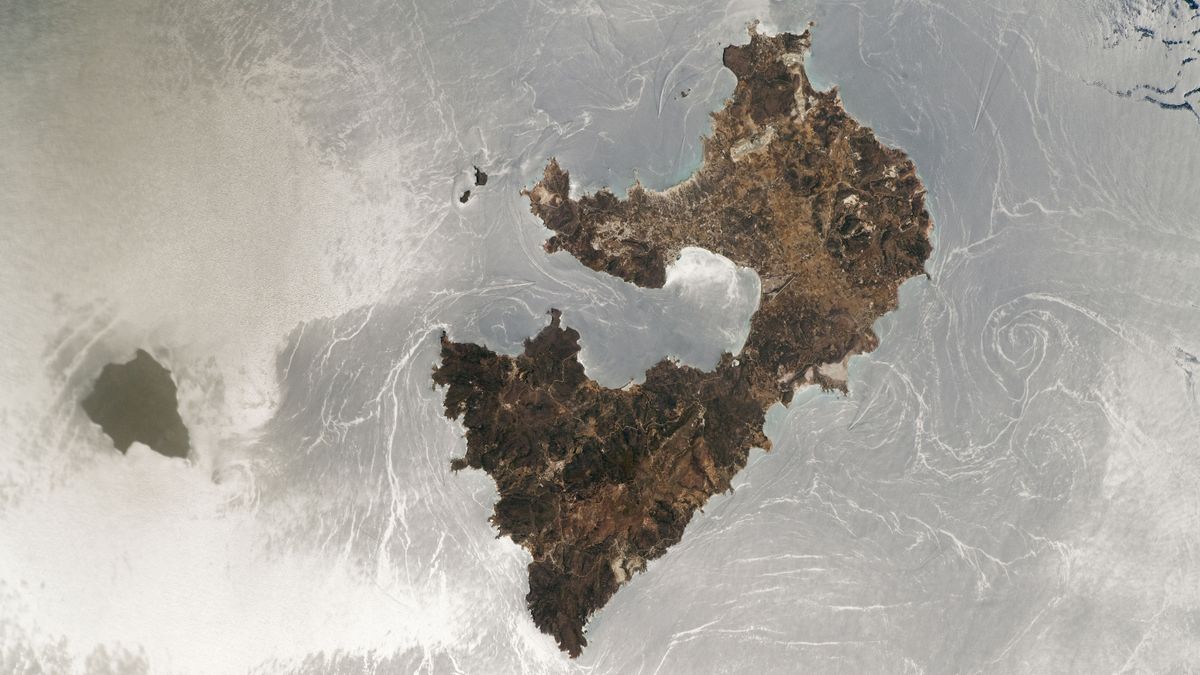
In this stunning astronaut photo, a rare “sunglint” transforms the Mediterranean Sea’s surface into a swirling, silver mirror surrounding a pair of Greek islands — Milos (center) and Antimilos (left).

A sunglint occurs when sunlight reflects off a flat body of water directly toward an observer orbiting Earth, such as a satellite or astronaut. It is similar to how light reflects off the sea during sunrise or sunset. But instead of a bright-orange streak reflected off the waves, it looks like a massive, silvery patch that can cover several hundred square miles. From space, sunglints appear to move across the ocean as Earth rotates.

Wind-driven surface currents, deeper ocean currents, spinning gyres and other oceanographic phenomena cause the wavy lines and swirls that cut across the sea’s silver surface in the image, according to NASA’s Earth Observatory.

Most of these features would normally be invisible from space. But because they scatter some of the sun’s light, they become visible during a sunglint.

Related: See all the best images of Earth from space

A photo of planet Earth with a bright silver sunglint on the ocean's surface

Sunglints can cover several hundred square miles of the ocean’s surface at a time. (Image credit: NASA Earth Observatory)

One of the most striking oceanographic features in the photo is a gyre spinning like a giant whirlpool to the east (right) of Milos. Another noteworthy feature is the long, straight line in the bottom left of the picture, which is most likely the wake from a ship, according to the Earth Observatory.

However, the rarest phenomenon in the image is a set of parallel lines located just off the northwest coast (top left) of Antimilos. These lines, which are partly obscured by clouds, are “internal waves” — massive vertical waves that pass through the water beneath the surface, according to the Earth Observatory.

Get the world’s most fascinating discoveries delivered straight to your inbox.

Unlike surface waves, which are mainly driven by ocean currents or strong winds, internal waves are the result of gravity waves (not to be confused with gravitational waves in space-time), which pass across the interface of two fluid mediums when gravity disrupts the equilibrium between them. In this case, the waves are rippling along the submerged border between two layers of water that have been stratified by temperature and salinity and disrupted by Earth’s changing tides, according to a 2021 article in The Conversation.

While sunglints are visually stunning, they can pose problems for marine scientists who rely on color in satellite imagery to monitor the health of the ocean. As a result, researchers often have to digitally remove them from images, according to the National Oceanographic and Atmospheric Administration (NOAA).

On the other hand, scientists can use sunglints to more accurately measure oil spills on the ocean’s surface, because petroleum absorbs sunlight rather than reflecting it into space, according to NOAA.

Source link

Share. Facebook Twitter Pinterest LinkedIn Tumblr Email
Previous ArticleChina’s Xi affirms ‘no limits’ partnership with Putin in call on Ukraine war anniversary
Next Article Prosecutors aim to flush out alleged golden toilet thieves in U.K. trial
Editor
  • Website

Related Posts

Lifestyle

‘Eventually, it becomes you’: Inventors of new ‘living’ knee replacement describe why this tech is desperately needed and how it works

April 25, 2026
Lifestyle

The Trump administration wants to open precious East Coast forests to logging and mining

April 25, 2026
Lifestyle

‘The push towards renewables is unstoppable because it’s in a country’s self-interest’: Climate scientist Andy Reisinger on Trump, Iran, and the future of Earth

April 25, 2026
Add A Comment

Comments are closed.

Categories
  • Entertainment
  • Lifestyle
  • News
  • Sports
  • Tech
  • Travel
Recent Posts
  • ‘Eventually, it becomes you’: Inventors of new ‘living’ knee replacement describe why this tech is desperately needed and how it works
  • The Trump administration wants to open precious East Coast forests to logging and mining
  • ‘The push towards renewables is unstoppable because it’s in a country’s self-interest’: Climate scientist Andy Reisinger on Trump, Iran, and the future of Earth
  • Science news this week: Atlantic current edges closer to collapse, scientists make artificial-neuron breakthrough, and a copy of the “Iliad” is found inside an Egyptian mummy
  • Why are some constellations visible for only part of the year?
calendar
April 2026
M T W T F S S
 12345
6789101112
13141516171819
20212223242526
27282930  
« Mar    
Recent Posts
  • ‘Eventually, it becomes you’: Inventors of new ‘living’ knee replacement describe why this tech is desperately needed and how it works
  • The Trump administration wants to open precious East Coast forests to logging and mining
  • ‘The push towards renewables is unstoppable because it’s in a country’s self-interest’: Climate scientist Andy Reisinger on Trump, Iran, and the future of Earth
About

Welcome to Baynard Media, your trusted source for a diverse range of news and insights. We are committed to delivering timely, reliable, and thought-provoking content that keeps you informed
and inspired

Categories
  • Entertainment
  • Lifestyle
  • News
  • Sports
  • Tech
  • Travel
Facebook X (Twitter) Pinterest WhatsApp
  • Contact Us
  • About Us
  • Privacy Policy
  • Disclaimer
  • UNSUBSCRIBE
© 2026 copyrights reserved

Type above and press Enter to search. Press Esc to cancel.