Close Menu
  • Home
  • UNSUBSCRIBE
  • News
  • Lifestyle
  • Tech
  • Entertainment
  • Sports
  • Travel
Facebook X (Twitter) WhatsApp
Trending
  • Science news this week: PCOS has a new name, Neanderthals were the world’s oldest dentists, and the first nuclear bomb explosion spawned an ‘alien’ crystal
  • Newly discovered, blue-whale-size asteroid will fly super close to Earth Monday — and you can watch it live
  • Don Juan Pond: Antarctica’s salty, syrupy lake that never freezes, even when it’s minus 58 F
  • Withings ScanWatch 2 review: Style meets next-level health monitoring
  • AI Chatbots are turbo-charging violence against women and girls: We urgently need to regulate them | Yvonne McDermott Rees
  • ‘The biggest El Niño event since the 1870s’: ‘Super’ El Niño is now the most likely scenario by the end of this year ‪—‬ and the humanitarian cost could be huge
  • Antarctica’s sudden sea ice loss is one of the most extreme and confusing events in the modern climate record. Scientists now know why it’s happening.
  • ‘I heard gasps’: Artemis II astronauts reveal inside story of their mind-bending solar eclipse
Facebook X (Twitter) WhatsApp
Baynard Media
  • Home
  • UNSUBSCRIBE
  • News
  • Lifestyle
  • Tech
  • Entertainment
  • Sports
  • Travel
Baynard Media
Home»Lifestyle»Early human ancestor ‘Lucy’ was a bad runner, and this one tendon could explain why
Lifestyle

Early human ancestor ‘Lucy’ was a bad runner, and this one tendon could explain why

EditorBy EditorDecember 26, 2024No Comments3 Mins Read
Share Facebook Twitter Pinterest LinkedIn Tumblr Reddit Telegram Email
Share
Facebook Twitter LinkedIn Pinterest Email

“Lucy,” our 3.2 million-year-old hominin relative, couldn’t run very fast, according to a new study. But modeling her running ability has provided new insights into the evolution of human anatomy key to running performance.

The human ability to walk and run efficiently on two feet arose around 2 million years ago with our Homo erectus ancestors. But our earlier relatives, the australopithecines, were also bipedal around 4 million years ago. Given the long arms and different body proportions of species like Australopithecus afarensis, though, researchers have assumed that australopithecines were less capable of walking on two legs than modern humans.

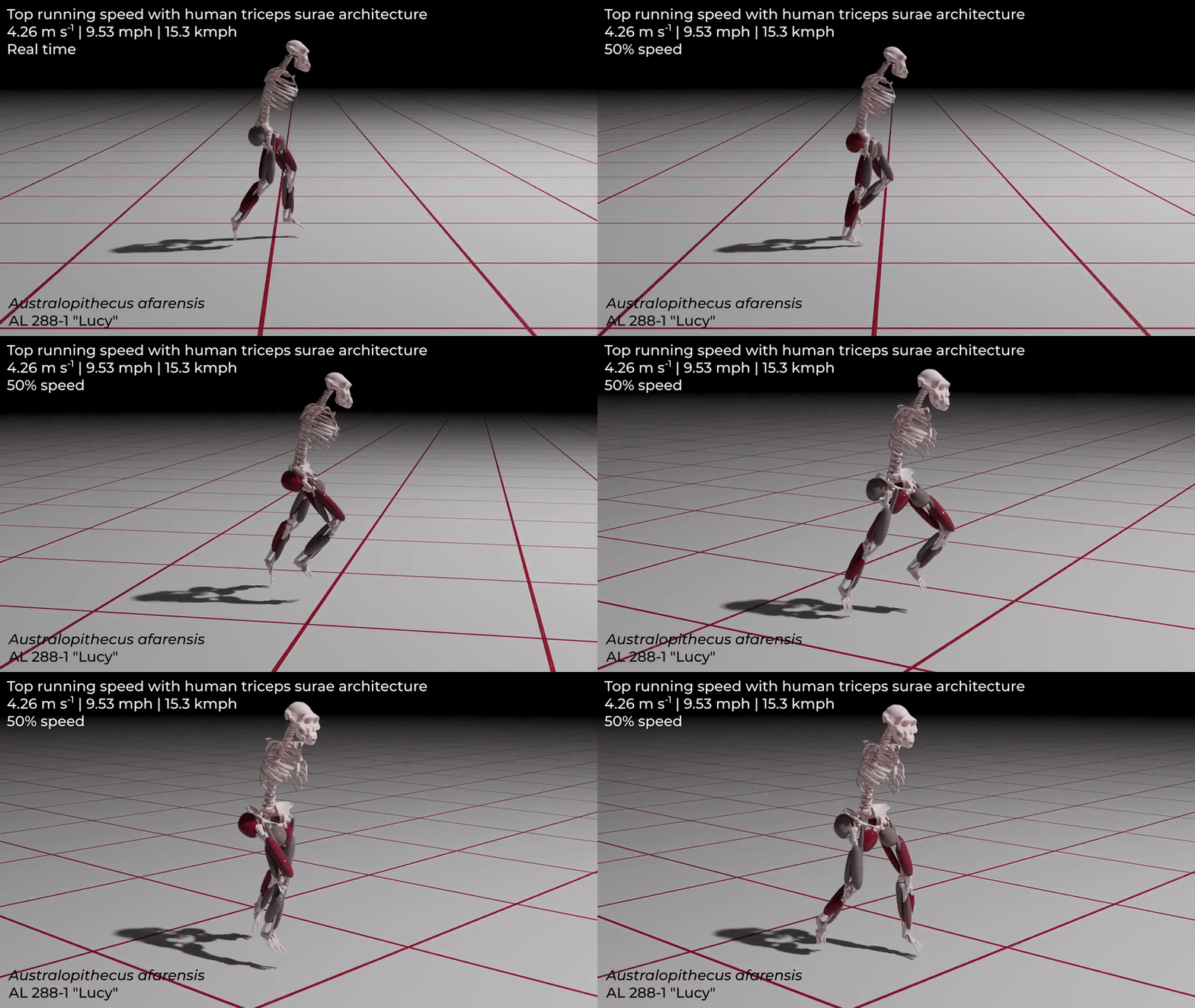
In a study published online Dec. 18 in the journal Current Biology, a team of researchers modeled the skeletal and muscular anatomy of Lucy to determine her maximum running speed, the energetic costs associated with running, and her running endurance.

Through a series of simulations of running gait, the researchers wrote in their study that Lucy’s “maximum running speed was considerably lower than our human model,” topping out around 11 mph (18 km/h). For reference, Usain Bolt’s top speed is more than 27 mph (43 km/h) and a recreational runner’s top sprinting speed is about 13.5 mph (22 km/h). Additionally, in spite of this lower top speed, Lucy used up between 1.7 and 2.9 times more energy than modern humans do to run that fast, suggesting she would have required significantly more energy to travel a given distance than a modern human would.

Australopithecines like Lucy had large upper bodies, long arms and short legs, which likely limited their running speed. But the researchers discovered that another potential reason for Lucy’s slow, inefficient running may have been a differently shaped Achilles tendon and triceps surae, a group of muscles in the calf.

Related: Lucy’s last day: What the iconic fossil reveals about our ancient ancestor’s last hours

Modern humans have a long, spring-like Achilles tendon, the researchers noted, which connects calf and ankle muscles to the heel bone. This anatomical arrangement provides humans with the powerful and efficient ankle crucial to high running performance.

Get the world’s most fascinating discoveries delivered straight to your inbox.

When the researchers modeled Lucy’s movement with human-like Achilles and calf muscles, she was still slower, but the differences in this tweaked running ability were mostly due to her smaller body size.

“This wider context therefore emphasizes the crucial role of the Achilles tendon and triceps surae architecture in the evolution of hominin running energetics,” the researchers wrote in the study. “Key features in the human body plan evolved specifically for improved running performance.”

The new study is the first time researchers have directly estimated running ability in Lucy’s species using musculoskeletal modeling, the researchers noted, but further work is needed, such as models that include arm swing and torso rotations to more fully understand the differences between australopithecine and human locomotion.

Source link

Share. Facebook Twitter Pinterest LinkedIn Tumblr Email
Previous Article3 people shot and 1 person stabbed at Phoenix airport following apparent family dispute
Next Article This Fan-Favorite Elf Quote Almost Didn’t Make It Into the Film
Editor
  • Website

Related Posts

Lifestyle

Science news this week: PCOS has a new name, Neanderthals were the world’s oldest dentists, and the first nuclear bomb explosion spawned an ‘alien’ crystal

May 16, 2026
Lifestyle

Newly discovered, blue-whale-size asteroid will fly super close to Earth Monday — and you can watch it live

May 16, 2026
Lifestyle

Don Juan Pond: Antarctica’s salty, syrupy lake that never freezes, even when it’s minus 58 F

May 16, 2026
Add A Comment

Comments are closed.

Categories
  • Entertainment
  • Lifestyle
  • News
  • Sports
  • Tech
  • Travel
Recent Posts
  • Science news this week: PCOS has a new name, Neanderthals were the world’s oldest dentists, and the first nuclear bomb explosion spawned an ‘alien’ crystal
  • Newly discovered, blue-whale-size asteroid will fly super close to Earth Monday — and you can watch it live
  • Don Juan Pond: Antarctica’s salty, syrupy lake that never freezes, even when it’s minus 58 F
  • Withings ScanWatch 2 review: Style meets next-level health monitoring
  • AI Chatbots are turbo-charging violence against women and girls: We urgently need to regulate them | Yvonne McDermott Rees
calendar
May 2026
M T W T F S S
 123
45678910
11121314151617
18192021222324
25262728293031
« Apr    
Recent Posts
  • Science news this week: PCOS has a new name, Neanderthals were the world’s oldest dentists, and the first nuclear bomb explosion spawned an ‘alien’ crystal
  • Newly discovered, blue-whale-size asteroid will fly super close to Earth Monday — and you can watch it live
  • Don Juan Pond: Antarctica’s salty, syrupy lake that never freezes, even when it’s minus 58 F
About

Welcome to Baynard Media, your trusted source for a diverse range of news and insights. We are committed to delivering timely, reliable, and thought-provoking content that keeps you informed
and inspired

Categories
  • Entertainment
  • Lifestyle
  • News
  • Sports
  • Tech
  • Travel
Facebook X (Twitter) Pinterest WhatsApp
  • Contact Us
  • About Us
  • Privacy Policy
  • Disclaimer
  • UNSUBSCRIBE
© 2026 copyrights reserved

Type above and press Enter to search. Press Esc to cancel.