Close Menu
  • Home
  • UNSUBSCRIBE
  • News
  • Lifestyle
  • Tech
  • Entertainment
  • Sports
  • Travel
Facebook X (Twitter) WhatsApp
Trending
  • Can people catch infections from plants?
  • Andes virus spreads via ‘close contact’ — but what exactly does that mean?
  • 8-year-old African American boy from Colonial Maryland found buried with white Colonists, and it’s unclear if he was enslaved
  • Science news this week: PCOS has a new name, Neanderthals were the world’s oldest dentists, and the first nuclear bomb explosion spawned an ‘alien’ crystal
  • Newly discovered, blue-whale-size asteroid will fly super close to Earth Monday — and you can watch it live
  • Don Juan Pond: Antarctica’s salty, syrupy lake that never freezes, even when it’s minus 58 F
  • Withings ScanWatch 2 review: Style meets next-level health monitoring
  • AI Chatbots are turbo-charging violence against women and girls: We urgently need to regulate them | Yvonne McDermott Rees
Facebook X (Twitter) WhatsApp
Baynard Media
  • Home
  • UNSUBSCRIBE
  • News
  • Lifestyle
  • Tech
  • Entertainment
  • Sports
  • Travel
Baynard Media
Home»Lifestyle»Could the universe ever stop expanding? New theory proposes a cosmic ‘off switch’
Lifestyle

Could the universe ever stop expanding? New theory proposes a cosmic ‘off switch’

EditorBy EditorMarch 14, 2025No Comments3 Mins Read
Share Facebook Twitter Pinterest LinkedIn Tumblr Reddit Telegram Email
Share
Facebook Twitter LinkedIn Pinterest Email

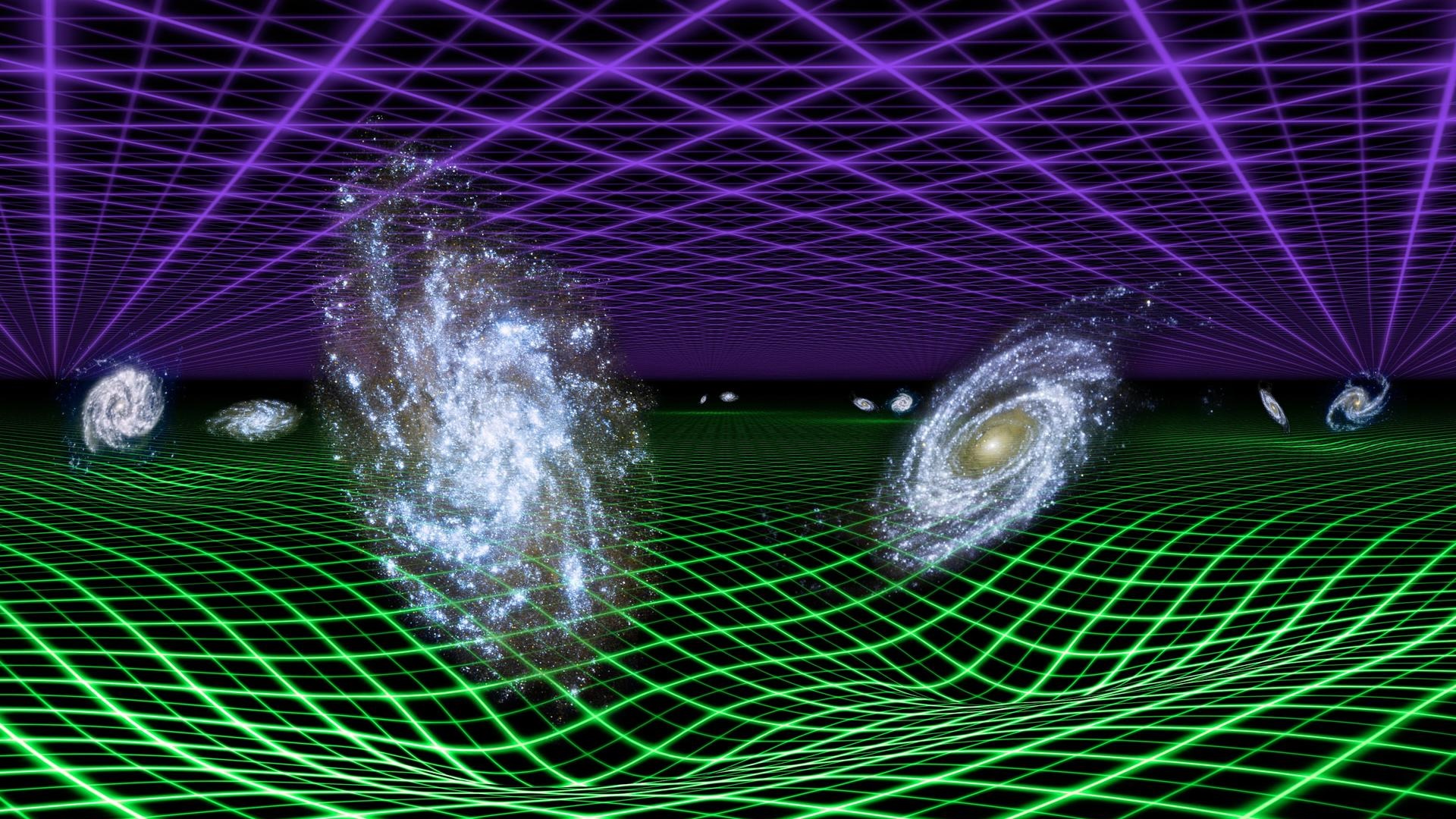
Dark energy may have switched directions sometime in the distant past — and this violent transition may explain why cosmological observations aren’t adding up, researchers propose in a new paper.

The modern picture of the evolution of the universe is known as ΛCDM (or lambda-CDM), for dark energy (represented by the Greek letter Λ) and cold dark matter. Dark energy is the mysterious force driving the accelerating expansion of the universe, and cold dark matter refers to the mysterious, invisible substance that provides most of the mass of almost every single galaxy.

This model has explained a wide variety of observations, such as the behavior of galaxies and clusters, the growth of large-scale structures, and the appearance of the cosmic microwave background. But in recent years, two troubling tensions have popped up.

One such problem, known as the Hubble tension, is a difference in measuring the present-day expansion rate of the universe, a number known as the Hubble constant. Probes of the distant, early universe seem to be giving estimates significantly lower than probes of the nearby, late universe do.

Related: After 2 years in space, the James Webb telescope has broken cosmology. Can it be fixed?

Related to this issue is the second problem, known as the sigma-8 tension. This is a measure of how clumpy matter is in the universe, and once again, different probes are yielding different results.

A cosmic slowdown

Something in the ΛCDM model has to be wrong, but we’re not sure what. One hypothesis is that dark energy might be more dynamic than we originally thought. In the usual ΛCDM picture, dark energy is a cosmological constant. It stays the same through cosmic history.

Get the world’s most fascinating discoveries delivered straight to your inbox.

But in a recent model that’s been gaining interest, dark energy changes. And not by a little; it undergoes a complete phase transition, from decelerating the universe to accelerating the universe.

Now, adding a twist to that theory, a research team has explored the possibility that the phase change is even more dramatic. In a paper posted to the preprint server arXiv in February but not yet peer-reviewed, dark energy doesn’t just switch signs; it also changes strength, so that it powers an acceleration differently than it powers a deceleration.

Then, the researchers tested their model against a wide variety of observations and datasets. These included the Planck space observatory’s measurements of the cosmic microwave background, the oldest light we can see in the universe; a measurement of a phenomenon called the baryon acoustic oscillation, a pattern in the arrangement of galaxies at very large scales; the Pantheon dataset of supernova distance measures; and a weak lensing map that provides details accounting for the effects of dark matter.

They found that the new model alleviated some of the Hubble and sigma-8 tensions, and thus they contend that this approach might be a promising way forward.

That said, the researchers noted that this model isn’t exactly grounded in known physics. It’s just a toy, a way to explore the physical consequences of a model without knowing the underlying physics. But because it seems like a promising direction, this approach could motivate theorists to come up with mechanisms to explain how dark energy might switch like this.

No matter what, it appears that the universe — especially dark energy — is more complicated than we assumed.

Source link

Share. Facebook Twitter Pinterest LinkedIn Tumblr Email
Previous ArticleDemocratic anger over ‘Schumer surrender’ shows party’s deep divisions on how to take on Trump
Next Article Watch live as NASA astronauts launch to space station
Editor
  • Website

Related Posts

Lifestyle

Can people catch infections from plants?

May 16, 2026
Lifestyle

Andes virus spreads via ‘close contact’ — but what exactly does that mean?

May 16, 2026
Lifestyle

8-year-old African American boy from Colonial Maryland found buried with white Colonists, and it’s unclear if he was enslaved

May 16, 2026
Add A Comment

Comments are closed.

Categories
  • Entertainment
  • Lifestyle
  • News
  • Sports
  • Tech
  • Travel
Recent Posts
  • Can people catch infections from plants?
  • Andes virus spreads via ‘close contact’ — but what exactly does that mean?
  • 8-year-old African American boy from Colonial Maryland found buried with white Colonists, and it’s unclear if he was enslaved
  • Science news this week: PCOS has a new name, Neanderthals were the world’s oldest dentists, and the first nuclear bomb explosion spawned an ‘alien’ crystal
  • Newly discovered, blue-whale-size asteroid will fly super close to Earth Monday — and you can watch it live
calendar
May 2026
M T W T F S S
 123
45678910
11121314151617
18192021222324
25262728293031
« Apr    
Recent Posts
  • Can people catch infections from plants?
  • Andes virus spreads via ‘close contact’ — but what exactly does that mean?
  • 8-year-old African American boy from Colonial Maryland found buried with white Colonists, and it’s unclear if he was enslaved
About

Welcome to Baynard Media, your trusted source for a diverse range of news and insights. We are committed to delivering timely, reliable, and thought-provoking content that keeps you informed
and inspired

Categories
  • Entertainment
  • Lifestyle
  • News
  • Sports
  • Tech
  • Travel
Facebook X (Twitter) Pinterest WhatsApp
  • Contact Us
  • About Us
  • Privacy Policy
  • Disclaimer
  • UNSUBSCRIBE
© 2026 copyrights reserved

Type above and press Enter to search. Press Esc to cancel.