Close Menu
  • Home
  • UNSUBSCRIBE
  • News
  • Lifestyle
  • Tech
  • Entertainment
  • Sports
  • Travel
Facebook X (Twitter) WhatsApp
Trending
  • Once-in-a-century ‘super’ El Niño in the cards as ocean temperatures reach near record highs in April
  • Goodbye PCOS: Polycystic ovary syndrome is getting a new name that doctors say better reflects the underlying disease
  • Microplastics absorb heat in the atmosphere and contribute to global warming — as if they weren’t bad enough
  • ‘Insect apocalypse’ is already fueling malnutrition in some regions, first-of-its-kind study reveals
  • Hantavirus LIVE: American passengers from cruise head to specialized facilities in Nebraska
  • New ‘trick’ fixes major flaw in neutral-atom quantum computers — inching us closer to a superpowerful system
  • A 2025 Alaskan tsunami was one of the largest on record, new research finds
  • Lion’s head pendant: An ancient Egyptian board game piece that was later repurposed into a magical religious object with baboons
Facebook X (Twitter) WhatsApp
Baynard Media
  • Home
  • UNSUBSCRIBE
  • News
  • Lifestyle
  • Tech
  • Entertainment
  • Sports
  • Travel
Baynard Media
Home»Lifestyle»Coral Triangle: The giant hidden ‘Amazon’ beneath the sea that appears somewhat resilient to climate change
Lifestyle

Coral Triangle: The giant hidden ‘Amazon’ beneath the sea that appears somewhat resilient to climate change

EditorBy EditorOctober 10, 2025No Comments4 Mins Read
Share Facebook Twitter Pinterest LinkedIn Tumblr Reddit Telegram Email
Share
Facebook Twitter LinkedIn Pinterest Email

QUICK FACTS

Name: Coral Triangle

Location: Ocean around the Solomon Islands, Papua New Guinea, Timor-Leste, parts of Indonesia and Malaysia, and the Philippines

Why it’s incredible: The Coral Triangle is home to 76% of known coral species in the world.

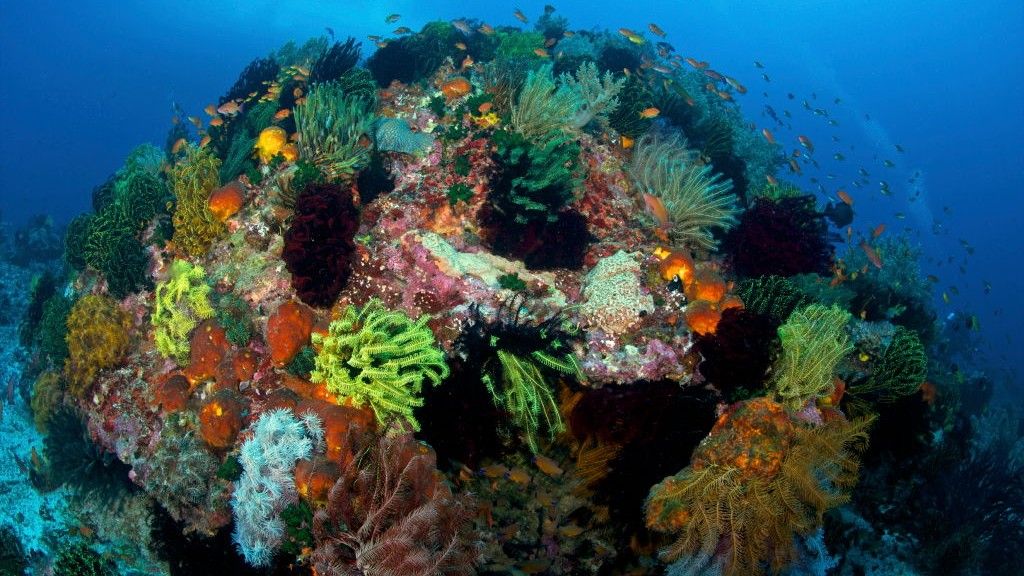
The Coral Triangle is a tropical marine region between the Pacific and Indian oceans where 76% of Earth’s coral species are found. It encompasses 2.3 million square miles (6 million square kilometers) of ocean around the Philippines, Indonesia and Papua New Guinea, and stretches south to Timor-Leste and as far east as the Solomon Islands.

Biodiversity in the Coral Triangle is much higher than in other regions with coral reefs, such as the Caribbean Sea and the southwest Pacific Ocean. Around 605 reef-building coral species inhabit the Coral Triangle — 10 times the number in the Caribbean Sea, according to an article from the U.K.’s Natural History Museum (NHM).

These corals provide a home for six of the world’s seven sea turtle species and 37% of the world’s coral reef fish species, as well as marine mammals like dolphins, dugongs, blue whales and sperm whales, according to the NHM article. This incredible array of species has earned the Coral Triangle the nickname the “Amazon of the sea.”

“This part of the world contains the highest diversity of marine species,” Nadia Santodomingo, a coral expert and marine biologist at the NHM, said in the article. “Scientists have been trying to understand why it’s so diverse for a very long time.” In fact, British naturalist and explorer Alfred Russel Wallace was working there when Charles Darwin was alive, trying to solve the same problem, she added.

Wallace traveled through the Malay Archipelago between mainland Southeast Asia and Australia, collecting specimens and developing theories regarding the region’s staggering biodiversity. He came up with what scientists call the “Wallace Line” — a gigantic biological boundary that separates the Oriental and Australian faunal regions — and proposed the theory of evolution by natural selection around the same time as Darwin.

Scientists today have more tools at their disposal to understand the region, with evidence suggesting that murkier conditions in the Coral Triangle compared with other shallow tropical waters may provide a haven for different species. The Coral Triangle has been a biodiversity hotspot for at least the past 20 million years, and this is partly thanks to a huge variety of habitat types and optimal conditions for larvae that ride on ocean currents, according to the nongovernmental organization Blue Corner Marine Research.

Research also suggests that the Coral Triangle has a plethora of species simply because diversity built up over time. Unlike temperate and polar marine regions that have undergone glaciations, tropical regions like the Coral Triangle have remained relatively stable. And what sets this region apart from other tropical seas is its unique, platform-like geology and location at the intersection between two oceans, researchers say.

A map of the Coral Triangle.

The Coral Triangle is located between the Pacific and Indian oceans. (Image credit: Main_sail/Getty Images)

Like other coral reef regions, the Coral Triangle is vulnerable to overfishing, pollution from coastal development, and ocean acidification linked to climate change — although scientists think its murky conditions may shield it somewhat.

“Corals living under continuous sediment stress seem to be more resilient, as the mud may block light, which in turn alleviates bleaching stress induced by high temperatures,” Kenneth Johnson, a paleobiologist and principal researcher at the NHM, said in the article.

Nevertheless, it’s important to protect this patch of ocean, Johnson said. “Nobody really thinks about these reefs,” he said, “but they might be the ones we really want to protect.”


Discover more incredible places, where we highlight the fantastic history and science behind some of the most dramatic landscapes on Earth.

Source link

Share. Facebook Twitter Pinterest LinkedIn Tumblr Email
Previous ArticleTop Dem candidate excoriated as ‘pathetic’ for not revoking endorsement of Jay Jones
Next Article Israeli hospital prepares for the arrival of hostages
Editor
  • Website

Related Posts

Lifestyle

Once-in-a-century ‘super’ El Niño in the cards as ocean temperatures reach near record highs in April

May 12, 2026
Lifestyle

Goodbye PCOS: Polycystic ovary syndrome is getting a new name that doctors say better reflects the underlying disease

May 12, 2026
Lifestyle

Microplastics absorb heat in the atmosphere and contribute to global warming — as if they weren’t bad enough

May 12, 2026
Add A Comment

Comments are closed.

Categories
  • Entertainment
  • Lifestyle
  • News
  • Sports
  • Tech
  • Travel
Recent Posts
  • Once-in-a-century ‘super’ El Niño in the cards as ocean temperatures reach near record highs in April
  • Goodbye PCOS: Polycystic ovary syndrome is getting a new name that doctors say better reflects the underlying disease
  • Microplastics absorb heat in the atmosphere and contribute to global warming — as if they weren’t bad enough
  • ‘Insect apocalypse’ is already fueling malnutrition in some regions, first-of-its-kind study reveals
  • Hantavirus LIVE: American passengers from cruise head to specialized facilities in Nebraska
calendar
May 2026
M T W T F S S
 123
45678910
11121314151617
18192021222324
25262728293031
« Apr    
Recent Posts
  • Once-in-a-century ‘super’ El Niño in the cards as ocean temperatures reach near record highs in April
  • Goodbye PCOS: Polycystic ovary syndrome is getting a new name that doctors say better reflects the underlying disease
  • Microplastics absorb heat in the atmosphere and contribute to global warming — as if they weren’t bad enough
About

Welcome to Baynard Media, your trusted source for a diverse range of news and insights. We are committed to delivering timely, reliable, and thought-provoking content that keeps you informed
and inspired

Categories
  • Entertainment
  • Lifestyle
  • News
  • Sports
  • Tech
  • Travel
Facebook X (Twitter) Pinterest WhatsApp
  • Contact Us
  • About Us
  • Privacy Policy
  • Disclaimer
  • UNSUBSCRIBE
© 2026 copyrights reserved

Type above and press Enter to search. Press Esc to cancel.