Close Menu
  • Home
  • UNSUBSCRIBE
  • News
  • Lifestyle
  • Tech
  • Entertainment
  • Sports
  • Travel
Facebook X (Twitter) WhatsApp
Trending
  • Some fungi can influence the weather ‪—‬ and now we know how they do it
  • Neanderthals’ brains weren’t to blame for their demise, new study suggests
  • NASA Curiosity rover uncovers rock with 7 new organic molecules on Mars
  • Mystery of golden orb found in depths of ocean off Alaska finally solved: ‘Everyone was like, What the heck? What is that?’
  • How everything you do is being monitored in an AI-fuelled ‘surveillance capitalism system’ that’s ramping up aggressively
  • Amazfit Active 3 Premium review: A wallet- and beginner-friendly running watch
  • Miniature camelid effigy: A silver llama with a wry smile that the Inca crafted 600 years ago
  • Antarctica’s sea ice suddenly started shrinking a decade ago — and deep-diving robots are revealing why
Facebook X (Twitter) WhatsApp
Baynard Media
  • Home
  • UNSUBSCRIBE
  • News
  • Lifestyle
  • Tech
  • Entertainment
  • Sports
  • Travel
Baynard Media
Home»Lifestyle»Bite marks reveal giant terror birds were potentially prey for another apex predator — humongous caiman
Lifestyle

Bite marks reveal giant terror birds were potentially prey for another apex predator — humongous caiman

EditorBy EditorJuly 23, 2025No Comments3 Mins Read
Share Facebook Twitter Pinterest LinkedIn Tumblr Reddit Telegram Email
Share
Facebook Twitter LinkedIn Pinterest Email

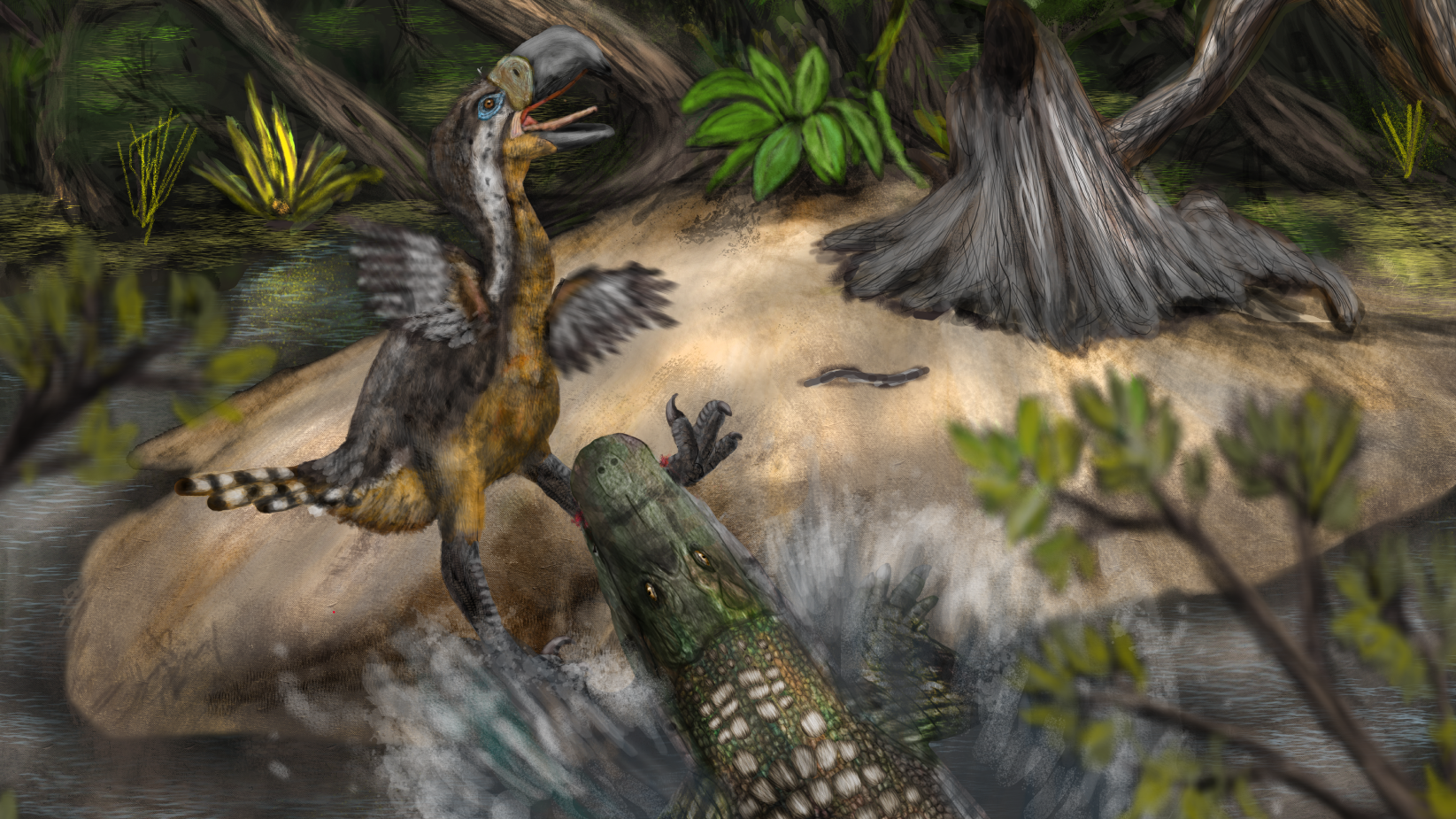
Fossilized bite marks suggest there could have been a dramatic tussle between a gigantic terror bird and an even more massive crocodile around 12 million years ago.

Phorusrhacids, commonly known as “terror birds,” were apex predators that terrorized prey in the ancient ecosystems of South America. While these flightless carnivores had little to fear on land, a new study, published Tuesday (July 22) in the journal Biology Letters, indicates that they weren’t necessarily safe around water.

Researchers analyzed tooth marks on the leg bone of one of the largest terror birds ever discovered — estimated to have stood more than 9 feet (2.7 meters) tall — unearthed at the La Venta fossil site in Colombia. The team concluded that a 15-foot-long (4.7 meter) caiman was likely responsible for the marks.


You may like

“We have learned that terror birds could also be preyed [upon] and that even being an apex predator has risks,” study lead author Andrés Link, a paleontologist and biologist at the University of the Andes in Colombia, told Live Science in an email.

The study doesn’t rule out the possibility that the terror bird simply died near a body of water and was subsequently munched on by the caiman, making it a case of scavenging rather than hunting.

Related: Why giant moa — a bird that once towered over humans — are even harder to de-extinct than dire wolves

Researchers first unveiled the terror bird fossil in a study published last year. The study’s authors said at the time they suspected a crocodilian killed the bird, but they hadn’t yet published an analysis of the four tooth marks found on the bone.

Get the world’s most fascinating discoveries delivered straight to your inbox.

For the new study, the researchers evaluated the bite mark by creating detailed 3D images of the fossil. The bone marks had no signs of healing, while the size and shape of the marks were consistent with those delivered by a caiman that was around 15.1 to 15.8 feet (4.6 to 4.8 m) long, according to the study.

Two 3D models of a caiman skull lining up with tooth marks on a terror bird fossil, beneath illustrations of the terror bird being attacked and scavenged.

3D models of the terror bird fossil and a caiman skull revealed that the bite marks lined up with caiman teeth (presented here in images a and b). Two potential explanations for the bite are predation and scavenging (illustrated here in images c and d). (Image credit: Julian Bayona Becerra/Biology Letters)

The team hypothesized that La Venta’s largest ancient caiman species, Purussaurus neivensis, was behind the bite. However, the individual responsible would have been a subadult, and not yet fully grown. Link told Live Science that P. neivensis could grow up to around 33 feet (10 m) long. “It was a massive animal!” he said.

Without direct evidence of the caiman eating the terror bird, the findings represent an anecdotal account of an aquatic apex predator feeding on a land apex predator during the middle of the Miocene epoch (23 million to 5 million years ago).

“In my opinion this study contributes to understanding the diet of Purussaurus, the landscape of fear near the water bodies [at] La Venta during the middle Miocene and the complex ecological interactions in the protoAmazonian ecosystems of [tropical] South America,” Link said.

Source link

Share. Facebook Twitter Pinterest LinkedIn Tumblr Email
Previous ArticleMan charged for allegedly hiding homemade bombs on NYC subway tracks and rooftops
Next Article Erik Menendez diagnosed with ‘serious medical condition,’ attorney says
Editor
  • Website

Related Posts

Lifestyle

Some fungi can influence the weather ‪—‬ and now we know how they do it

April 28, 2026
Lifestyle

Neanderthals’ brains weren’t to blame for their demise, new study suggests

April 28, 2026
Lifestyle

NASA Curiosity rover uncovers rock with 7 new organic molecules on Mars

April 27, 2026
Add A Comment

Comments are closed.

Categories
  • Entertainment
  • Lifestyle
  • News
  • Sports
  • Tech
  • Travel
Recent Posts
  • Some fungi can influence the weather ‪—‬ and now we know how they do it
  • Neanderthals’ brains weren’t to blame for their demise, new study suggests
  • NASA Curiosity rover uncovers rock with 7 new organic molecules on Mars
  • Mystery of golden orb found in depths of ocean off Alaska finally solved: ‘Everyone was like, What the heck? What is that?’
  • How everything you do is being monitored in an AI-fuelled ‘surveillance capitalism system’ that’s ramping up aggressively
calendar
April 2026
M T W T F S S
 12345
6789101112
13141516171819
20212223242526
27282930  
« Mar    
Recent Posts
  • Some fungi can influence the weather ‪—‬ and now we know how they do it
  • Neanderthals’ brains weren’t to blame for their demise, new study suggests
  • NASA Curiosity rover uncovers rock with 7 new organic molecules on Mars
About

Welcome to Baynard Media, your trusted source for a diverse range of news and insights. We are committed to delivering timely, reliable, and thought-provoking content that keeps you informed
and inspired

Categories
  • Entertainment
  • Lifestyle
  • News
  • Sports
  • Tech
  • Travel
Facebook X (Twitter) Pinterest WhatsApp
  • Contact Us
  • About Us
  • Privacy Policy
  • Disclaimer
  • UNSUBSCRIBE
© 2026 copyrights reserved

Type above and press Enter to search. Press Esc to cancel.