Close Menu
  • Home
  • UNSUBSCRIBE
  • News
  • Lifestyle
  • Tech
  • Entertainment
  • Sports
  • Travel
Facebook X (Twitter) WhatsApp
Trending
  • ‘This was a pioneering achievement’: Stone Age people put up posts to observe the solstices near Stonehenge long before the stones of sacred site were placed
  • ‘It’s a huge deal’: Archaeologists discover second cannonball from the Battle of the Alamo, and it was likely fired by Texans
  • ‘A mixture from zero to infinity’: Physicists split apart a photon — and ended up with an improbable swarm of particles
  • ‘The system is critically stressed’: San Andreas and San Jacinto faults scarily close to major earthquake, study finds
  • Diagnostic dilemma: Viral infection caused woman not to recognize her own father
  • World’s first functioning nuclear clock could unlock new physics
  • ‘Is having two legs useful’ in space?: Astronaut John McFall explains what life in orbit might be like for the first physically disabled person in space
  • Wreck of World War II Japanese ‘hellship’ that sank with more than 1,000 Allied POWs on board discovered off the Philippines
Facebook X (Twitter) WhatsApp
Baynard Media
  • Home
  • UNSUBSCRIBE
  • News
  • Lifestyle
  • Tech
  • Entertainment
  • Sports
  • Travel
Baynard Media
Home»Lifestyle»Gold glitters around Ghana’s ‘lake of souls’ thanks to catastrophic meteor strike — Earth from space
Lifestyle

Gold glitters around Ghana’s ‘lake of souls’ thanks to catastrophic meteor strike — Earth from space

EditorBy EditorMay 26, 2026No Comments4 Mins Read
Share Facebook Twitter Pinterest LinkedIn Tumblr Reddit Telegram Email
Share
Facebook Twitter LinkedIn Pinterest Email

QUICK FACTS

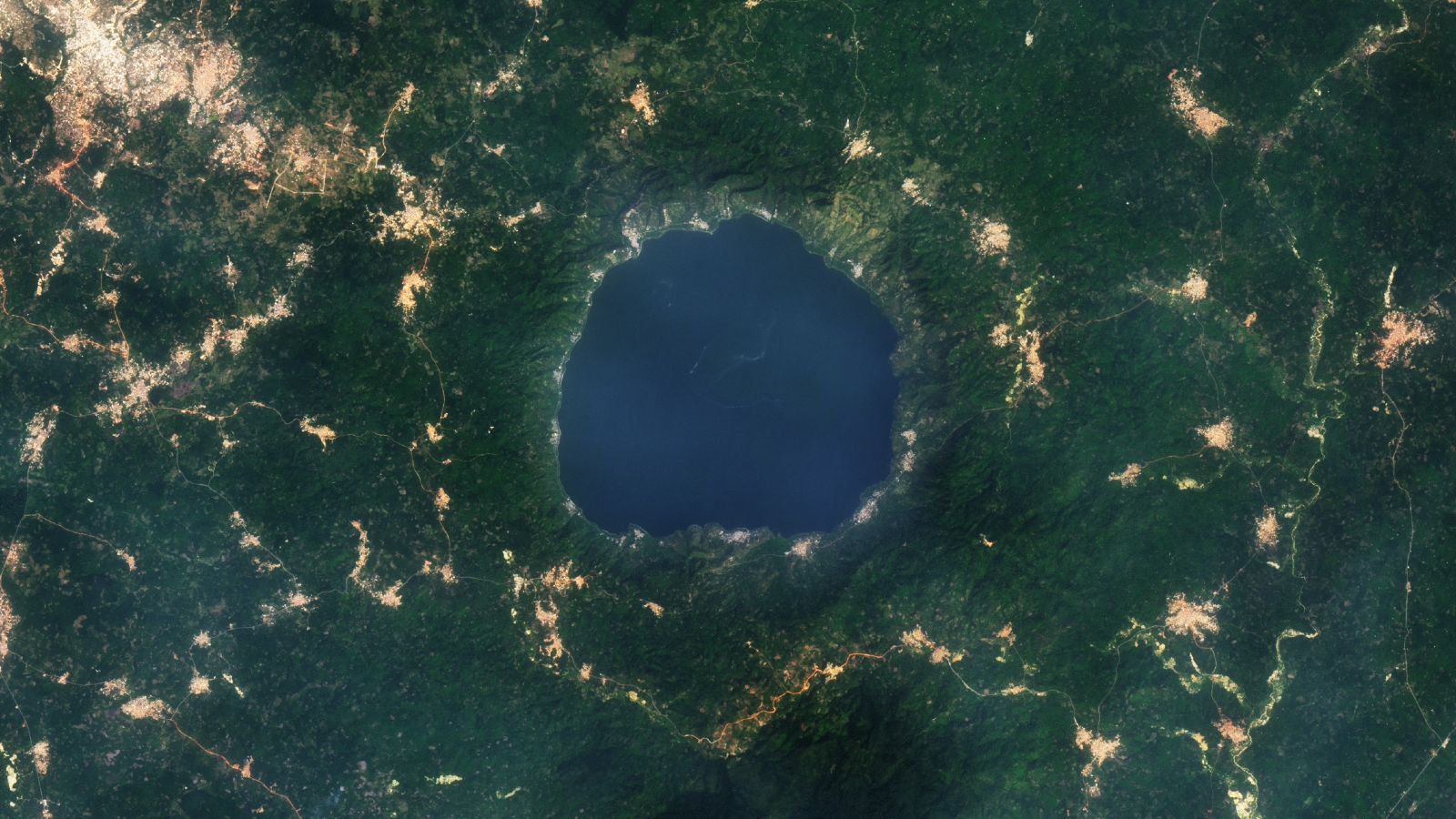
Where is it? Lake Bosumtwi, Ghana [6.498727489, -1.4087398896]

What’s in the photo? Ghana’s only natural lake, surrounded by exposed veins of gold

Which satellite took the photo? Landsat 8

When was it taken? Dec. 29, 2015

This shimmering satellite image shows tendrils of gold surrounding Ghana’s sacred “lake of souls,” which was carved out by a devastating asteroid strike around 1 million years ago.

Lake Bosumtwi (also spelled Bosomtwe) spans 19 square miles (19 square kilometers) ‪—‬ a little smaller than Manhattan ‪—‬ and is located just to the southeast of Ghana’s second-largest city, Kumasi (partially visible in the top left of the photo). The roughly circular body of water, which is up to 240 feet (70 meters) deep, is the country’s only natural lake.

To the Indigenous Asante people, the lake is a sacred site. According to their mythology, a hunter named Akora Bompe chased a wounded antelope into a small magical pond, causing the small body of water to rapidly swell into the lake we see today. It is also considered a “place where souls bid farewell to Earth before entering the afterlife,” according to NASA’s Earth Observatory.


You may like

In reality, the lake actually formed around 1 million years ago, when a roughly 3,300-foot-wide (1 km) meteor slammed into our planet, creating “arguably the best-preserved complex young impact structure known on Earth,” according to the International Commission on Geoheritage.

The catastrophic collision likely triggered “a blinding flash of light and an immense fireball [that] would have incinerated life for dozens of kilometers,” Marian Selorm Sapah, a senior lecturer in the University of Ghana’s Department of Earth Science, told the Earth Observatory. If the same event occurred today, it would likely obliterate the city of Kumasi, she added.

A photo of the lake from a low-flying plane with dark clouds overhead

Lake Bosumtwi is Ghana’s only natural freshwater lake.

(Image credit: International Commission on Geoheritage)

Remote sensing analysis has revealed that the material blasted out of the impact settled in a raised, lobed pattern known as a “rampart” crater. This suggests the area was covered in a layer of groundwater when the collision occurred, according to the Earth Observatory.

Rampart craters are rare on Earth but are more common throughout the solar system, including on Mars, as well as on smaller bodies, such as Ganymede, Dione, Tethys and Charon. As a result, studying Lake Bosumtwi could provide insight into how these extraterrestrial craters formed, Sapah said.

Get the world’s most fascinating discoveries delivered straight to your inbox.

The impact also fractured Earth’s crust and allowed mineral-rich magma to rise to Earth’s surface, forming shallow veins of gold and other valuable elements that have been mined for generations. This activity has resulted in the golden flecks and lines visible in this satellite image.

The rate of gold mining has accelerated in recent years due to advances in technology. Another satellite photo taken in 2024 (see below) shows much more visible gold, which has been exposed by this increased activity. (The lake also appears green in the newer photo due to higher concentrations of phytoplankton in its waters.)

A 2024 satellite photo showing the lake surrounded by even more gold

A more recent satellite photo, captured in 2024, shows that the level of gold mining around Lake Bosumtwi has increased significantly over the last decade.

(Image credit: NASA/Landsat)

“The stark visual evidence of anthropogenic [human-caused] change juxtaposed with a million-year-old geological landmark is striking,” Sapah said.


An astronaut photo showing two stripy blue structures next to a green river in the rusty brown landscape of the Colorado Plateau Bright-blue ‘potash ponds’ in Utah

A 2017 astronaut photo shows two sets of solar evaporation ponds alongside the Colorado River. The stripy structures are used to refine potassium chloride, or “potash,” which is mined nearby.
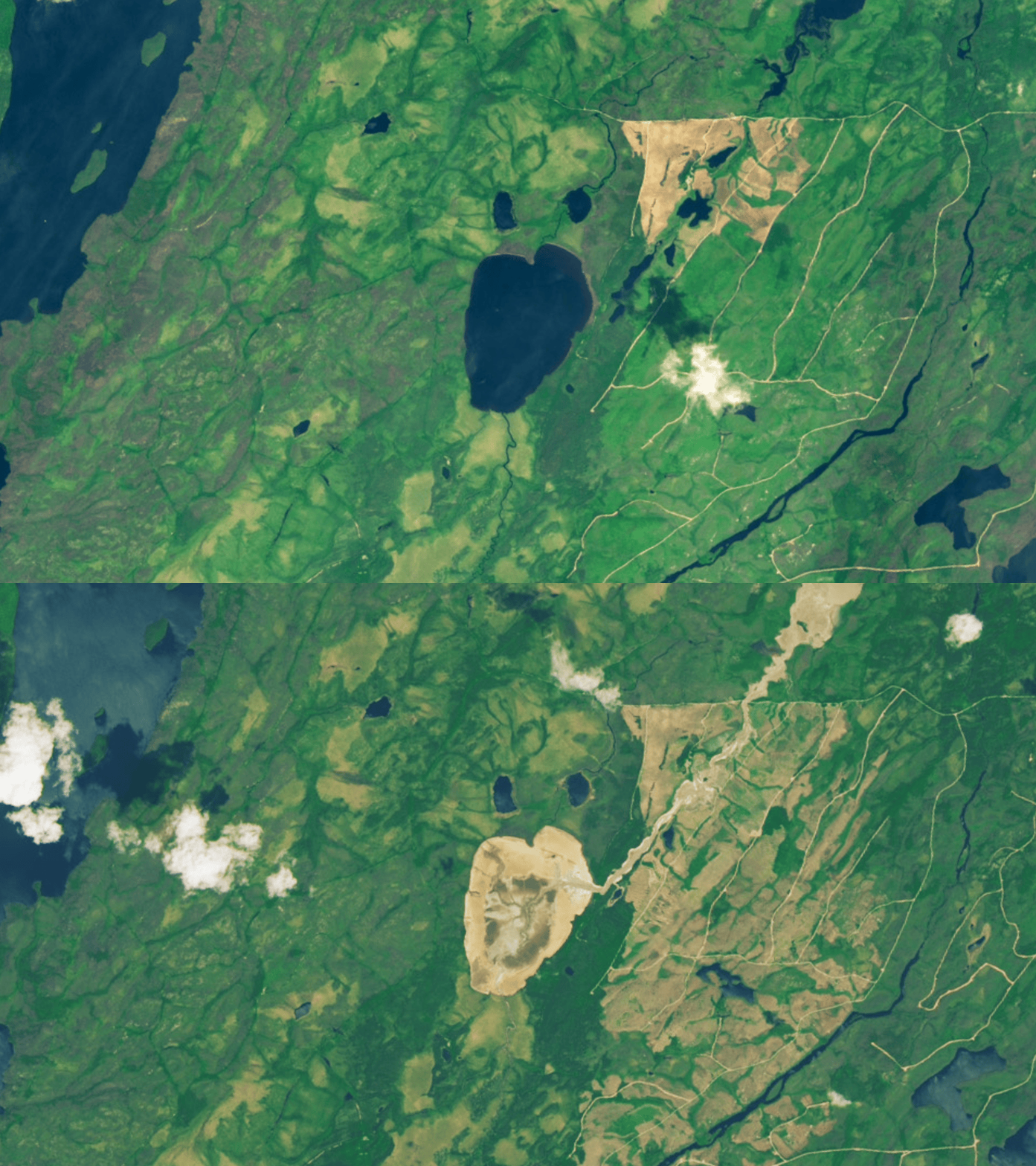
Looped satellite photos showing before and after a face-shaped Canadian lake completely emptiedCanadian ’emoji lake’ disappears

A pair of satellite photos reveals the drastic transformation of Canada’s Lake Rouge, which was fully drained after the sudden collapse of one of its banks. A multitude of factors led to the demise of the shocked-emoji-like lake, experts say.

A satellite photo showing a pair of rivers and a series of colorful lakes surrounding a giant white expanse Africa’s rainbow ‘phantom lakes’

A 2011 astronaut photo shows off a series of colorful mini-lakes that appeared around the edge of a giant salt flat, known as the Etosha Pan, following a major flooding event.


Source link

Share. Facebook Twitter Pinterest LinkedIn Tumblr Email
Previous ArticleDoctors may soon be able to check your red blood cells by filming your eyeball
Next Article Brilliant-green fireball meteor explodes over erupting volcano in the Philippines
Editor
  • Website

Related Posts

Lifestyle

‘This was a pioneering achievement’: Stone Age people put up posts to observe the solstices near Stonehenge long before the stones of sacred site were placed

June 18, 2026
Lifestyle

‘It’s a huge deal’: Archaeologists discover second cannonball from the Battle of the Alamo, and it was likely fired by Texans

June 17, 2026
Lifestyle

‘A mixture from zero to infinity’: Physicists split apart a photon — and ended up with an improbable swarm of particles

June 17, 2026
Add A Comment

Comments are closed.

Categories
  • Entertainment
  • Lifestyle
  • News
  • Sports
  • Tech
  • Travel
Recent Posts
  • ‘This was a pioneering achievement’: Stone Age people put up posts to observe the solstices near Stonehenge long before the stones of sacred site were placed
  • ‘It’s a huge deal’: Archaeologists discover second cannonball from the Battle of the Alamo, and it was likely fired by Texans
  • ‘A mixture from zero to infinity’: Physicists split apart a photon — and ended up with an improbable swarm of particles
  • ‘The system is critically stressed’: San Andreas and San Jacinto faults scarily close to major earthquake, study finds
  • Diagnostic dilemma: Viral infection caused woman not to recognize her own father
calendar
June 2026
M T W T F S S
1234567
891011121314
15161718192021
22232425262728
2930  
« May    
Recent Posts
  • ‘This was a pioneering achievement’: Stone Age people put up posts to observe the solstices near Stonehenge long before the stones of sacred site were placed
  • ‘It’s a huge deal’: Archaeologists discover second cannonball from the Battle of the Alamo, and it was likely fired by Texans
  • ‘A mixture from zero to infinity’: Physicists split apart a photon — and ended up with an improbable swarm of particles
About

Welcome to Baynard Media, your trusted source for a diverse range of news and insights. We are committed to delivering timely, reliable, and thought-provoking content that keeps you informed
and inspired

Categories
  • Entertainment
  • Lifestyle
  • News
  • Sports
  • Tech
  • Travel
Facebook X (Twitter) Pinterest WhatsApp
  • Contact Us
  • About Us
  • Privacy Policy
  • Disclaimer
  • UNSUBSCRIBE
© 2026 copyrights reserved

Type above and press Enter to search. Press Esc to cancel.