Close Menu
  • Home
  • UNSUBSCRIBE
  • News
  • Lifestyle
  • Tech
  • Entertainment
  • Sports
  • Travel
Facebook X (Twitter) WhatsApp
Trending
  • Oldest known plague victims found in a 5,500-year-old burial ground in Siberia — and many of them were children
  • ‘This was a pioneering achievement’: Stone Age people put up posts to observe the solstices near Stonehenge long before the stones of sacred site were placed
  • ‘It’s a huge deal’: Archaeologists discover second cannonball from the Battle of the Alamo, and it was likely fired by Texans
  • ‘A mixture from zero to infinity’: Physicists split apart a photon — and ended up with an improbable swarm of particles
  • ‘The system is critically stressed’: San Andreas and San Jacinto faults scarily close to major earthquake, study finds
  • Diagnostic dilemma: Viral infection caused woman not to recognize her own father
  • World’s first functioning nuclear clock could unlock new physics
  • ‘Is having two legs useful’ in space?: Astronaut John McFall explains what life in orbit might be like for the first physically disabled person in space
Facebook X (Twitter) WhatsApp
Baynard Media
  • Home
  • UNSUBSCRIBE
  • News
  • Lifestyle
  • Tech
  • Entertainment
  • Sports
  • Travel
Baynard Media
Home»Lifestyle»Bead net funerary shroud: A 2,500-year-old beaded veil from Egypt depicting the deceased’s transformation into Osiris
Lifestyle

Bead net funerary shroud: A 2,500-year-old beaded veil from Egypt depicting the deceased’s transformation into Osiris

EditorBy EditorMay 25, 2026No Comments3 Mins Read
Share Facebook Twitter Pinterest LinkedIn Tumblr Reddit Telegram Email
Share
Facebook Twitter LinkedIn Pinterest Email

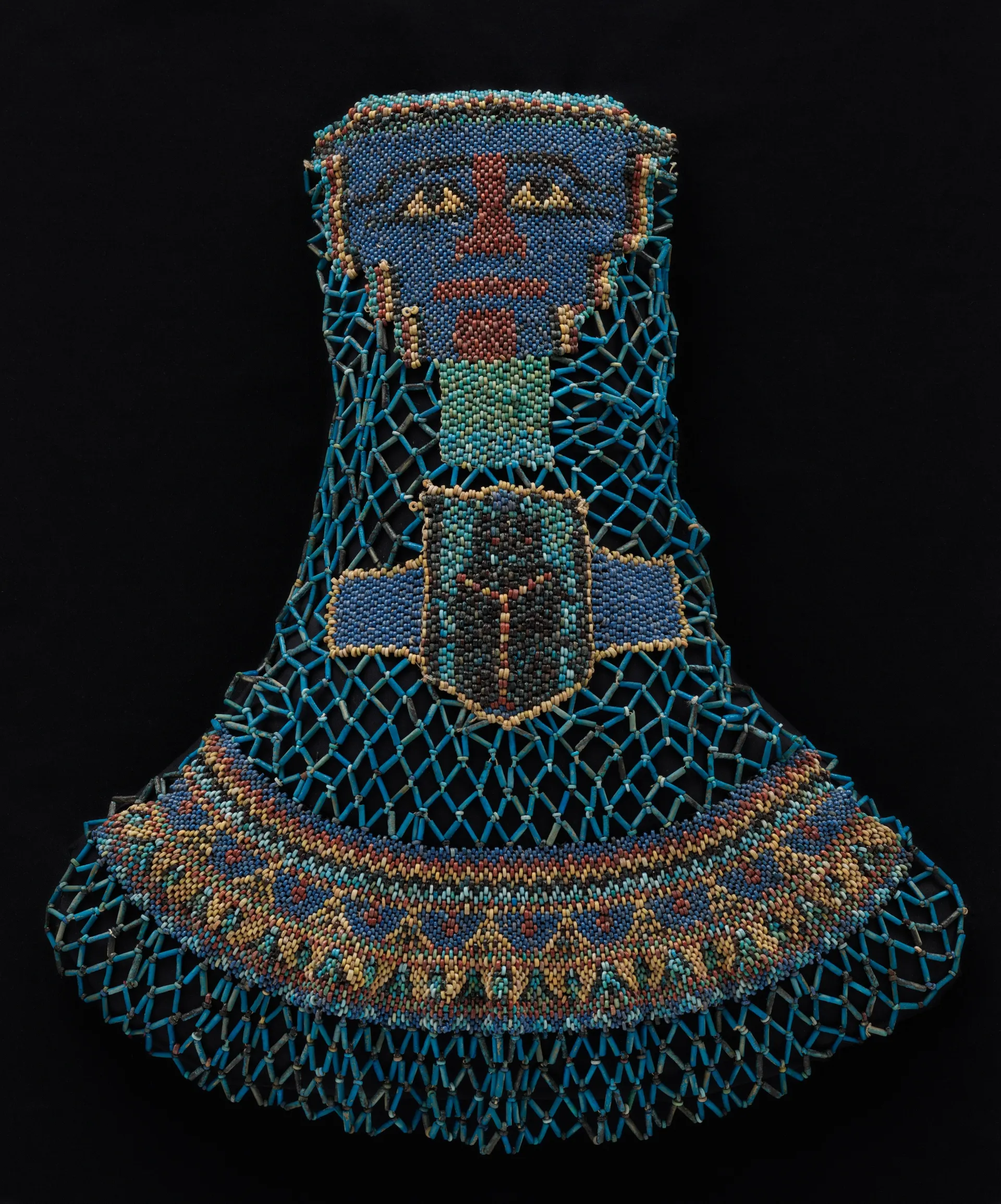
a beaded funeral shroud from ancient Egypt that depicts a person's face and a large scarab beetle

The shroud was made from a net of thousands of colored beads.

(Image credit: Art Institute of Chicago, Gift of Henry H. Getty and Charles L. Hutchinson (CC0, Public Domain))
QUICK FACTS

Name: Bead net funerary shroud

What it is: A veil of multicolored beads

Where it is from: Luxor, Egypt

When it was made: Circa 664 to 525 B.C.

Ancient Egyptians wove impressively detailed nets of colored beads to create funeral shrouds around 2,500 years ago. The popular bead nets were placed on top of mummies wrapped in linen and symbolized the transformation of the deceased into Osiris, the god of fertility and the sovereign of the dead.

This beaded funerary shroud is in the collection of the Art Institute of Chicago (AIC), which purchased it in the late 19th century from Rev. Chauncey Murch, the director of the American Presbyterian Mission at Luxor, who was an avid collector of ancient Egyptian art. The shroud measures 18 inches long and 15.8 inches wide (45.7 by 40 centimeters), meaning it can easily cover a person’s head and upper chest.

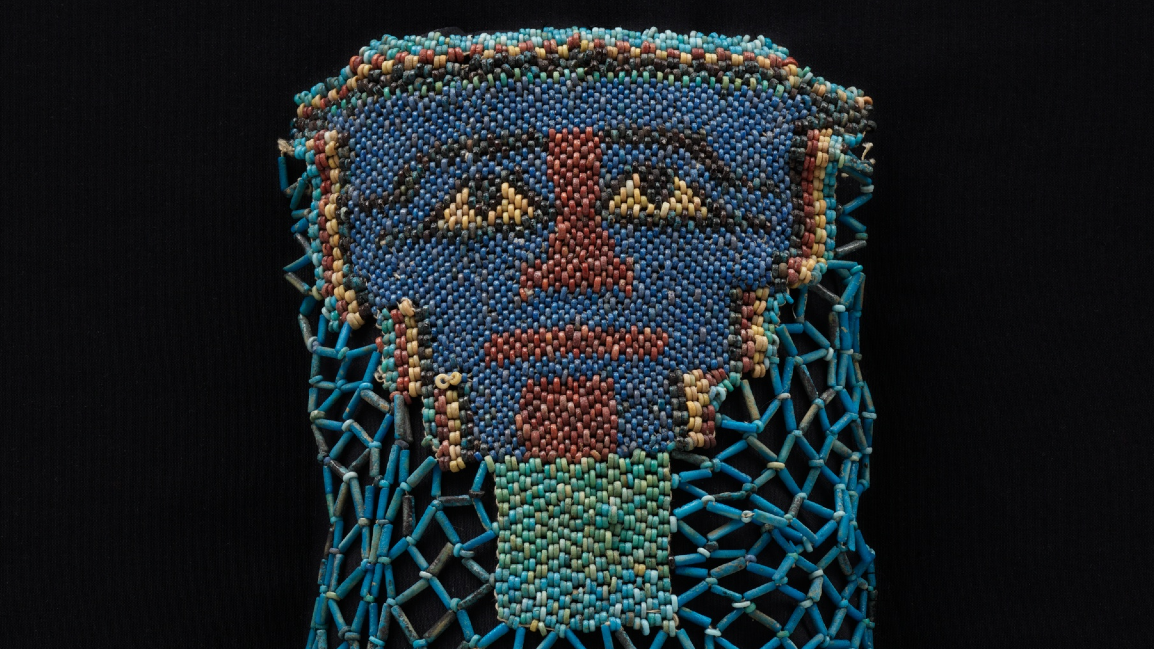
The bead-net shroud has three main components: a human face, a winged scarab and a broad collar, according to Egyptologist Emily Teeter, who published a close analysis of the artifact for the museum.


You may like

The person’s face has been crafted primarily from dark-blue beads, while their facial features and eye makeup are abstractly depicted with black, red and yellow beads. A false beard similar to the famous example on the mask of Tutankhamun has been added in teal beads. The use of numerous blue beads may be a nod to the sky goddess Nut, whose body was sometimes depicted as a series of stars in a field of blue, Teeter wrote.

Just under the face is a winged scarab rendered in multicolored beads. It probably invokes Khepri, a scarab-faced sun god who represented creation and renewal, according to the AIC. While scarab amulets were often added to mummies during the wrapping process, this artwork depicts the scarab in beads on the shroud itself.

Below the scarab is a collar made of dark-blue, red, yellow, black and light-blue beads that create a series of yellow lotus flowers and red floral pendants.

MORE ASTONISHING ARTIFACTS

Bead-net shrouds were typically placed over red linen that covered the wrapped mummy, according to Teeter. The shroud would have been held in place with ties that wrapped around the back.

“Together, the shroud and net imitated the wrappings of Osiris, hence symbolizing the assimilation of the deceased to the god,” Teeter wrote. The goddess Nut also appeared frequently on mummies’ chests. “Just as the arms of Nut encircled the deceased, the bead net enveloped the mummy,” she wrote.

For more stunning archaeological discoveries, check out our Astonishing Artifacts archives.

TOPICS

astonishing artifacts

Source link

Share. Facebook Twitter Pinterest LinkedIn Tumblr Email
Previous ArticleRare genetic disease makes scientists reconsider what the ‘seat of fear’ in the brain really is
Next Article Chinese medical practitioners used extremely toxic plant as a topical anesthetic 600 years ago, study finds
Editor
  • Website

Related Posts

Lifestyle

Oldest known plague victims found in a 5,500-year-old burial ground in Siberia — and many of them were children

June 18, 2026
Lifestyle

‘This was a pioneering achievement’: Stone Age people put up posts to observe the solstices near Stonehenge long before the stones of sacred site were placed

June 18, 2026
Lifestyle

‘It’s a huge deal’: Archaeologists discover second cannonball from the Battle of the Alamo, and it was likely fired by Texans

June 17, 2026
Add A Comment

Comments are closed.

Categories
  • Entertainment
  • Lifestyle
  • News
  • Sports
  • Tech
  • Travel
Recent Posts
  • Oldest known plague victims found in a 5,500-year-old burial ground in Siberia — and many of them were children
  • ‘This was a pioneering achievement’: Stone Age people put up posts to observe the solstices near Stonehenge long before the stones of sacred site were placed
  • ‘It’s a huge deal’: Archaeologists discover second cannonball from the Battle of the Alamo, and it was likely fired by Texans
  • ‘A mixture from zero to infinity’: Physicists split apart a photon — and ended up with an improbable swarm of particles
  • ‘The system is critically stressed’: San Andreas and San Jacinto faults scarily close to major earthquake, study finds
calendar
June 2026
M T W T F S S
1234567
891011121314
15161718192021
22232425262728
2930  
« May    
Recent Posts
  • Oldest known plague victims found in a 5,500-year-old burial ground in Siberia — and many of them were children
  • ‘This was a pioneering achievement’: Stone Age people put up posts to observe the solstices near Stonehenge long before the stones of sacred site were placed
  • ‘It’s a huge deal’: Archaeologists discover second cannonball from the Battle of the Alamo, and it was likely fired by Texans
About

Welcome to Baynard Media, your trusted source for a diverse range of news and insights. We are committed to delivering timely, reliable, and thought-provoking content that keeps you informed
and inspired

Categories
  • Entertainment
  • Lifestyle
  • News
  • Sports
  • Tech
  • Travel
Facebook X (Twitter) Pinterest WhatsApp
  • Contact Us
  • About Us
  • Privacy Policy
  • Disclaimer
  • UNSUBSCRIBE
© 2026 copyrights reserved

Type above and press Enter to search. Press Esc to cancel.