
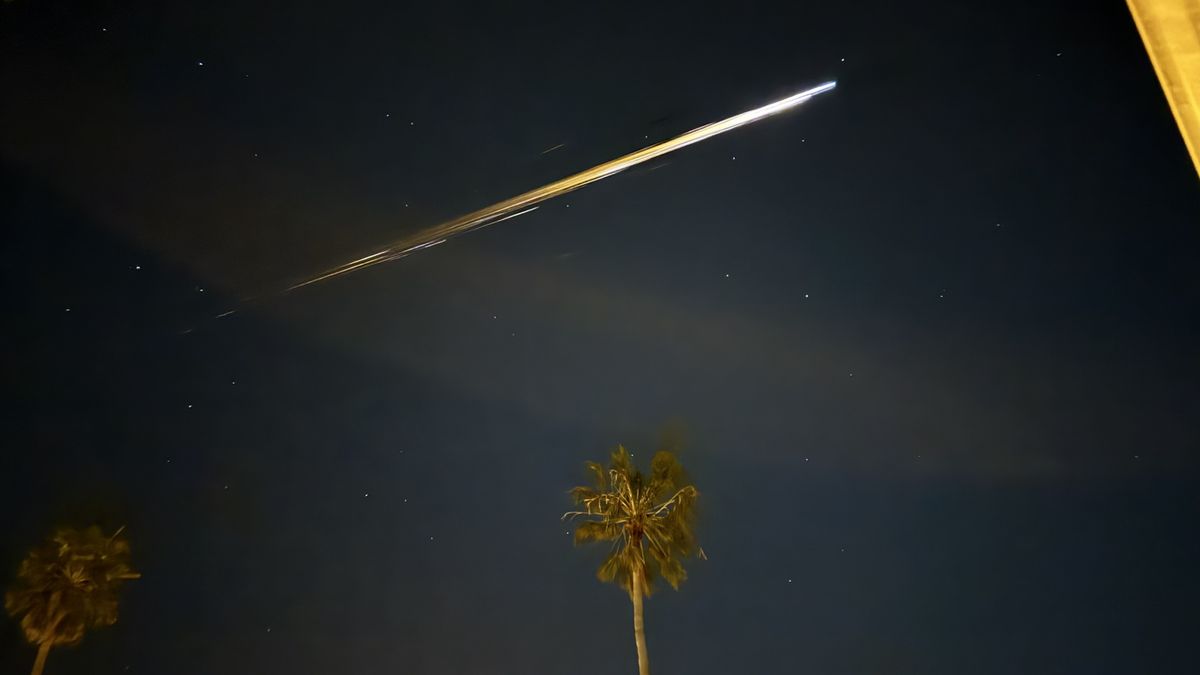
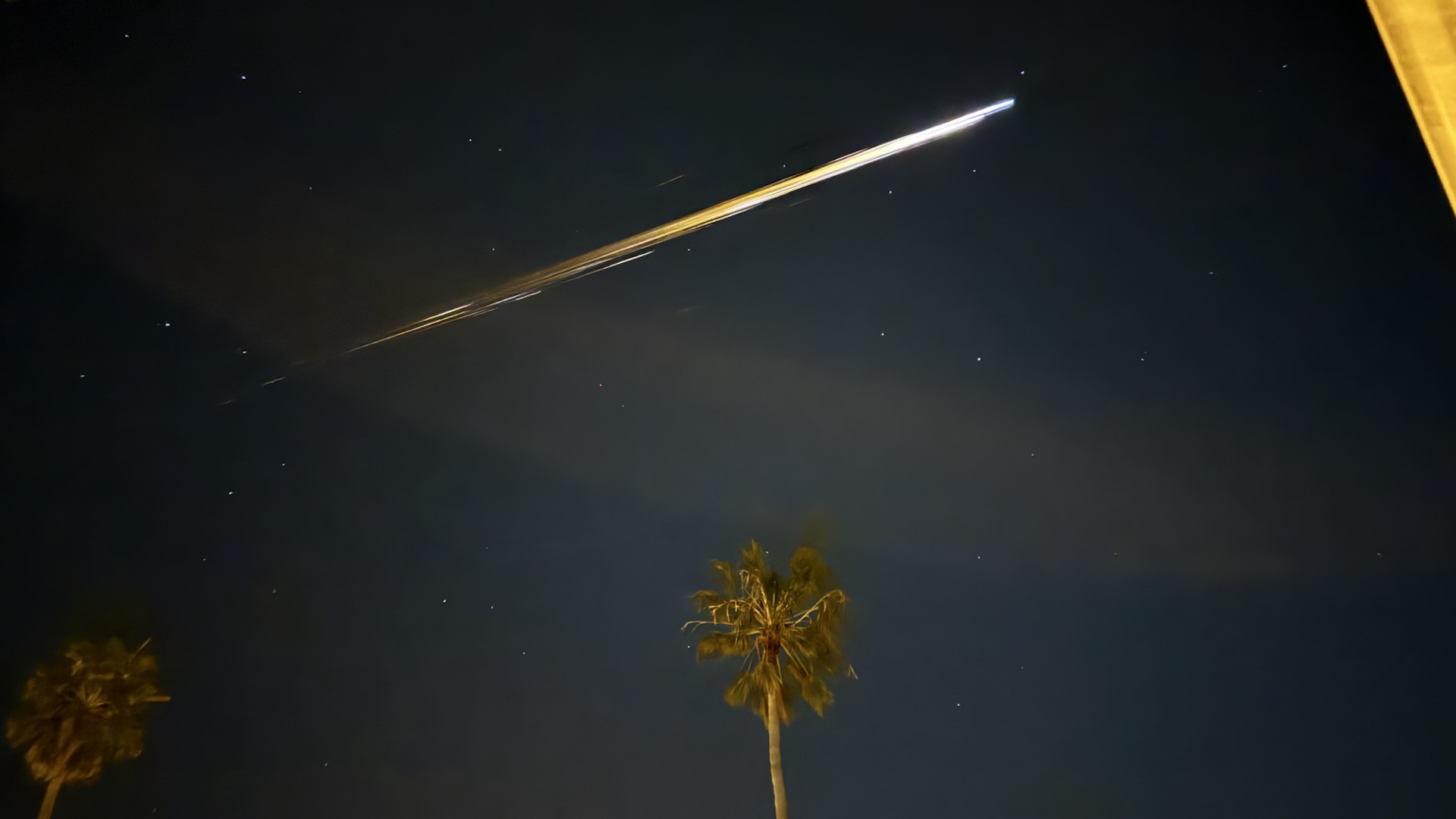
On 2 April, a shower of fireballs lit up the night sky over Los Angeles and much of central and Southern California. Onlookers wondered whether they were witnessing a meteor, a failed rocket launch, or even a UFO.
Astronomers later confirmed that the fireballs were space debris from the orbital module of a Chinese spacecraft called Shenzhou-15, first launched in November 2022. The spacecraft’s uncontrolled reentry sparked international complaints about the dangers of space junk plunging to Earth, but the event also inspired a new way for seismologists to use ground signals to track the fate of such debris.
Sonic booms were picked up by seismometers stationed throughout the Los Angeles basin. Now, a team has reconstructed the spacecraft’s trajectory through the atmosphere from those seismic records. This new technique could help researchers detect incoming space debris around the globe, even without visual observations.
“I’m not aware of work that’s been done to try to track and characterize space debris using seismic measurements,” said planetary scientist Benjamin Fernando of Johns Hopkins University in Baltimore, the study’s lead author. Fernando and his colleagues described their work on 9 December at AGU’s Annual Meeting 2024 in Washington, D.C.
Related: Space junk: How broken satellites are creating a garbage crisis in the sky
The growing hazards of space debris
Until recently, out-of-control space debris was a rare phenomenon. “Increasing space missions have led to larger and more spaceships being launched that subsequently deorbit,” Fernando said. “Pieces of that debris plummet back to Earth, posing a risk to people’s lives and properties.”
Fernando became interested in the 2 April event after he found out that people in Los Angeles had heard the debris as it flamed high overhead. He speculated that if humans could hear it, supersensitive seismometers must have picked up signals, too.
“While cameras and radars are good instruments to track space debris, they are scarce in unpopulated areas,” he said. “Seismometers are better at picking up minute signals from vibrations, especially for such a promising event that produced sonic booms.”
Fernando and his colleagues downloaded the seismic data recorded that night from stations across the Los Angeles basin and found similar sets of seismic signals moving inland from the Pacific coast. Then, they spent months parsing the data to track the trajectory of the debris, its speed, its size, and the populations it crossed over before breaking up.
Fernando was involved last year with a planned effort to track an incoming human-made object through Earth’s atmosphere: a capsule carrying samples from the asteroid Bennu, part of NASA’s Origins, Spectral Interpretation, Resource Identification, and Security–Regolith Explorer (OSIRIS-REx) mission. Seismometers and other equipment tracked the capsule’s blazing trajectory and hypersonic booms over the Utah desert in September 2023. Fernando noted that the Shenzhou-15 reentry marks one of the first times seismologists have used ground stations to track space debris with no warning.
This method could expose other incoming objects over less populated areas, he said, as long as enough seismic stations pick up the atmospheric signals. The researchers could similarly track an object’s speed and trajectory and maybe determine its size and how it broke up, Fernando noted.
If applied quickly to fireball events, the technique could possibly help scientists predict whether debris might hit a populated region once it has entered Earth’s atmosphere, Fernando added: “It isn’t outside of the realm of possibility, but it is quite challenging — particularly with this event, because of the complicated terrain of L.A.”
The challenges of a moving target
The new approach is a novel use of seismic data, said Kathleen McKee, a volcano geophysicist at Vanderbilt University in Nashville, Tenn. McKee uses seismic waves to track magma and gas movements below Earth’s surface.
Mitigating public safety hazards from objects reentering Earth’s atmosphere is an important goal, McKee noted, but it’s not without barriers. “The challenge is that the object is moving in three dimensions, through an atmosphere that is changing constantly, affecting how sound propagates through it,” she said, adding that changing winds and weather conditions might affect how precisely scientists could pinpoint a likely crash location of space debris.
Nevertheless, it’s a valuable challenge in applied research, she said. “It is a hard problem to solve, but definitely one worth pursuing.”
This article was originally published on Eos.org. Read the original article.
