Close Menu
  • Home
  • UNSUBSCRIBE
  • News
  • Lifestyle
  • Tech
  • Entertainment
  • Sports
  • Travel
Facebook X (Twitter) WhatsApp
Trending
  • Google wants to release 64 million bacteria-riddled mosquitoes across California and Florida. Here’s why scientists are enthusiastic.
  • ‘In an unrecoverable state’: NASA confirms MAVEN spacecraft is officially dead after loss of signal behind Mars
  • 2 rivers merged to form the Euphrates 3.6 million years ago, eventually leading to the Fertile Crescent
  • NASA confirms fireball meteor exploded over northeastern US with force of 230 tons of TNT
  • Astronauts could use lightning-like plasma jets to kill germs on the moon and Mars, demo hints
  • First whole-genome sequence of a Greenland shark holds clues to their extreme longevity
  • Heading a soccer ball just once is enough to raise levels of proteins associated with brain damage
  • OpenAI’s internal AI model just solved an 80-year-old math problem ‪—‬ and mathematicians verified it
Facebook X (Twitter) WhatsApp
Baynard Media
  • Home
  • UNSUBSCRIBE
  • News
  • Lifestyle
  • Tech
  • Entertainment
  • Sports
  • Travel
Baynard Media
Home»Lifestyle»World’s tiniest cat was a palm-sized tiddler that lived in China 300,000 years ago
Lifestyle

World’s tiniest cat was a palm-sized tiddler that lived in China 300,000 years ago

EditorBy EditorJanuary 15, 2025No Comments4 Mins Read
Share Facebook Twitter Pinterest LinkedIn Tumblr Reddit Telegram Email
Share
Facebook Twitter LinkedIn Pinterest Email

Researchers in China have found the remains of a cat that was so small it could have nestled in the palm of your hand. The fossils were discovered deep within a cave where early humans lived.

The pocket-size feline is a newfound species, Prionailurus kurteni, which the scientists described in a study published Nov. 19, 2024 in the journal Annales Zoologici Fennici. The researchers believe that the extinct animal, which could date as far back as 300,000 years, may be the smallest cat ever found.

The newly identified species is part of the leopard cat genus Prionailurus, a family of wild cats that still exists today in South Asia. While most modern-day leopard cats are closer in size to domestic cats — which reach average lengths of 28 inches (70 centimeters) and weigh at least 4.4 pounds (2 kilograms) — the new species was more diminutive.

“This cat is clearly smaller than a domestic cat. It is comparable to the smallest living cat, [at around] 1 kilogram [2.2 pounds],” lead author Qigao Jiangzuo, a researcher at the Chinese Academy of Sciences Institute of Vertebrate Paleontology and Paleoanthropology, told Live Science.

Related: 35,000-year-old saber-toothed kitten with preserved whiskers pulled from permafrost in Siberia

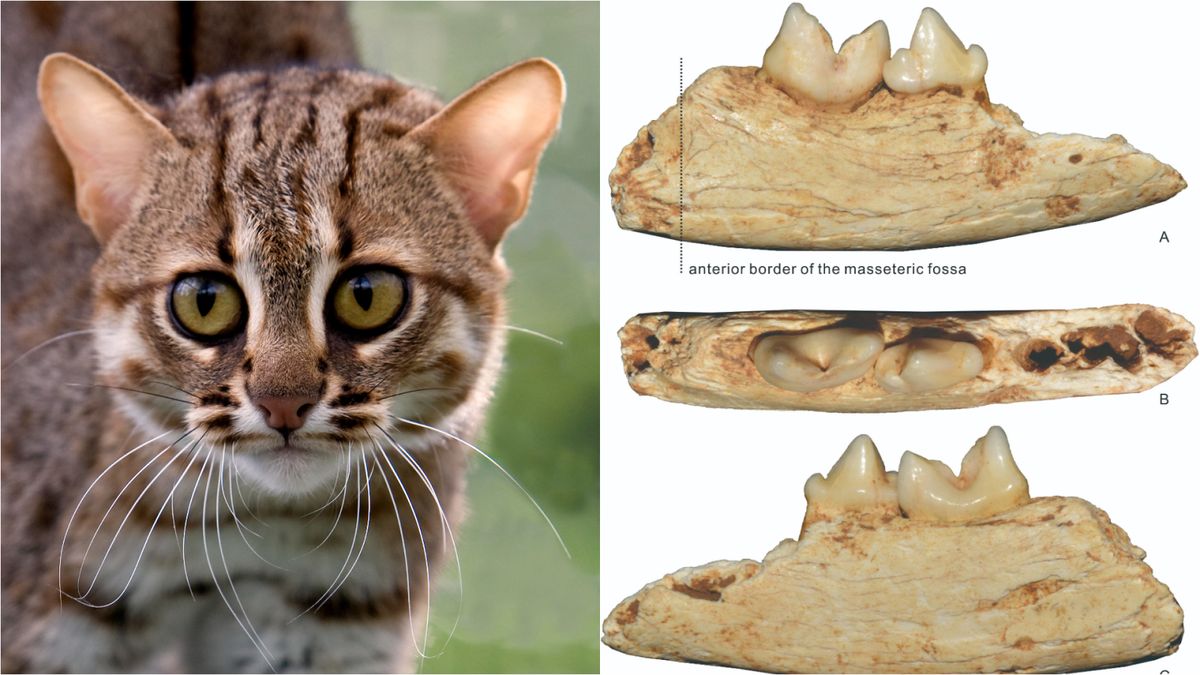
Today, the smallest living wild cat species are the black-footed cat (Felis nigripes) and the rusty-spotted cat (Prionailurus rubiginosus), which are about 13.7 to 20.4 inches (35 to 52 cm) and 13.7 to 18.9 inches (35 to 48 cm) long respectively. Based on the newfound species’ fossilized remains, the researchers estimated that the extinct feline was roughly the same size, or possibly smaller, than both the modern-day species, estimating that it measured between 13.7 and 19.7 inches (50 cm), Jiangzuo said.

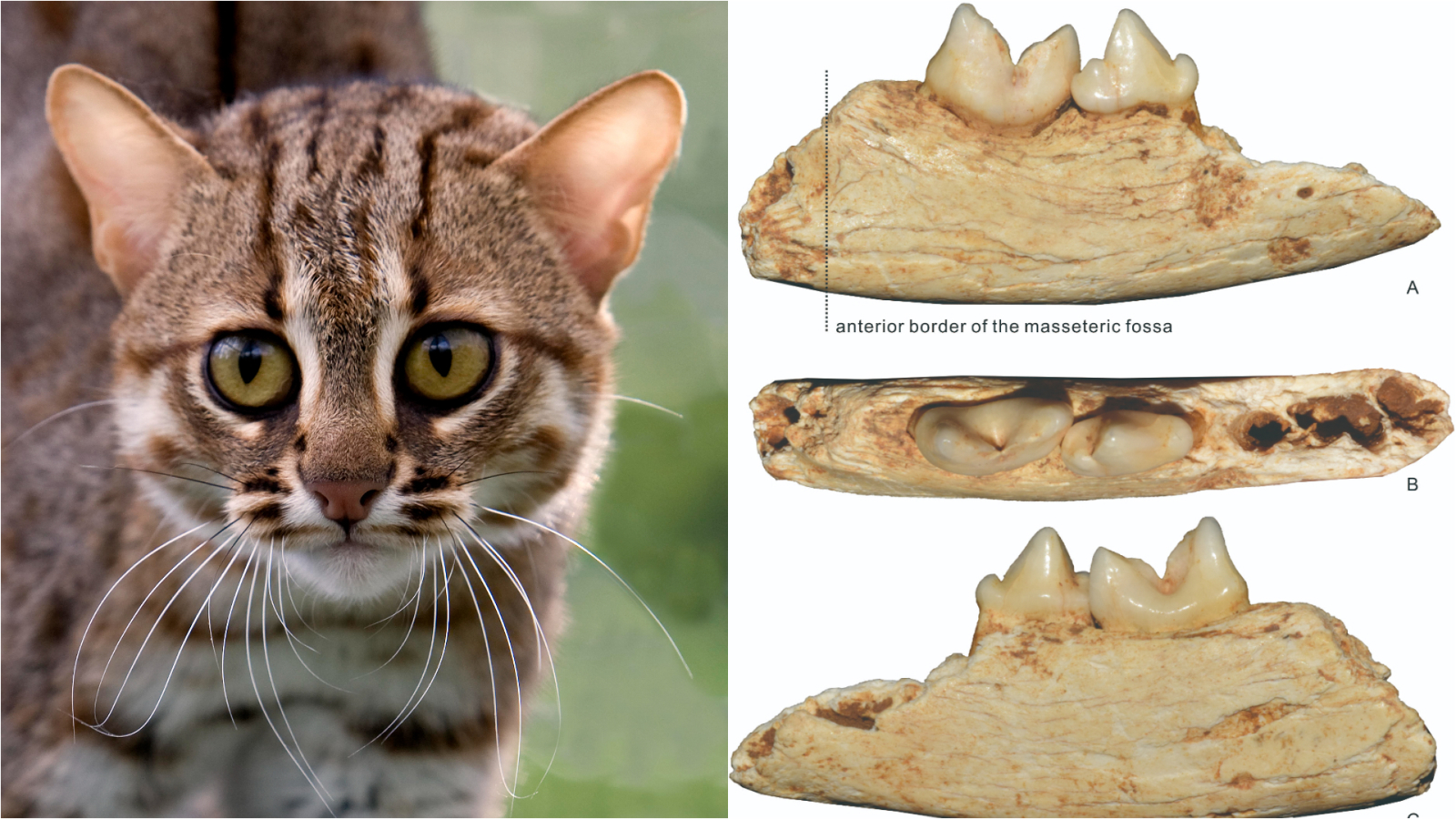
Clues to the life and size of this miniature feline came from a single, fossilized fragment of its lower jawbone, complete with two teeth, which was discovered in a palaeontological hotspot in eastern China called Hualongdong Cave.

Get the world’s most fascinating discoveries delivered straight to your inbox.

“Cats are common elements in the Quaternary [the geological period that spans from 2.58 million years ago until today] deposit of caves. However, finding such a small cat is a surprise,” Jiangzuo said.

Fossilized remains of leopard cat ancestors are rare, because these animals tend to live in unsheltered forest environments where their bones degrade more quickly, meaning few prehistoric specimens have survived. But in the protective environment of the cave, the bones of the recently discovered specimen were preserved, giving the researchers a unique opportunity to examine them.

The prehistoric leopard cat may have wandered into the cave in pursuit of rats and mice that may have been feeding on food scraps left behind by early human inhabitants that once lived in Hualongdong Cave, the researchers told the South China Morning Post.

The inclined angle of one of the mini cat’s teeth also connects the prehistoric leopard cat to the common ancestor of domestic cats and a species called the Pallas’s cat (Otocolobus manul). While it was already known that leopard cats share heritage with these other species, the Hualongdong Cave findings provide the first fossil evidence of that link.

According to the study, the leopard cat family is the most diverse cat genus in the southern and southeastern forests of Asia, with five living species spread across the region. The cave specimen adds valuable detail to this family history: “The new species for the first time reveals the past diversity of this genus,” Jianghuo said.

This has given the researchers new data with which to investigate the origins of all cats, he added. “We plan to systematically survey the fossil cats in China and around the world, which were not well studied in the past. We hope to trace the origins and past diversity of the cat family.”

Source link

Share. Facebook Twitter Pinterest LinkedIn Tumblr Email
Previous ArticleSam Darnold led the Vikings to their best record in years. But two bad games may have cost him his job — and millions
Next Article Rory McIlroy wins Seve Ballesteros Award and voted DP World Tour Player of the Year for 2024 Race to Dubai season | Golf News
Editor
  • Website

Related Posts

Lifestyle

Google wants to release 64 million bacteria-riddled mosquitoes across California and Florida. Here’s why scientists are enthusiastic.

June 3, 2026
Lifestyle

‘In an unrecoverable state’: NASA confirms MAVEN spacecraft is officially dead after loss of signal behind Mars

June 3, 2026
Lifestyle

2 rivers merged to form the Euphrates 3.6 million years ago, eventually leading to the Fertile Crescent

June 2, 2026
Add A Comment

Comments are closed.

Categories
  • Entertainment
  • Lifestyle
  • News
  • Sports
  • Tech
  • Travel
Recent Posts
  • Google wants to release 64 million bacteria-riddled mosquitoes across California and Florida. Here’s why scientists are enthusiastic.
  • ‘In an unrecoverable state’: NASA confirms MAVEN spacecraft is officially dead after loss of signal behind Mars
  • 2 rivers merged to form the Euphrates 3.6 million years ago, eventually leading to the Fertile Crescent
  • NASA confirms fireball meteor exploded over northeastern US with force of 230 tons of TNT
  • Astronauts could use lightning-like plasma jets to kill germs on the moon and Mars, demo hints
calendar
June 2026
M T W T F S S
1234567
891011121314
15161718192021
22232425262728
2930  
« May    
Recent Posts
  • Google wants to release 64 million bacteria-riddled mosquitoes across California and Florida. Here’s why scientists are enthusiastic.
  • ‘In an unrecoverable state’: NASA confirms MAVEN spacecraft is officially dead after loss of signal behind Mars
  • 2 rivers merged to form the Euphrates 3.6 million years ago, eventually leading to the Fertile Crescent
About

Welcome to Baynard Media, your trusted source for a diverse range of news and insights. We are committed to delivering timely, reliable, and thought-provoking content that keeps you informed
and inspired

Categories
  • Entertainment
  • Lifestyle
  • News
  • Sports
  • Tech
  • Travel
Facebook X (Twitter) Pinterest WhatsApp
  • Contact Us
  • About Us
  • Privacy Policy
  • Disclaimer
  • UNSUBSCRIBE
© 2026 copyrights reserved

Type above and press Enter to search. Press Esc to cancel.