Close Menu
  • Home
  • UNSUBSCRIBE
  • News
  • Lifestyle
  • Tech
  • Entertainment
  • Sports
  • Travel
Facebook X (Twitter) WhatsApp
Trending
  • Florida is facing its most intense drought in 15 years. Here’s how it got so bad and how long it will last.
  • New blood test aims to spot liver scarring when it’s still reversible and before it paves the way to cancer
  • ‘We’re the best servants anyone could dream of!’: AI superintelligence has no need to enslave humans because we’re already bowing to it
  • Glowing ring of plankton surrounding New Zealand islands linked to deadly underwater plateau — Earth from space
  • Omar files new financial form in response to Trump, GOP critics
  • New study confirms lobsters feel pain, driving scientists to call for a ban on boiling them alive
  • Ex-CENTCOM commanderwarns against ‘risky’ US ground op to seize Iran uranium
  • Santa Ana’s Upcoming Report on Police Firing on ICE Protesters Lacks Details
Facebook X (Twitter) WhatsApp
Baynard Media
  • Home
  • UNSUBSCRIBE
  • News
  • Lifestyle
  • Tech
  • Entertainment
  • Sports
  • Travel
Baynard Media
Home»Lifestyle»Why modern humans have smaller faces than Neanderthals and chimpanzees
Lifestyle

Why modern humans have smaller faces than Neanderthals and chimpanzees

EditorBy EditorMarch 27, 2025No Comments3 Mins Read
Share Facebook Twitter Pinterest LinkedIn Tumblr Reddit Telegram Email
Share
Facebook Twitter LinkedIn Pinterest Email

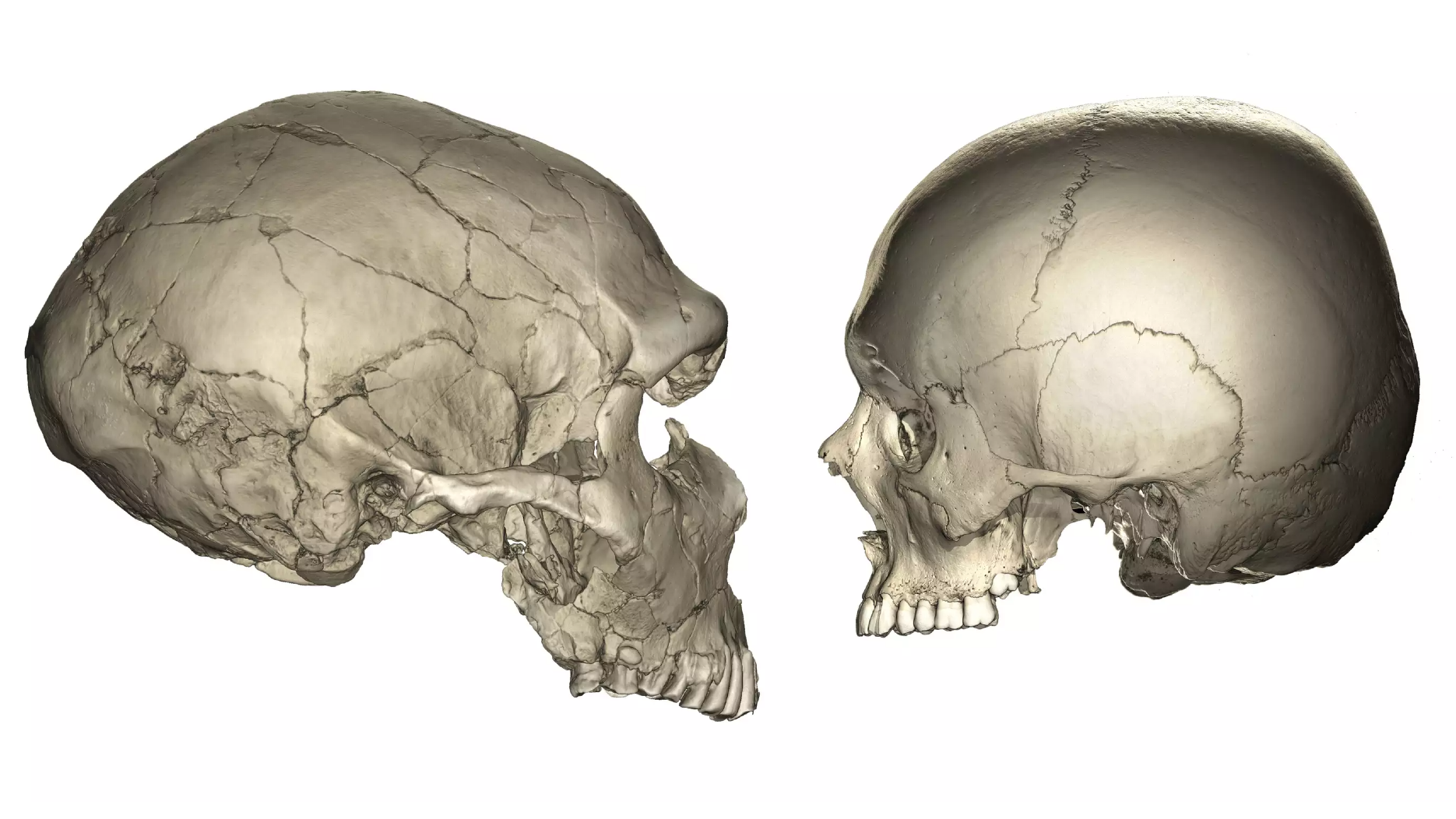
Modern humans have uniquely small and flat faces, especially compared with our Neanderthal cousins’ notoriously robust faces and large noses, but the reason for this difference has eluded paleoanthropologists. Now, researchers have determined that human faces grow slowly and stop growing during early adolescence, whereas Neanderthals’ faces kept growing into early adulthood.

“These two human species followed different developmental trajectories for their facial bones,” Alexandra Schuh, a postdoctoral researcher at the Max Planck Institute for Evolutionary Anthropology in Germany, told Live Science.

In a study published Monday (March 24) in the Journal of Human Evolution, Schuh and colleagues analyzed the midface region of 174 skulls of Homo sapiens, Neanderthals and chimpanzees. By including skulls from individuals throughout childhood and into adulthood, the researchers were able to investigate facial ontogeny — how the facial bones of the skull develop and grow.

The researchers used two techniques to closely examine the skulls. First, they created virtual 3D models of the skulls and digitized over 200 landmarks on the upper jawbone to look at patterns of growth and development. Then, they undertook microscopic analysis to look for bone formation and bone resorption, a normal process in bone remodeling that helps the tissue retain its structure and strength.

Related: 28,000-year-old Neanderthal-and-human ‘Lapedo child’ lived tens of thousands of years after our closest relatives went extinct

“We found that bone formation is predominant in Neanderthals — from birth on — who develop larger and more projecting faces,” Schuh said. “In contrast, present-day humans exhibit significantly higher levels of bone resorption.”

The new research showed that both chimpanzees and Neanderthals had larger, faster-growing faces, while modern humans have smaller faces that stop growing sometime during adolescence.

Get the world’s most fascinating discoveries delivered straight to your inbox.

“Earlier growth cessation is a distinctive feature of our species,” Schuh said. “We have identified a unique developmental pattern seen exclusively in Homo sapiens.”

Experts have put forth numerous explanations for why Neanderthals had such large faces and noses, including adaptation to a cold climate, higher energy needs, the chewing of tough foods, and the use of their teeth as tools. Explanations for humans’ small faces, on the other hand, include the invention of cooking and increases in brain size.

But the reason humans evolved these uniquely small faces is a particularly complex question in paleoanthropology that has not yet been solved. “However, our study addresses aspects of the ‘how,'” Schuh said, “providing an important first step toward understanding these processes.”


Neanderthal quiz: How much do you know about our closest relatives?

Source link

Share. Facebook Twitter Pinterest LinkedIn Tumblr Email
Previous ArticleFigure skater whose parents died in DC plane crash says they changed their flight
Next Article Oil executives bluntly criticize Trump tariffs and ‘drill, baby, drill’ in anonymous survey
Editor
  • Website

Related Posts

Lifestyle

Florida is facing its most intense drought in 15 years. Here’s how it got so bad and how long it will last.

April 21, 2026
Lifestyle

New blood test aims to spot liver scarring when it’s still reversible and before it paves the way to cancer

April 21, 2026
Lifestyle

‘We’re the best servants anyone could dream of!’: AI superintelligence has no need to enslave humans because we’re already bowing to it

April 21, 2026
Add A Comment

Comments are closed.

Categories
  • Entertainment
  • Lifestyle
  • News
  • Sports
  • Tech
  • Travel
Recent Posts
  • Florida is facing its most intense drought in 15 years. Here’s how it got so bad and how long it will last.
  • New blood test aims to spot liver scarring when it’s still reversible and before it paves the way to cancer
  • ‘We’re the best servants anyone could dream of!’: AI superintelligence has no need to enslave humans because we’re already bowing to it
  • Glowing ring of plankton surrounding New Zealand islands linked to deadly underwater plateau — Earth from space
  • Omar files new financial form in response to Trump, GOP critics
calendar
April 2026
M T W T F S S
 12345
6789101112
13141516171819
20212223242526
27282930  
« Mar    
Recent Posts
  • Florida is facing its most intense drought in 15 years. Here’s how it got so bad and how long it will last.
  • New blood test aims to spot liver scarring when it’s still reversible and before it paves the way to cancer
  • ‘We’re the best servants anyone could dream of!’: AI superintelligence has no need to enslave humans because we’re already bowing to it
About

Welcome to Baynard Media, your trusted source for a diverse range of news and insights. We are committed to delivering timely, reliable, and thought-provoking content that keeps you informed
and inspired

Categories
  • Entertainment
  • Lifestyle
  • News
  • Sports
  • Tech
  • Travel
Facebook X (Twitter) Pinterest WhatsApp
  • Contact Us
  • About Us
  • Privacy Policy
  • Disclaimer
  • UNSUBSCRIBE
© 2026 copyrights reserved

Type above and press Enter to search. Press Esc to cancel.