
To say that Christopher Columbus was a latecomer to the Western Hemisphere would be an understatement.
By the time he arrived in 1492, the Native Americans had been there for tens of thousands of years. The Vikings had also been there about 500 years earlier, and it’s possible that Polynesians had also ventured into the Western Hemisphere before the voyages of Columbus.
The first people in the Americas
The first people to arrive in the Western Hemisphere were Indigenous Americans, who were descended from an ancestral group of Ancient North Siberians and East Asians. They likely traveled along the Bering Land Bridge by land or sea.
When the first Americans arrived is a source of ongoing debate. Several studies suggest that a series of fossilized human footprints found at White Sands National Park in New Mexico date to sometime between 21,000 and 23,000 years ago. That dates them to the coldest part of the last ice age, the last glacial maximum (which lasted from around 26,500 to 19,000 years ago), when the northern part of the continent was covered in glaciers and ice sheets.
Other controversial studies suggest even earlier dates. For example, one study dated stone artifacts in Chiquihuite Cave, in Mexico, to more than 30,000 years ago. However, it’s unclear if humans actually crafted these rocks or if they formed naturally that way, making the finding uncertain.

Other studies go back much further. In 2017, a controversial study in the journal Nature reported mastodon bones in California that may have been modified by humans around 130,000 years ago. However, other archaeologists have expressed concerns about the excavation of this finding and noted that other natural events or animals could have modified the bones. To put the 130,000-year-old date into context, the earliest evidence for Homo sapiens dates to around 300,000 years ago in Morocco, while the earliest evidence for a successful migration of humans into Asia was more than 100,000 years ago and the earliest evidence of successful human migration into Europe was around 55,000 years ago.
Vikings in the Western Hemisphere
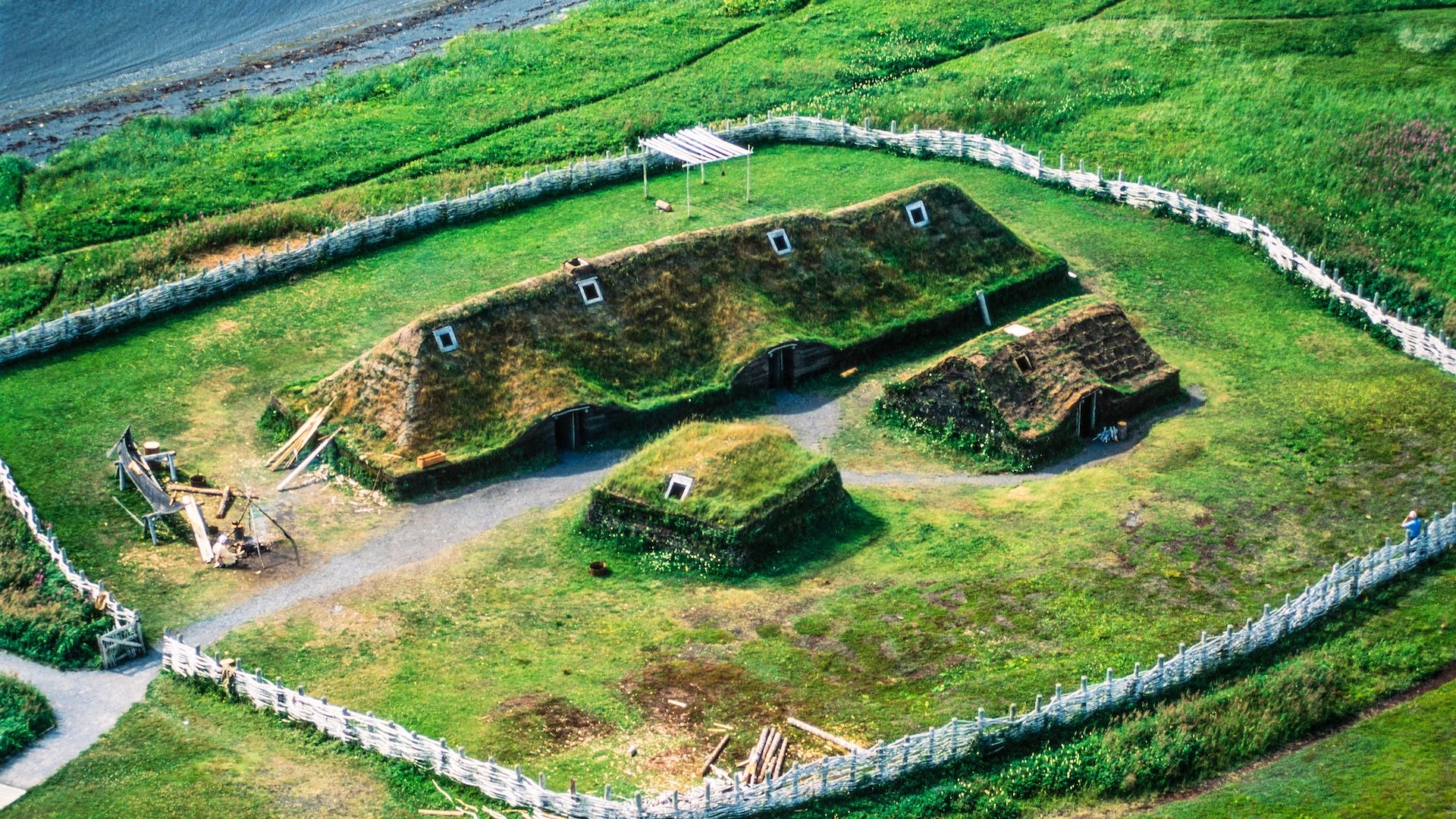
The Vikings journeyed to the Western Hemisphere in the 11th century — about 500 years before Columbus — and even built an outpost at L’Anse aux Meadows on the northern tip of Newfoundland. It’s unclear which Viking individual was the first to reach North America.
However, there are clues in the Icelandic sagas, which were written by people who were likely the Viking’s descendants in the 13th and 14th centuries.
According to “The Saga of Erik the Red,” a merchant named Bjarni Herjólfsson and his crew may have been the first Vikings to reach North America in the late 10th century, said Kevin McAleese, a curator at The Rooms provincial museum in St. John’s, Newfoundland and Labrador, who has studied the Vikings extensively. The saga says that the crew was blown off course while trying to reach Greenland and ended up sailing down the coast of what was likely North America. Herjólfsson decided not to land, and instead skimmed the coast before heading to Greenland.
In contrast, the Greenlanders’ saga suggests that Leif Erikson may have been the first Viking to reach North America in the late 10th century and made multiple voyages there, McAleese told Live Science.
Regardless of which Viking was the first to reach North America, the Norse stories say that any attempt at colonization was thwarted because the Vikings had a hostile relationship with Native American groups and were massively outnumbered by them.

Polynesian voyages?
The Polynesians may have voyaged to the Western Hemisphere centuries before Columbus arrived. In 2020, a DNA study showed that Polynesians and Native Americans — likely from what is now Colombia — paired up around 800 years ago. However, whether this encounter was from Polynesians sailing to the Western Hemisphere or people from the Western Hemisphere sailing to Polynesian islands is unclear.
Crops from the Western Hemisphere, such as sweet potatoes, have been found at many Polynesian sites, giving rise to a debate about whether they were brought to the islands by people or by ocean currents. A 2024 study that analyzed plants from Rapa Nui (also known as Easter Island) found that people on the island were eating plants from South America about 1,000 years ago.

Christopher Columbus
While Columbus is famous for his voyages to the Western Hemisphere, he continued to state that the lands he had visited were in Asia.
“He’d staked his reputation on the expectation that he would reach Asia,” Ida Altman, a professor emerita of history at the University of Florida, told Live Science in an email. “This was why people invested in his voyages and that made it difficult [for him] to back down.”
Columbus’ position may have also been financial. Spain had promised him grand titles and a portion of the wealth that came out of trade from Asia but only if he had, in fact, found a new route to Asia.
Late in his life, Columbus’ stance may have changed somewhat. His “position was not entirely consistent, and in some of his later writings, he referred to the Americas as a kind of ‘paradise’ that he had found, implying that it was a new region for Europeans,” Anna Suranyi, a history professor at Endicott College in Massachusetts, told Live Science in an email.
Regardless of Columbus’s own beliefs, the impact his voyage had on the world was immense, with Indigenous groups in the Western Hemisphere being decimated by disease and people from Europe colonizing North and South America, eventually resulting in the creation of new countries.
