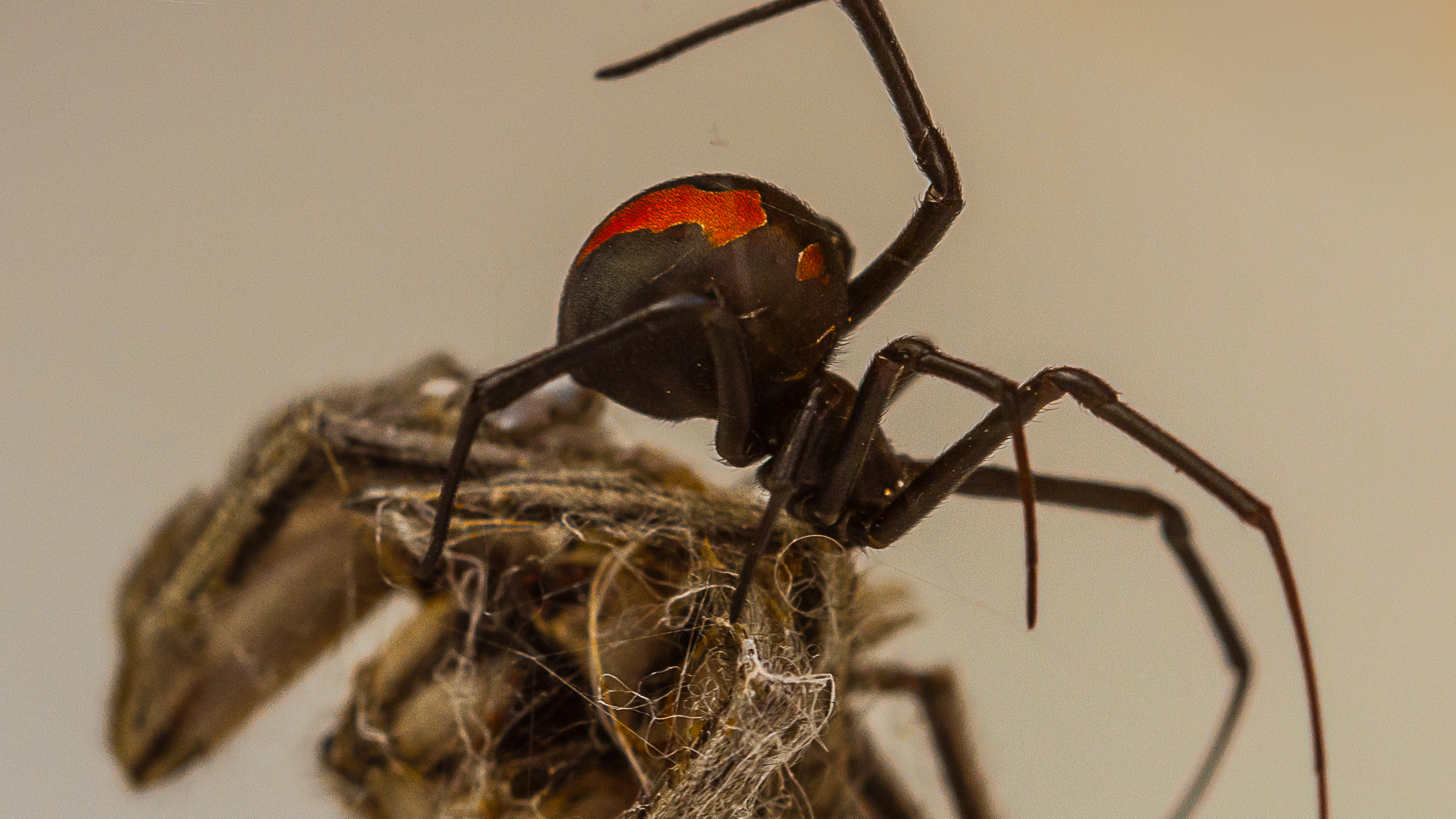
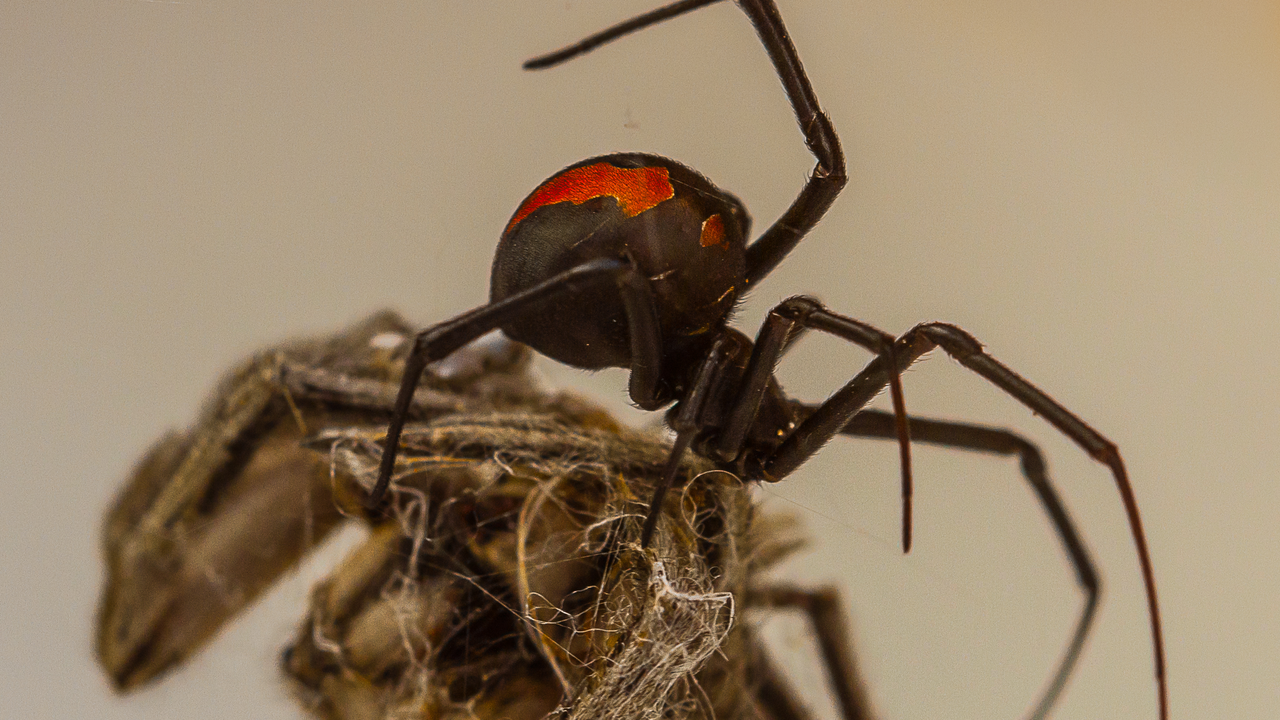
A wild widow spider behavior involving a backflip into death during sex has a simple genetic explanation, new research finds.
Male redback spiders (Latrodectus hasselti) — Australia’s version of black widows — flip into females’ fangs while mating in order to make sex last longer. They also constrict their abdomens — a maneuver that seems to help them survive the experience of being eaten alive long enough to finish transferring their sperm. Then, they break off their sperm-transferring organs, known as pedipalps, into the females like a cork on a bottle, which prevents other males from inseminating them.
Intriguingly, a close New Zealand cousin of the redback, the katipō (Latrodectus katipo), doesn’t do any of this. There are no backflips and no cannibalism — just a respectful courtship dance and a polite parting of ways afterward. That difference offered researchers an opportunity to understand the genetics of the more gymnastic mating behavior.
Latest Videos FromLive Science
“What makes this system so intriguing is the fact that we are dealing with two species here, which are very closely related,” Kardelen Özgün Uludağ, a doctoral student of behavioral biology at the University of Hamburg in Germany, told Live Science in an email. These two species may have separated less than 100,000 years ago, but they still show entirely different behavior and observable traits. “This is very uncommon in animals,” she said.
To figure out the genetic basis of this behavioral schism, Uludağ and her colleagues first exposed katipō females to redback males so that they would mate. The two are closely related enough to yield hybrid offspring. The researchers then crossbred hybrid females with either male redbacks or male katipō spiders. This led to mixed-genetic males. (The researchers couldn’t mate katipō males with redback females in the first place because redback females will eat katipōs instead of mating with them.)
The researchers took these hybrid males and paired them with katipō females so they could watch their mating behavior without any of them getting eaten. Then, they tracked how often the hybrid males backflipped and/or constricted their abdomens at the (presumably baffled) noncannibalistic females.
To their surprise, the researchers found that the behaviors did not have close genetic links. Hybrid males combined backflips and life-extending abdominal constrictions only about half the time, otherwise doing just one or the other. The researchers also saw patterns of inheritance that suggested that the somersaulting was linked to the spiders’ sex chromosome — the X chromosome. Male and female spiders both have two X chromosomes, but females’ X chromosomes carry two full sets of chromosomes, while males’ carry only one. What’s more, the somersaulting behavior had a surprisingly simple dominant-recessive pattern of being passed to offspring.
The abdominal constriction, on the other hand, was a more complex genetic trait, the researchers reported Wednesday (Aug. 12) in the journal Biology Letters. That behavior may be controlled by multiple genes or strongly influenced by female behavior, the researchers concluded.
Although widow spiders are famed for eating their mates, only a couple of black widow species really do. The Australian redback is one, and the U.S.-based Southern black widow (Latrodectus mactans) is another.
The researchers would like to get to the bottom of what drives this behavior. “It would be nice to investigate more species of the genus Latrodectus to allow comparative studies,” Uludağ said.
Özgün Uludag, K., Ivanov, V., Krehenwinkel, H., & M. Schneider, J. Crossing experiments suggest a simple genetic basis of complex male self-sacrifice phenotypes in widow spiders. Biology Letters, 22:20260211. https://doi.org/10.1098/rsbl.2026.0211
What do you know about spiders? Test your smarts with our spider quiz!