Close Menu
  • Home
  • UNSUBSCRIBE
  • News
  • Lifestyle
  • Tech
  • Entertainment
  • Sports
  • Travel
Facebook X (Twitter) WhatsApp
Trending
  • Largest 2D map of the universe charts 4 billion objects in the night sky — and helps other telescopes with their work
  • Genetics triggers male black widows to blackflip into death, study finds
  • Aspen trees provide a natural buffer against wildfires, even as fire season intensifies, study shows
  • Ancient bullets reveal where a Roman camp hid in the Pyrenees of Spain before being ambushed
  • First deaths from Cyclospora outbreak reported in Michigan
  • Scientists uncover big clue as to how Antarctica’s mysterious Blood Falls came to be
  • ‘Poop pills’ may ease insomnia by reprogramming the gut microbiome, early study hints
  • Did fungi give mammals an evolutionary edge after the dinosaur-killing asteroid hit? New evidence revives a provocative hypothesis
Facebook X (Twitter) WhatsApp
Baynard Media
  • Home
  • UNSUBSCRIBE
  • News
  • Lifestyle
  • Tech
  • Entertainment
  • Sports
  • Travel
Baynard Media
Home»Lifestyle»Largest 2D map of the universe charts 4 billion objects in the night sky — and helps other telescopes with their work
Lifestyle

Largest 2D map of the universe charts 4 billion objects in the night sky — and helps other telescopes with their work

EditorBy EditorAugust 12, 2026No Comments3 Mins Read
Share Facebook Twitter Pinterest LinkedIn Tumblr Reddit Telegram Email
Share
Facebook Twitter LinkedIn Pinterest Email

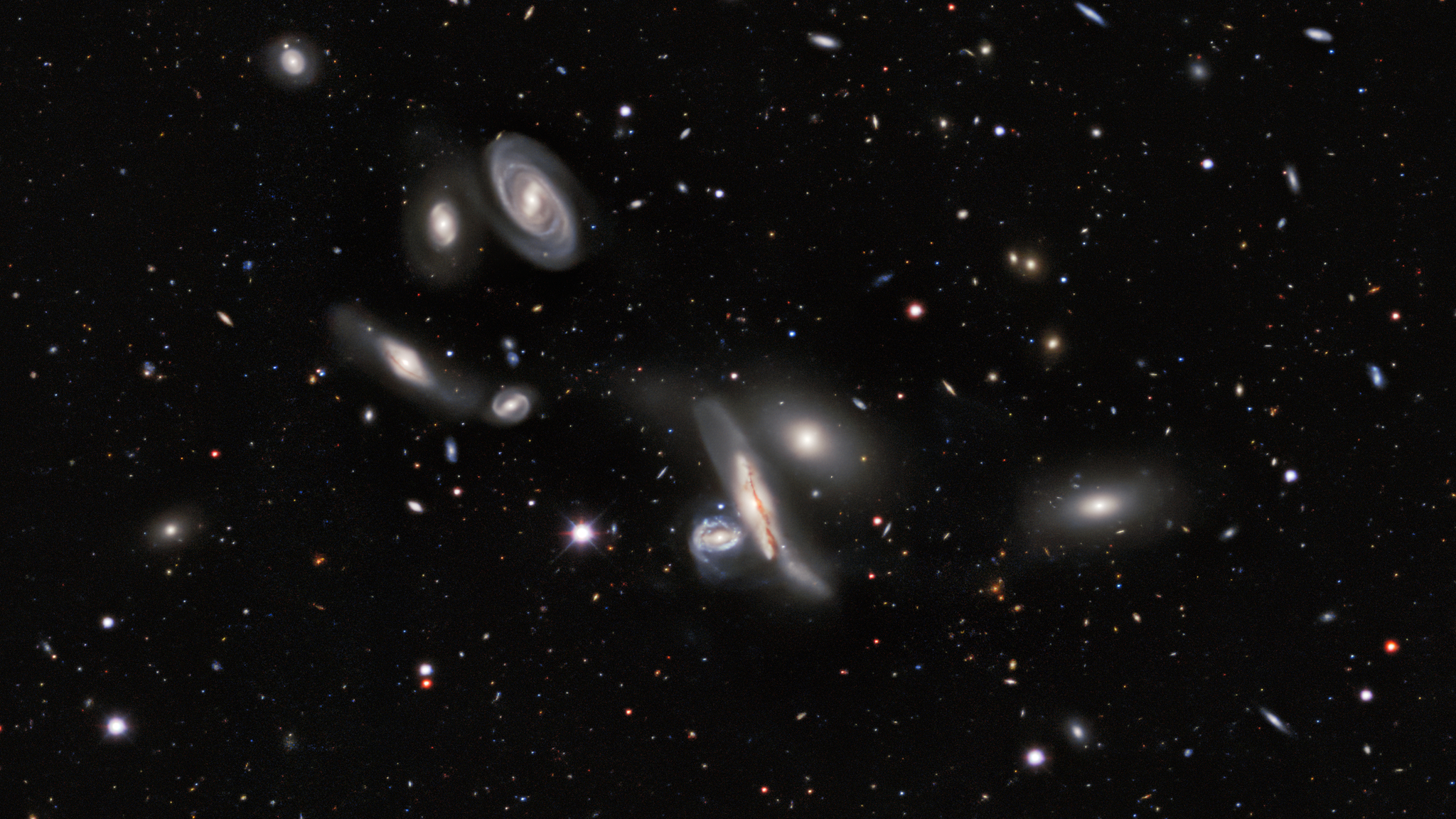
The largest 2D map of the universe just dropped, and it’s a stunner. Compiled from more than a decade of observations, the new map charts 4 billion stars, galaxies, black holes, asteroids and other objects of interest throughout the cosmos.

The map reveals about three-quarters of the night sky in high resolution, spanning both visible and near-infrared light wavelengths and charting the areas of the universe not blocked by dust or gas. The map is so big, in fact, that it’s impossible to reproduce as a single image here; instead, astronomers invite you to explore their vision of the universe using the free Legacy Survey Sky Browser webpage.

It took 13 years and three ground-based sky surveys, using telescopes from the National Science Foundation (NSF) and the University of Arizona to gather the information for the map. The results are available for other scientific investigators to use and will likely help other telescopes to search the cosmos.

Latest Videos FromLive Science

“Astronomers and citizen scientists can combine the map with their own observations to better understand our universe,” NSF officials from NOIRLab said in a statement Aug. 10.

“Researchers can search for rare phenomena like gravitational lenses, observe fleeting events like supernovae, and investigate two of physics’ biggest mysteries: dark matter, the invisible substance that accounts for most of the mass in our universe, and dark energy, the force driving our universe’s accelerating expansion,” the statement added.


You may like

A spiral galaxy glows white in the darkness of space

The spiral galaxy Messier 96, another stunning detail captured in the new map of the cosmos.

(Image credit: DESI Legacy Imaging Surveys/LBNL/DOE & KPNO/CTIO/NOIRLab/NSF/AURA)

Past versions of the map have generated at least 1,800 science papers, according to the statement. The latest map is expected to inform newer observing projects, such as the Vera C. Rubin Observatory and the Nancy Grace Roman Space Telescope. Additionally, these maps laid the groundwork for the Dark Energy Spectroscopic Instrument (DESI) survey, which is creating a 3D map of the cosmos by measuring the light of celestial objects to figure out their distances.

DESI’s first five-year survey wrapped up in April, and the early results suggest dark energy may be getting weaker with time. As physicists grapple with the implications, including how the universe may end, more data from DESI is coming shortly, with improved results from the first five years expected next year. DESI’s work will continue into 2028, so even more is to come.

Get the world’s most fascinating discoveries delivered straight to your inbox.

The three telescopes behind the map are The Dark Energy Camera, mounted on the NSF’s Victor M. Blanco 4-meter Telescope in Chile, the NSF Nicholas U. Mayall 4-meter Telescope at Kitt Peak National Observatory in Arizona, and the UA Bok 2.3-meter Telescope, also at Kitt Peak. The observations were supplemented by years of data from NASA’s Wide-field Infrared Survey Explorer (WISE) satellite mission.

Source link

Share. Facebook Twitter Pinterest LinkedIn Tumblr Email
Previous ArticleGenetics triggers male black widows to blackflip into death, study finds
Editor
  • Website

Related Posts

Lifestyle

Genetics triggers male black widows to blackflip into death, study finds

August 12, 2026
Lifestyle

Aspen trees provide a natural buffer against wildfires, even as fire season intensifies, study shows

August 4, 2026
Lifestyle

Ancient bullets reveal where a Roman camp hid in the Pyrenees of Spain before being ambushed

August 4, 2026
Add A Comment

Comments are closed.

Categories
  • Entertainment
  • Lifestyle
  • News
  • Sports
  • Tech
  • Travel
Recent Posts
  • Largest 2D map of the universe charts 4 billion objects in the night sky — and helps other telescopes with their work
  • Genetics triggers male black widows to blackflip into death, study finds
  • Aspen trees provide a natural buffer against wildfires, even as fire season intensifies, study shows
  • Ancient bullets reveal where a Roman camp hid in the Pyrenees of Spain before being ambushed
  • First deaths from Cyclospora outbreak reported in Michigan
calendar
August 2026
M T W T F S S
 12
3456789
10111213141516
17181920212223
24252627282930
31  
« Jul    
Recent Posts
  • Largest 2D map of the universe charts 4 billion objects in the night sky — and helps other telescopes with their work
  • Genetics triggers male black widows to blackflip into death, study finds
  • Aspen trees provide a natural buffer against wildfires, even as fire season intensifies, study shows
About

Welcome to Baynard Media, your trusted source for a diverse range of news and insights. We are committed to delivering timely, reliable, and thought-provoking content that keeps you informed
and inspired

Categories
  • Entertainment
  • Lifestyle
  • News
  • Sports
  • Tech
  • Travel
Facebook X (Twitter) Pinterest WhatsApp
  • Contact Us
  • About Us
  • Privacy Policy
  • Disclaimer
  • UNSUBSCRIBE
© 2026 copyrights reserved

Type above and press Enter to search. Press Esc to cancel.