Close Menu
  • Home
  • UNSUBSCRIBE
  • News
  • Lifestyle
  • Tech
  • Entertainment
  • Sports
  • Travel
Facebook X (Twitter) WhatsApp
Trending
  • More young people are getting colorectal cancer — here’s what scientists think might be happening
  • ‘I have no doubt that life is out there’: Why radio astronomers are convinced alien contact is only a matter of time
  • 800-year-old ‘hugging skeletons’ are genetically confirmed as Poland’s only medieval same-sex double burial
  • There’s a new T. rex from the dinosaur age — and it ruled the seas with a skull-crushing bite
  • Great Pyramid of Giza is remarkably resilient to earthquakes —‬ and it’s due to the ancient Egyptians’ ‘extraordinary’ engineering knowledge
  • China’s real-life ‘transformer’ mech is a giant humanoid robot that can switch from bounding on 4 legs to walking on 2
  • How can we prevent AI models from cannibalizing themselves when human-generated data runs out? Scientists say they’ve found the answer.
  • ‘The system is likely to reach a breaking point’: Major Italian volcano is speeding toward a transition, and a major eruption could be on the way
Facebook X (Twitter) WhatsApp
Baynard Media
  • Home
  • UNSUBSCRIBE
  • News
  • Lifestyle
  • Tech
  • Entertainment
  • Sports
  • Travel
Baynard Media
Home»Lifestyle»‘We can no longer ignore diseases in the deep human past’: Malaria influenced early humans’ migrations across Africa, study suggests
Lifestyle

‘We can no longer ignore diseases in the deep human past’: Malaria influenced early humans’ migrations across Africa, study suggests

EditorBy EditorApril 30, 2026No Comments4 Mins Read
Share Facebook Twitter Pinterest LinkedIn Tumblr Reddit Telegram Email
Share
Facebook Twitter LinkedIn Pinterest Email

The risk of malaria influenced where prehistoric people lived in sub-Saharan Africa, a new study suggests.

The research is the first to link early human habitation with the deadly disease and contrasts with early assumptions that prehistoric people migrated to different regions mainly for agricultural reasons.

In the study, researchers analyzed existing models of climate and environmental data that indicate where malaria was likely prevalent, and compared it with maps of early human settlements. They found that prehistoric humans seem to have avoided regions where malaria was endemic long before the introduction of farming in sub-Saharan Africa between about 3000 and 1000 B.C.


You may like

“For a long time, it was thought that infectious diseases only really became a problem with the advent of farming, and this was particularly true of malaria,” study co-author Eleanor Scerri, an archaeological scientist at the Max Panck Institute of Geoanthropology in Germany, told Live Science in an email.

But the study by Scerri and her colleagues, published April 22 in the journal Science Advances, suggests that humans have avoided settling in areas with a high risk of malaria for more than 70,000 years.

“Our work shows that we can no longer ignore diseases in the deep human past,” she said. “They don’t just have a small effect, they have — in the case of malaria, at least — transformative impacts that have helped to shape who humans are today.”

Malaria risks

The study authors used data from earlier studies to reconstruct the climate of sub-Saharan Africa over the past 74,000 years in intervals of between 1,000 and 2,000 years.

Get the world’s most fascinating discoveries delivered straight to your inbox.

Then, they calculated a “malaria stability index” for each area at every step, based on modern epidemiological data and the likelihood that an area contained habitats for the Anopheles genus of mosquito. The bites of female Anopheles mosquitoes transmit the parasite Plasmodium falciparum to humans, which causes malaria.

By comparing this index to maps of early human settlements, the authors showed that prehistoric hunter-gatherers in sub-Saharan Africa had actively avoided high-risk malaria hotspots. The researchers said that this behavior, in turn, helped determine human population structures by at least 13,000 years ago — several thousand years before the introduction of farming.

“The key message from our paper is that malaria was already a bit of a problem before agriculture,” study co-author Andrea Manica, an evolutionary ecologist at the University of Cambridge, told Live Science. But “it likely became even worse after people became sedentary and settled at high density as a consequence of food production.”

What to read next

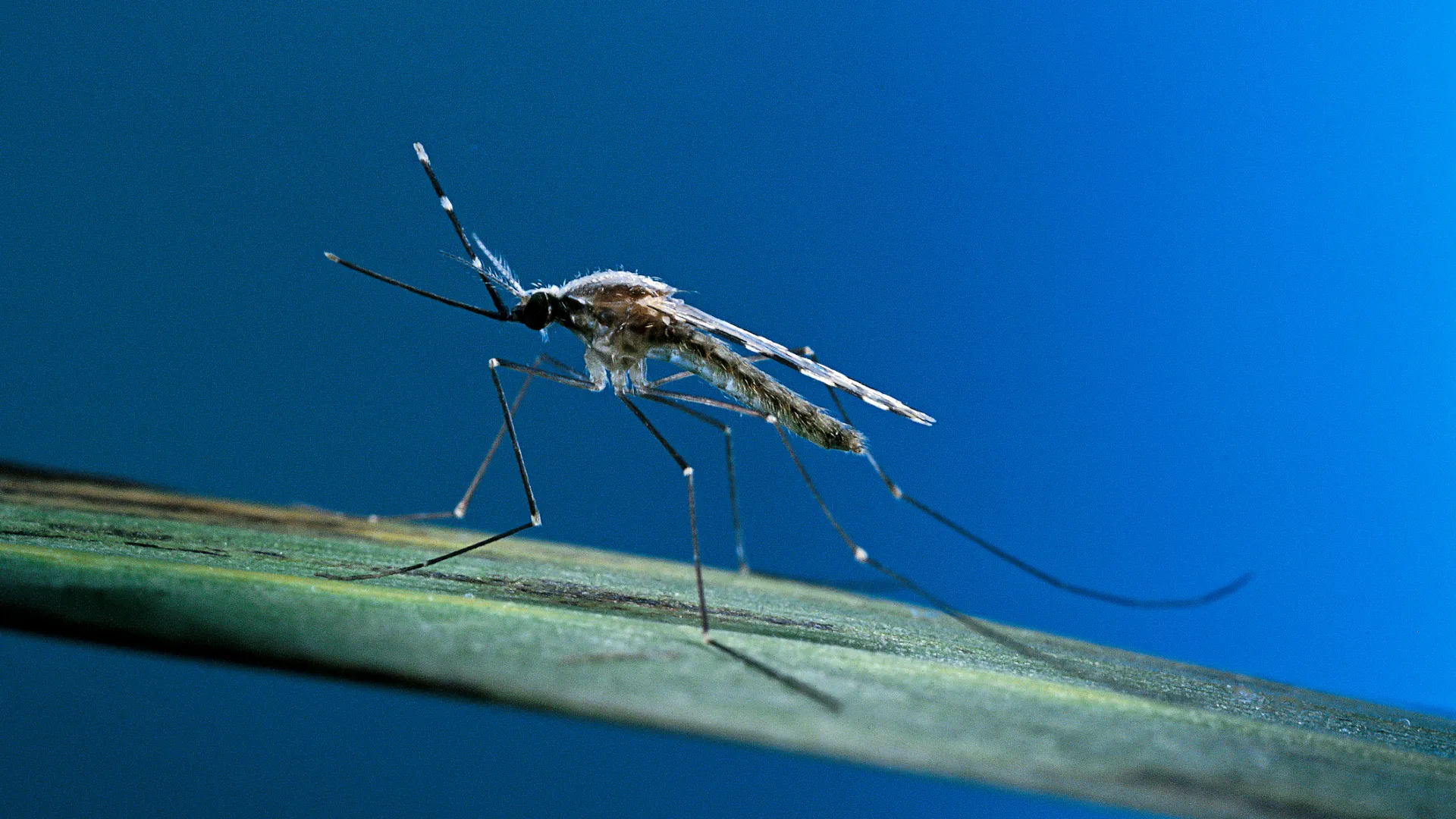
A close up of a mosquito on a long, green leaf

Mosquitoes in the genus Anopheles can carry the parasite that causes malaria.

(Image credit: Paul Starosta via Getty Images)

The study suggests that Central West Africa was hardest hit, he added, and the region remains a malaria hotspot today.

“Archaeology in Central West Africa is limited, but a number of findings agree with a view that populations in this area were highly fragmented,” Manica said.

Malaria hotspots

The study is the first to suggest that the locations of prehistoric human settlements were influenced by the risk of disease, rather than just changes in the climate — although both rainier and warmer weather would have encouraged populations of disease-carrying Anopheles mosquitoes.

“The role of disease in the deep human past, particularly in the earliest, African phases of our species’ prehistory has not been well investigated because we lack ancient DNA from those time periods,” Scerri said.

But the new study showed how the lack of evidence could be overcome. “We have developed a pipeline that is capable of exploring a number of vector-borne diseases,” Scerri said. “It’s an exciting breakthrough and we hope it will open up a new field of inquiry.”

“We have shown that it is possible to track a disease back in time and assess its potential impact on past inhabitation,” Manica added. “The next phase is to start exploring other diseases besides Plasmodium falciparum to see their role.”

Simon Underdown, a biological anthropologist at Oxford Brookes University in the U.K., who was not involved in the new study, said he agreed with the study’s conclusions.

“Disease has always been with us, and it actually shaped what humans could do, where humans could move,” he told Live Science.

Colucci, M., Leonardi, M., Blinkhorn, J., Irish, S. R., Padilla-Iglesias, C., Kaboth-Bar, S., Gosling, W. D., Snow, R. W., Manica, A., & Scerri, E. M. L. (2026). Malaria shaped human spatial organization for the past 74 thousand years. Science Advances, 12(17), eaea2316. https://doi.org/10.1126/sciadv.aea2316


See how much you know about early humans with our human evolution quiz!

Source link

Share. Facebook Twitter Pinterest LinkedIn Tumblr Email
Previous ArticleUsed SpaceX rocket stage could hit the moon’s Einstein crater this summer, report finds
Next Article ‘The detectors never stopped beeping!’ Nearly 3,000 coins discovered in field are Norway’s largest Viking hoard on record
Editor
  • Website

Related Posts

Lifestyle

More young people are getting colorectal cancer — here’s what scientists think might be happening

May 22, 2026
Lifestyle

‘I have no doubt that life is out there’: Why radio astronomers are convinced alien contact is only a matter of time

May 22, 2026
Lifestyle

800-year-old ‘hugging skeletons’ are genetically confirmed as Poland’s only medieval same-sex double burial

May 21, 2026
Add A Comment

Comments are closed.

Categories
  • Entertainment
  • Lifestyle
  • News
  • Sports
  • Tech
  • Travel
Recent Posts
  • More young people are getting colorectal cancer — here’s what scientists think might be happening
  • ‘I have no doubt that life is out there’: Why radio astronomers are convinced alien contact is only a matter of time
  • 800-year-old ‘hugging skeletons’ are genetically confirmed as Poland’s only medieval same-sex double burial
  • There’s a new T. rex from the dinosaur age — and it ruled the seas with a skull-crushing bite
  • Great Pyramid of Giza is remarkably resilient to earthquakes —‬ and it’s due to the ancient Egyptians’ ‘extraordinary’ engineering knowledge
calendar
May 2026
M T W T F S S
 123
45678910
11121314151617
18192021222324
25262728293031
« Apr    
Recent Posts
  • More young people are getting colorectal cancer — here’s what scientists think might be happening
  • ‘I have no doubt that life is out there’: Why radio astronomers are convinced alien contact is only a matter of time
  • 800-year-old ‘hugging skeletons’ are genetically confirmed as Poland’s only medieval same-sex double burial
About

Welcome to Baynard Media, your trusted source for a diverse range of news and insights. We are committed to delivering timely, reliable, and thought-provoking content that keeps you informed
and inspired

Categories
  • Entertainment
  • Lifestyle
  • News
  • Sports
  • Tech
  • Travel
Facebook X (Twitter) Pinterest WhatsApp
  • Contact Us
  • About Us
  • Privacy Policy
  • Disclaimer
  • UNSUBSCRIBE
© 2026 copyrights reserved

Type above and press Enter to search. Press Esc to cancel.