
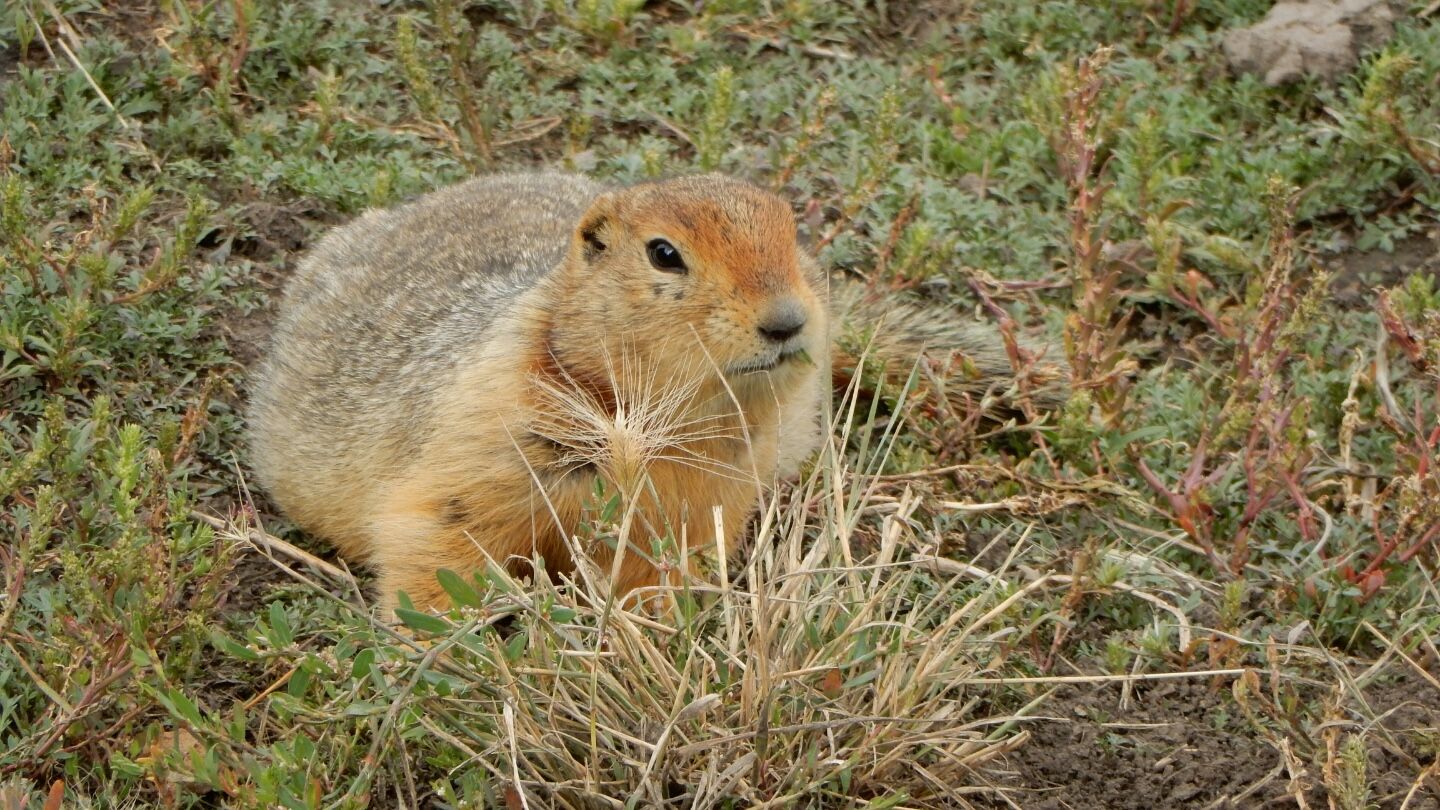
Frozen droppings of prehistoric ground squirrels are chock-full of DNA from ice-age beasts, including woolly mammoths, a mysterious big cat and a huge array of other organisms, revealing a remarkably detailed genetic snapshot of ancient life in Canada’s rugged Yukon.
Although the genetic material of large creatures was found in the ground squirrels’ poop, these rodents were not carnivores. They were opportunistic omnivores that feasted on a wide variety of plant material and fungi, as well as insects, rodents and carrion, just like Arctic ground squirrels (Urocitellus parryii) do today in the Yukon Territory and other parts of northwestern North America and Siberia.
But Arctic ground squirrels also have a habit of collecting and storing various objects in their burrows, which may have introduced additional DNA into the droppings over time, potentially explaining some of the genetic signals detected, the researchers cautioned. It’s also possible that carnivores’ DNA ended up in the burrows because they were attempting to prey on the squirrels, they added.
“The Arctic ground squirrels that are in the Yukon today act kind of like pack rats,” study first author Tyler Murchie, a paleogenomics researcher with the Hakai Institute in British Columbia, Canada, said in a statement. “So they’ll go into the landscape, and they’ll collect a whole bunch of different bits of plant material and bones, seeds, and they’ll bring it back to their burrow.”
So whether these ancient rodents were feasting on carrion and other edibles or simply bringing it into their homes, these dropping help reveal the flora and fauna that lived in Beringia, an ancient region that once encompassed northeastern Asia and northwestern North America when the continents were connected by a land bridge during the last ice age. The findings were published Tuesday (June 9) in the journal Nature Communications.

The coprolites, or fossilized poop, in the study spanned several glacial periods.
(Image credit: Government of Yukon)
Poop detectives
For the study, the researchers analyzed samples extracted from the poop pellets, which had been preserved for millennia in burrows within the deep permafrost of the Yukon, which borders Alaska. These droppings, the oldest of which date to around 700,000 years ago, have yielded an extraordinary treasure trove of ancient environmental DNA from numerous plant, microbial, fungi and animal species.
Notably, the genetic material from the 700,000-year-old ground-squirrel droppings ranks among the oldest DNA ever recovered and sequenced, according to the authors.
Get the world’s most fascinating discoveries delivered straight to your inbox.
“The research shows us that ground squirrel coprolites, or droppings, preserve remarkably diverse genetic snapshots of ancient Beringia, making them exceptional repositories for understanding evolutionary and ecological change through the deep past,” study co-author Hendrik Poinar, director of the Ancient DNA Centre at McMaster University in Ontario, said in the statement.
“It helps reconstruct paleoenvironments in much deeper time, providing insights into environmental change, megafaunal evolution, dispersal and ultimately extinction,” Poinar added.

Ancient fecal pellets left by Arctic ground squirrels that were found in the Yukon’s Lower Quartz Creek.
(Image credit: Duane Froese/University of Alberta)
During their investigation, the researchers extracted ancient environmental DNA from a collection of ground-squirrel coprolites. This provided the team with sufficient quantities of well-preserved genetic material to reassemble more than 18 mitochondrial genomes, including those of woolly mammoths (Mammuthus primigenius), the now-extinct steppe bison (Bison priscus), horses (Equus), the snowshoe hare (Lepus americanus) and the Arctic ground squirrel itself.
A mitochondrial genome, or mitogenome, is the complete set of DNA found inside mitochondria — small structures located within cells that generate energy. The mitogenome assembled from the 700,000-year-old sample represents the oldest mitogenome ever recovered from ancient feces, the study reports.
The team also detected weaker genetic fingerprints from a range of other animals in the coprolites, including evidence of lemmings (Lemmus), caribou (Rangifer tarandus), gray wolves (Canis lupis) and a big cat — possibly a cougar or the extinct American cheetah (Miracinonyx trumani) — as well as fungi, bacteria and more than 200 groups of plants.
Given the rich archive of genetic material that has been uncovered, the findings could pave the way for future discoveries, according to the researchers.
“The thing I hope people take away from this kind of work is the unexpected mystery that you could find in remains that you might otherwise overlook,” Murchie said in a video statement.
Murchie, T. J., Cocker, S. L., Baleka, S., Vogel, N. A., Natola, L., Karpinski, E., Tirlea, D., Barrera, M. A., Grant, D. M., Morien, E., Long, G. S., Rutledge, L. Y., Zazula, G. D., Jensen, B. J., Froese, D. G., & Poinar, H. N. (2026). Ground squirrel coprolites preserve complex archives of ancient environmental DNA over 700,000 years. Nature Communications. https://doi.org/10.1038/s41467-026-72977-6
How much do you know about Earth’s frosty past? Find out with our last ice age quiz!
