Close Menu
  • Home
  • UNSUBSCRIBE
  • News
  • Lifestyle
  • Tech
  • Entertainment
  • Sports
  • Travel
Facebook X (Twitter) WhatsApp
Trending
  • ‘Feuding tech bros’ go head to head in legal showdown. But what does it mean for the future of AI?
  • Pregnancy quiz: Can you deliver on the science of growing babies?
  • Science news this week: The latest on the cruise ship hantavirus infections, a shortcut to Mars, and a fast-charging quantum battery
  • Hantavirus cruise LIVE: Cruise passengers monitored in at least 5 US states as American passengers set to receive repatriation flight
  • Mangroves clean up $8.7 billion of nitrogen pollution every year, study finds
  • Flowering plants transformed into ‘hopeful monsters’ in 9 dire bursts across evolutionary time, study finds
  • US government declassifies nearly 200 UAP files, including strange sightings from Apollo astronauts
  • Some gene therapies no longer require clinical trials, thanks to new FDA rule. Is this safe, and who will it help?
Facebook X (Twitter) WhatsApp
Baynard Media
  • Home
  • UNSUBSCRIBE
  • News
  • Lifestyle
  • Tech
  • Entertainment
  • Sports
  • Travel
Baynard Media
Home»Lifestyle»Visual confirmation: Groundbreaking image shows two black holes orbiting each other for first time
Lifestyle

Visual confirmation: Groundbreaking image shows two black holes orbiting each other for first time

EditorBy EditorOctober 9, 2025No Comments4 Mins Read
Share Facebook Twitter Pinterest LinkedIn Tumblr Reddit Telegram Email
Share
Facebook Twitter LinkedIn Pinterest Email

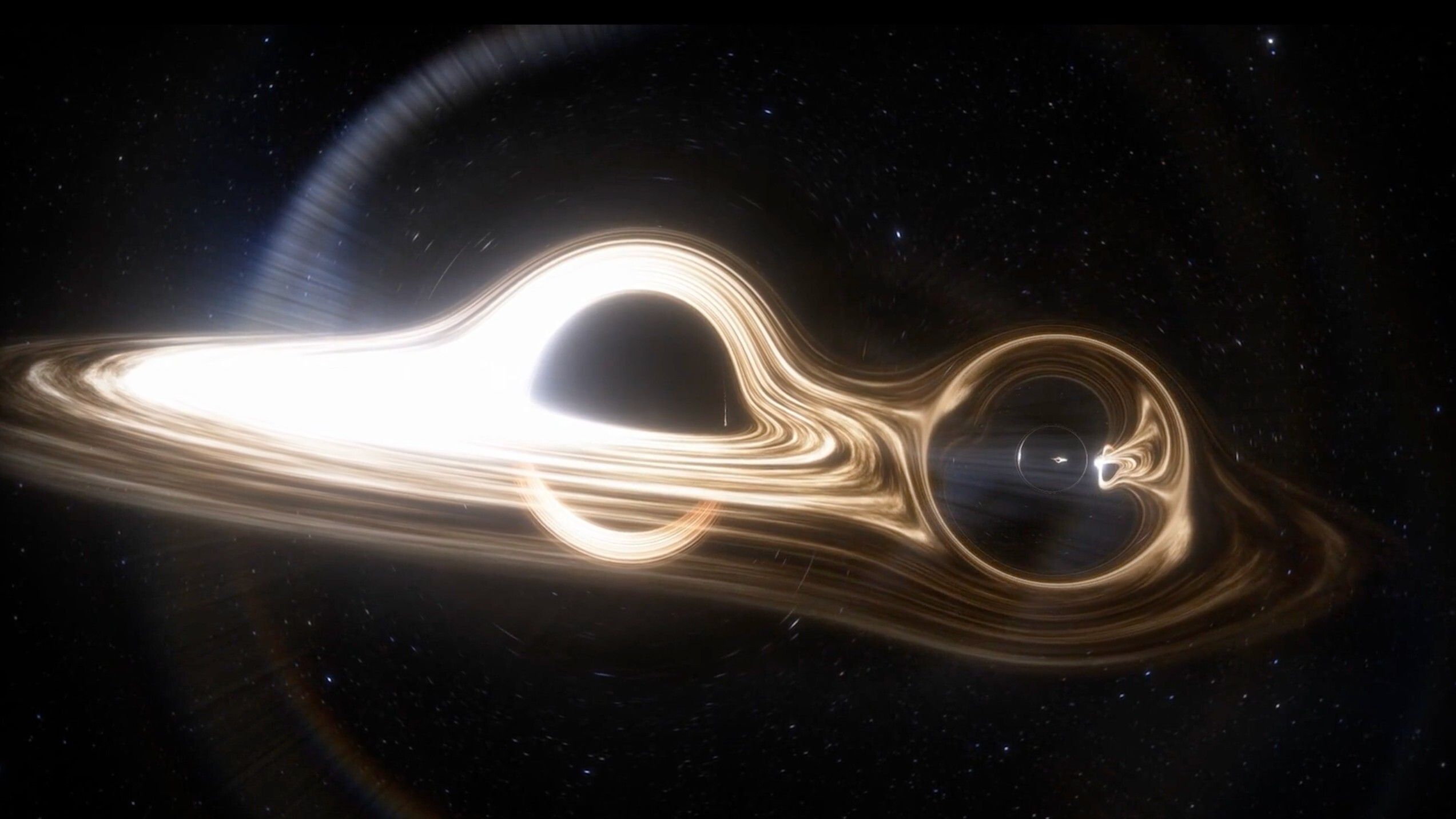
For the first time ever, astronomers have imaged two black holes orbiting each other, finally offering visual proof for the existence of black hole pairs.

Spotted through the faint fluctuations of radio light captured by telescopes both on the ground and in space, the two black holes are locked in a 12-year orbit some 5 billion light-years from Earth.

The smaller black hole was captured with a jet of near-light speed particles twisting around like a rotating garden hose or a dog’s wagging tail. The larger black hole, producing a bigger cosmic fountain known as the blazar OJ287, is a supermassive monster with a mass roughly 18 billion times greater than our sun. The researchers published their findings Oct. 9 in The Astrophysical Journal.


You may like

“For the first time, we managed to get an image of two black holes circling each other,” study first author Mauri Valtonen, an astronomer at the University of Turku in Finland, said in a statement. “In the image, the black holes are identified by the intense particle jets they emit. The black holes themselves are perfectly black, but they can be detected by these particle jets or by the glowing gas surrounding the hole.”

Black holes are born from the collapse of giant stars and grow by gorging on gas, dust, stars and other black holes. For some of these gluttonous space-time ruptures, friction causes the material spiraling into their maws to heat up and emit light that telescopes can detect, turning them into so-called active galactic nuclei (AGN).

The most extreme AGN are quasars — supermassive black holes billions of times heavier than the sun that shed their gaseous cocoons by shooting out light blasts trillions of times more luminous than the brightest stars. When these jets are pointed toward Earth’s line of sight, they are known as blazars.

Astronomers have previously imaged the supermassive giants at the center of our Milky Way and in the nearby galaxy Messier 87, and ample evidence also exists for the existence of black hole binaries and their mergers through detections of gravitational waves. Yet despite long-held suspicions that OJ287 contained an orbiting pair, telescopes lacked the resolution to separate them from a single dot.

Get the world’s most fascinating discoveries delivered straight to your inbox.

In fact, observations of OJ287 go back before astronomers even knew black holes existed; its semi-periodic flares in intensity were included in late 19th century photographic plates made to study nearby cosmic objects. Revisiting data taken from these plates and in follow-up observations led astronomers to begin speculating in the 1980s that the system’s regular dimming and brightening was caused by two orbiting black holes.

To arrive at visual proof, the astronomers used a radio image obtained by a network that includes the RadioAstron, or Spektr-R, satellite — a Russian scientific satellite carrying a radio telescope operational from 2011 to 2019.

A thereotical diagram (left) showing where the black holes and their jets were at the time of the image, and the radio image (right).

A thereotical diagram (left) showing where the black holes and their jets were at the time of the image, and the radio image (right). (Image credit: Valtonen et al, 2025.)

“The satellite’s radio antenna went halfway to the moon, which greatly improved the resolution of the image,” Valtonen said. “In recent years, we have only been able to use Earth-based telescopes, where the image resolution is not as good.”

Comparing the features in the image to past calculations, the researchers distinguished two components corresponding to the jets of each black hole appearing exactly where the theory suggests they should.

Yet some wrinkles remain: The researchers caution that the two jets in the image could overlap, meaning that the possibility can’t yet be fully excluded that there is only one.

“When the resolution close to that provided by RadioAstron is achieved again, in the future… it would be possible to verify the ‘wagging of the tail’ of the secondary black hole,” they wrote.

Source link

Share. Facebook Twitter Pinterest LinkedIn Tumblr Email
Previous ArticleFox News Politics Newsletter: Shutdown continues as White House slams Democrats
Next Article Grand jury indicts N.Y. Attorney General Letitia James
Editor
  • Website

Related Posts

Lifestyle

‘Feuding tech bros’ go head to head in legal showdown. But what does it mean for the future of AI?

May 9, 2026
Lifestyle

Pregnancy quiz: Can you deliver on the science of growing babies?

May 9, 2026
Lifestyle

Science news this week: The latest on the cruise ship hantavirus infections, a shortcut to Mars, and a fast-charging quantum battery

May 9, 2026
Add A Comment

Comments are closed.

Categories
  • Entertainment
  • Lifestyle
  • News
  • Sports
  • Tech
  • Travel
Recent Posts
  • ‘Feuding tech bros’ go head to head in legal showdown. But what does it mean for the future of AI?
  • Pregnancy quiz: Can you deliver on the science of growing babies?
  • Science news this week: The latest on the cruise ship hantavirus infections, a shortcut to Mars, and a fast-charging quantum battery
  • Hantavirus cruise LIVE: Cruise passengers monitored in at least 5 US states as American passengers set to receive repatriation flight
  • Mangroves clean up $8.7 billion of nitrogen pollution every year, study finds
calendar
May 2026
M T W T F S S
 123
45678910
11121314151617
18192021222324
25262728293031
« Apr    
Recent Posts
  • ‘Feuding tech bros’ go head to head in legal showdown. But what does it mean for the future of AI?
  • Pregnancy quiz: Can you deliver on the science of growing babies?
  • Science news this week: The latest on the cruise ship hantavirus infections, a shortcut to Mars, and a fast-charging quantum battery
About

Welcome to Baynard Media, your trusted source for a diverse range of news and insights. We are committed to delivering timely, reliable, and thought-provoking content that keeps you informed
and inspired

Categories
  • Entertainment
  • Lifestyle
  • News
  • Sports
  • Tech
  • Travel
Facebook X (Twitter) Pinterest WhatsApp
  • Contact Us
  • About Us
  • Privacy Policy
  • Disclaimer
  • UNSUBSCRIBE
© 2026 copyrights reserved

Type above and press Enter to search. Press Esc to cancel.