
Close Menu
  • Home
  • UNSUBSCRIBE
  • News
  • Lifestyle
  • Tech
  • Entertainment
  • Sports
  • Travel
Facebook X (Twitter) WhatsApp
Trending
  • New AI model spots pancreatic cancer up to 3 years earlier than human doctors in test
  • Watch NASA’s Curiosity rover ‘struggle’ to remove a rock that got stuck on its robotic arm for nearly a week
  • ‘Almost tragicomical’: Coins minted to protect the English from the Vikings ended up as Viking jewelry, experts discover
  • Andes virus — the only hantavirus strain that can spread between people — identified as culprit on cruise ship
  • New water battery could last until the 24th century — and it can be safely discarded in the environment
  • We remember little to nothing of early childhood — and a new mouse study may help explain why
  • The night sky could get three times brighter as new satellites launch — all but ruining the Vera C. Rubin Observatory’s survey of the universe
  • Happy 100th birthday, David Attenborough: 13 surprising facts about the famous naturalist
Facebook X (Twitter) WhatsApp
Baynard Media
  • Home
  • UNSUBSCRIBE
  • News
  • Lifestyle
  • Tech
  • Entertainment
  • Sports
  • Travel
Baynard Media
Home»Lifestyle»The Small Magellanic Cloud is being ripped to shreds, shocking study finds
Lifestyle

The Small Magellanic Cloud is being ripped to shreds, shocking study finds

EditorBy EditorApril 10, 2025No Comments3 Mins Read
Share Facebook Twitter Pinterest LinkedIn Tumblr Reddit Telegram Email
Share
Facebook Twitter LinkedIn Pinterest Email

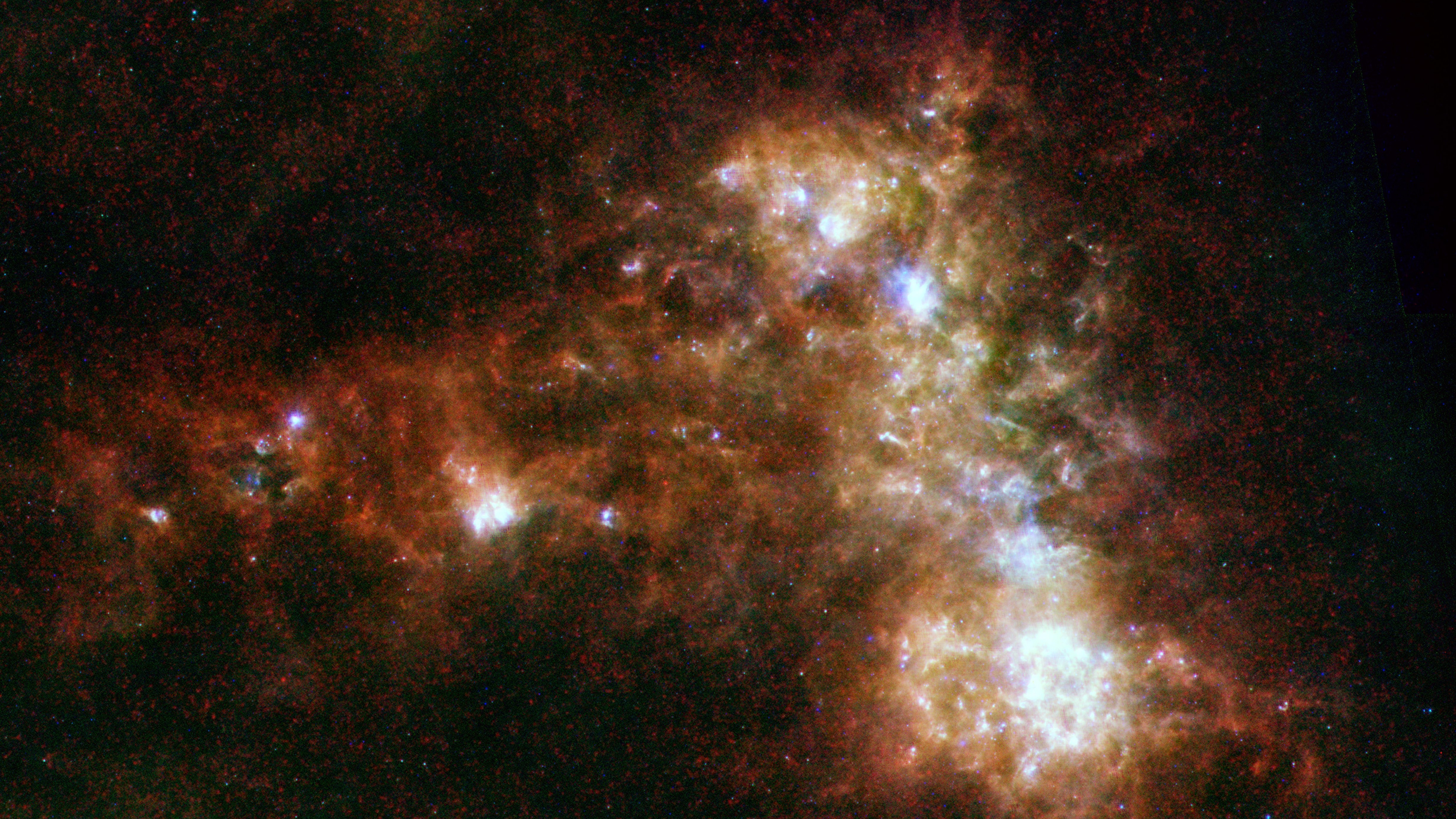
Astronomers have uncovered shocking evidence that one of the closest galaxies to our own is being torn to shreds by its neighbor.

Located around 200,000 light-years from Earth, the Small Magellanic Cloud (SMC) is a dwarf galaxy that, alongside its neighbor the Large Magellanic Cloud (LMC), is gravitationally bound to our Milky Way. The two satellite galaxies orbit alongside ours and, in a few billion years, will collide and merge with the Milky Way.

But before that far-future date, a new analysis of star patterns has revealed that a different fate may be in store for the SMC: being torn apart by its larger neighbor. This dire prediction was published April 10 in The Astrophysical Journal Supplement Series.

“When we first got this result, we suspected that there might be an error in our method of analysis,” co-author Kengo Tachihara, an astronomer at Nagoya University in Japan, said in a statement. “However, upon closer examination, the results are indisputable, and we were surprised.”

Alongside our Milky Way and the LMC, the SMC is part of the Local Group, a collection of roughly 30 galaxies in our cosmic backyard. The SMC’s triangle-shaped patch of a few hundred million stars is relatively small, measuring just 7,000 light-years across compared to our own galaxy’s 100,000 light-year diameter, and circles the LMC once every 900 million years and the Milky Way about once every 1.5 billion years.

Related: One of the closest galaxies to the Milky Way is hiding a second galaxy behind it, new research reveals

Yet despite the SMC’s proximity to us, the galaxy’s relatively small size and the obscuring effects of interstellar gas and dust have made observing it tricky.

Get the world’s most fascinating discoveries delivered straight to your inbox.

To peer into the SMC’s inner workings, the researchers turned to the European Space Agency’s recently retired Gaia spacecraft, which mapped the positions of roughly 2 billion stars within the Milky Way and its surrounding galaxies. By poring through Gaia’s third data release, the astronomers tracked the movements of roughly 7,000 stars from within the SMC to arrive at a shocking finding.

“The stars in the SMC were moving in opposite directions on either side of the galaxy, as though they are being pulled apart,” Tachihara said. “Some of these stars are approaching the LMC, while others are moving away from it.”

This unexpected movement suggests that the LMC is tugging on its smaller companion, Tachihara said, “leading to its gradual destruction.”

The researchers’ analysis also revealed that, unlike in our Milky Way, the massive stars tracked within the SMC were not rotating around the galaxy’s axis. This suggests that something may be wrong with our understanding of the galaxy’s mass and its history of interactions with the LMC and the Milky Way.

Further study of these conundrums could reveal some key insights. The SMC’s low metallicity and weak gravitational potential energy means it resembles what many galaxies may have looked like during their infancy in the early universe. This means that studying the interactions between the SMC and the LMC could help astronomers understand how galaxies were sculpted over time.

“We are unable to get a ‘bird’s-eye view’ of the galaxy in which we live – as a result, the SMC and the LMC are the only galaxies in which we can observe the details of stellar motion,” Tachihara noted. “This research is important because it allows us to study the process of star formation in connection with the motion of stars throughout the galaxy.”

Source link

Share. Facebook Twitter Pinterest LinkedIn Tumblr Email
Previous ArticleYou can now manipulate 3D holograms thanks to display breakthrough
Next Article Why is this giant desert turning green? Scientists may finally know the answer.
Editor
  • Website

Related Posts

Lifestyle

New AI model spots pancreatic cancer up to 3 years earlier than human doctors in test

May 7, 2026
Lifestyle

Watch NASA’s Curiosity rover ‘struggle’ to remove a rock that got stuck on its robotic arm for nearly a week

May 7, 2026
Lifestyle

‘Almost tragicomical’: Coins minted to protect the English from the Vikings ended up as Viking jewelry, experts discover

May 7, 2026
Add A Comment

Comments are closed.

Categories
  • Entertainment
  • Lifestyle
  • News
  • Sports
  • Tech
  • Travel
Recent Posts
  • New AI model spots pancreatic cancer up to 3 years earlier than human doctors in test
  • Watch NASA’s Curiosity rover ‘struggle’ to remove a rock that got stuck on its robotic arm for nearly a week
  • ‘Almost tragicomical’: Coins minted to protect the English from the Vikings ended up as Viking jewelry, experts discover
  • Andes virus — the only hantavirus strain that can spread between people — identified as culprit on cruise ship
  • New water battery could last until the 24th century — and it can be safely discarded in the environment
calendar
May 2026
M T W T F S S
 123
45678910
11121314151617
18192021222324
25262728293031
« Apr    
Recent Posts
  • New AI model spots pancreatic cancer up to 3 years earlier than human doctors in test
  • Watch NASA’s Curiosity rover ‘struggle’ to remove a rock that got stuck on its robotic arm for nearly a week
  • ‘Almost tragicomical’: Coins minted to protect the English from the Vikings ended up as Viking jewelry, experts discover
About

Welcome to Baynard Media, your trusted source for a diverse range of news and insights. We are committed to delivering timely, reliable, and thought-provoking content that keeps you informed
and inspired

Categories
  • Entertainment
  • Lifestyle
  • News
  • Sports
  • Tech
  • Travel
Facebook X (Twitter) Pinterest WhatsApp
  • Contact Us
  • About Us
  • Privacy Policy
  • Disclaimer
  • UNSUBSCRIBE
© 2026 copyrights reserved

Type above and press Enter to search. Press Esc to cancel.