Close Menu
  • Home
  • UNSUBSCRIBE
  • News
  • Lifestyle
  • Tech
  • Entertainment
  • Sports
  • Travel
Facebook X (Twitter) WhatsApp
Trending
  • Withings ScanWatch 2 review: Style meets next-level health monitoring
  • AI Chatbots are turbo-charging violence against women and girls: We urgently need to regulate them | Yvonne McDermott Rees
  • ‘The biggest El Niño event since the 1870s’: ‘Super’ El Niño is now the most likely scenario by the end of this year ‪—‬ and the humanitarian cost could be huge
  • Antarctica’s sudden sea ice loss is one of the most extreme and confusing events in the modern climate record. Scientists now know why it’s happening.
  • ‘I heard gasps’: Artemis II astronauts reveal inside story of their mind-bending solar eclipse
  • A pill can stop people from developing COVID after being exposed to the virus, trial finds
  • ‘There are 4 people in those pixels’: Earth-based telescope snapped Artemis II crew orbiting the moon
  • High-status Roman woman was buried in a lead coffin with jet hairpins and exotic resins, archaeologists find
Facebook X (Twitter) WhatsApp
Baynard Media
  • Home
  • UNSUBSCRIBE
  • News
  • Lifestyle
  • Tech
  • Entertainment
  • Sports
  • Travel
Baynard Media
Home»Lifestyle»See the reconstructed home of ‘polar dinosaurs’ that thrived in the Antarctic 120 million years ago
Lifestyle

See the reconstructed home of ‘polar dinosaurs’ that thrived in the Antarctic 120 million years ago

EditorBy EditorMay 12, 2025No Comments3 Mins Read
Share Facebook Twitter Pinterest LinkedIn Tumblr Reddit Telegram Email
Share
Facebook Twitter LinkedIn Pinterest Email

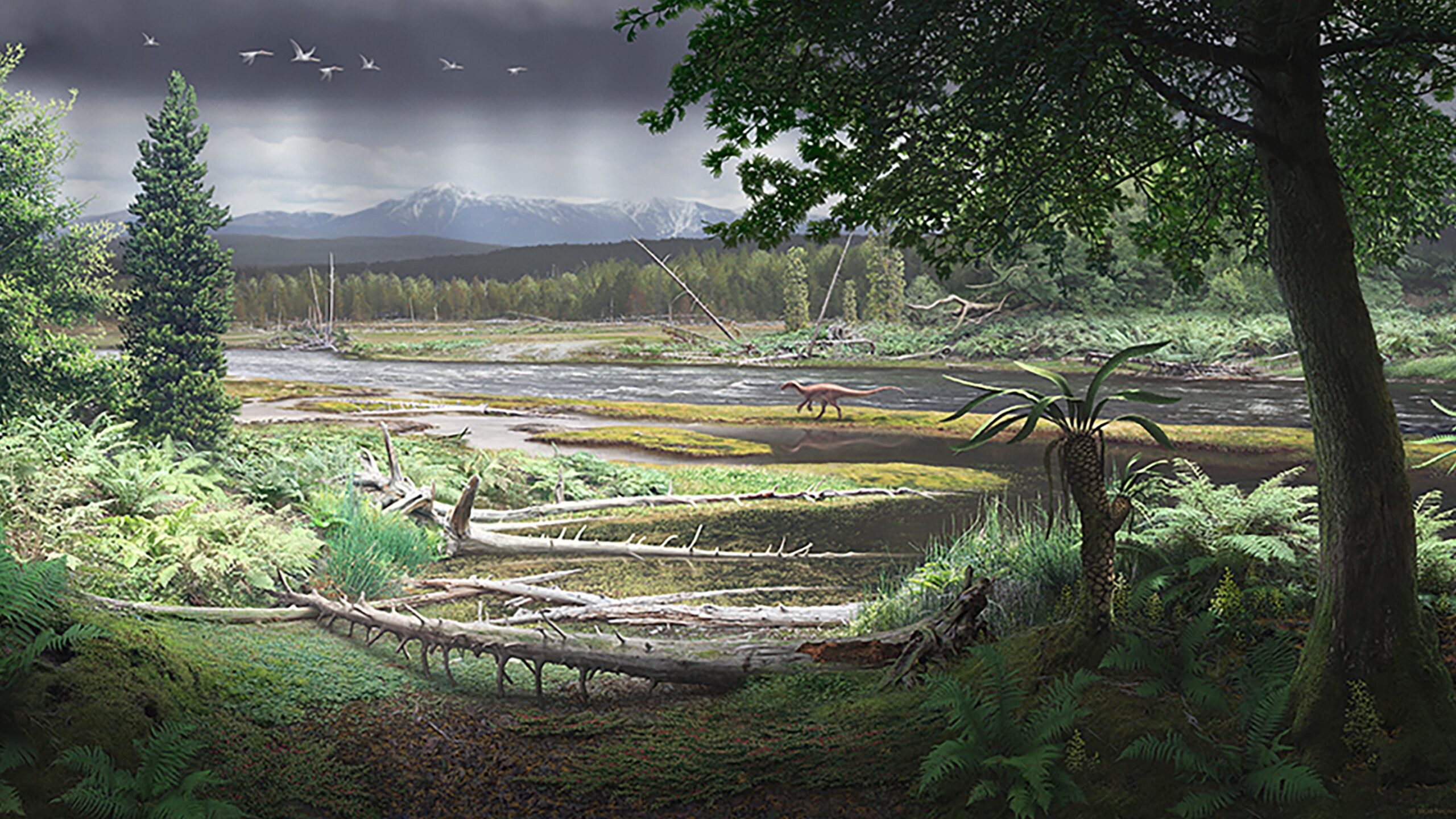
Australia is rather isolated today, but around 120 million years ago, the island straddled the polar circle and formed a giant landmass with Antarctica. At that time, dinosaurs lived on this landmass — and thanks to a new study, we now know what their habitat looked like.

New illustrations show that “polar dinosaurs” roamed cool-temperate forests crisscrossed by rivers and carpeted with large ferns. These dinosaurs included small ornithopods — herbivorous dinosaurs with beaks and cheeks full of teeth — and small theropods, which were mostly carnivorous dinosaurs that walked on two legs and often had feathers, one of the study’s authors wrote in The Conversation.

“What is now Victoria was once within the polar circle, up to 80 degrees south of the equator and shrouded in darkness for months at a time,” wrote co-author Vera Korasidis, a lecturer in environmental geoscience at the University of Melbourne and a research associate at the Smithsonian’s National Museum of Natural History. “Despite these harsh conditions, dinosaurs thrived here, leaving behind evidence of their existence at various palaeontological sites.”

The amount of sunlight reaching the Antarctic Circle has remained the same over the eons, but the climate was much balmier during the Cretaceous period (145 million to 66 million years ago) than it is today, with temperatures averaging between 11 and 25 degrees Fahrenheit (6 to 14 degrees Celsius) warmer than current temperatures. The Early Cretaceous (140 million to 110 million years ago), in particular, stands out as one of the warmest periods in the past 500 million years of Earth’s history, Korasidis wrote, ruling out the existence of polar ice caps.

Related: Dinosaurs might still roam Earth if it weren’t for the asteroid, study suggests

Paleontologists have been studying rocks containing dinosaur fossils from the southern Australian state of Victoria for decades, but they have also been analyzing microscopic spores and pollen grains that may be from plant life that existed near the South Pole during the Early Cretaceous, Korasidis wrote.

For the new study, Korasidis and her co-author Barbara Wagstaff, a pollen and spore specialist at the University of Melbourne, examined nearly 300 pollen and spore samples from 48 sites along the Victoria coast. These samples, which date to between 130 million and 110 million years ago, shed light on the evolution of forests and floodplains where dinosaurs lived, Korasidis wrote.

Get the world’s most fascinating discoveries delivered straight to your inbox.

Reconstruction of forest and understory vegetation during the early Cretaceous in what is now southern Australia.

The new illustrations are based on palynological, palaeobotanical, geochemical and sedimentological data. (Image credit: Artwork by Robert Nicholls. Published in Korasidis & Wagstaff (2025) Alcheringa. Redistributed under the terms of the Creative Commons Attribution License.)

The researchers published their findings and the first-ever reconstructions of Early Cretaceous polar landscapes Wednesday (May 7) in the journal Alcheringa.

Ancient conifers made up most of the forest canopy, while ferns — specifically, scaly tree ferns (Cyatheaceae), forked ferns (Gleicheniaceae) and another group of primitive ferns (Schizaeaceae) — dominated the understory, according to the study. The researchers noticed an abundance of flowering plants appeared starting around 113 million years ago, which agrees with the timing of the proliferation of flowering plants globally.

“The appearance of flowering plants in the landscape resulted in the extinction of numerous understorey plants,” Korasidis wrote in The Conversation. “As a result, by 100 million years ago, the forests of Victoria included an open conifer-dominated forest canopy. Flowering plants and ferns featured in the understorey, alongside liverworts, hornworts, lycophytes and sphagnum-like mosses.”

The changing vegetation likely influenced dinosaurs, with many expanding their diet to include flowering plants by the end of the Cretaceous, according to Smithsonian magazine.

Source link

Share. Facebook Twitter Pinterest LinkedIn Tumblr Email
Previous ArticleCould a planet really develop a brain?
Next Article Famous tomb said to hold Alexander the Great’s father actually contains younger man, a woman and 6 babies, study finds
Editor
  • Website

Related Posts

Lifestyle

Withings ScanWatch 2 review: Style meets next-level health monitoring

May 15, 2026
Lifestyle

AI Chatbots are turbo-charging violence against women and girls: We urgently need to regulate them | Yvonne McDermott Rees

May 15, 2026
Lifestyle

‘The biggest El Niño event since the 1870s’: ‘Super’ El Niño is now the most likely scenario by the end of this year ‪—‬ and the humanitarian cost could be huge

May 15, 2026
Add A Comment

Comments are closed.

Categories
  • Entertainment
  • Lifestyle
  • News
  • Sports
  • Tech
  • Travel
Recent Posts
  • Withings ScanWatch 2 review: Style meets next-level health monitoring
  • AI Chatbots are turbo-charging violence against women and girls: We urgently need to regulate them | Yvonne McDermott Rees
  • ‘The biggest El Niño event since the 1870s’: ‘Super’ El Niño is now the most likely scenario by the end of this year ‪—‬ and the humanitarian cost could be huge
  • Antarctica’s sudden sea ice loss is one of the most extreme and confusing events in the modern climate record. Scientists now know why it’s happening.
  • ‘I heard gasps’: Artemis II astronauts reveal inside story of their mind-bending solar eclipse
calendar
May 2026
M T W T F S S
 123
45678910
11121314151617
18192021222324
25262728293031
« Apr    
Recent Posts
  • Withings ScanWatch 2 review: Style meets next-level health monitoring
  • AI Chatbots are turbo-charging violence against women and girls: We urgently need to regulate them | Yvonne McDermott Rees
  • ‘The biggest El Niño event since the 1870s’: ‘Super’ El Niño is now the most likely scenario by the end of this year ‪—‬ and the humanitarian cost could be huge
About

Welcome to Baynard Media, your trusted source for a diverse range of news and insights. We are committed to delivering timely, reliable, and thought-provoking content that keeps you informed
and inspired

Categories
  • Entertainment
  • Lifestyle
  • News
  • Sports
  • Tech
  • Travel
Facebook X (Twitter) Pinterest WhatsApp
  • Contact Us
  • About Us
  • Privacy Policy
  • Disclaimer
  • UNSUBSCRIBE
© 2026 copyrights reserved

Type above and press Enter to search. Press Esc to cancel.