Close Menu
  • Home
  • UNSUBSCRIBE
  • News
  • Lifestyle
  • Tech
  • Entertainment
  • Sports
  • Travel
Facebook X (Twitter) WhatsApp
Trending
  • 2 rivers merged to form the Euphrates 3.6 million years ago, eventually leading to the Fertile Crescent
  • NASA confirms fireball meteor exploded over northeastern US with force of 230 tons of TNT
  • Astronauts could use lightning-like plasma jets to kill germs on the moon and Mars, demo hints
  • First whole-genome sequence of a Greenland shark holds clues to their extreme longevity
  • Heading a soccer ball just once is enough to raise levels of proteins associated with brain damage
  • OpenAI’s internal AI model just solved an 80-year-old math problem ‪—‬ and mathematicians verified it
  • Skeletal remains of Queen Elisenda, one of the most powerful rulers in medieval Europe, unearthed in Barcelona — along with several others who bore unexplained stab wounds
  • Tests that measure ‘biological age’ aren’t helpful for tracking your health, scientists say
Facebook X (Twitter) WhatsApp
Baynard Media
  • Home
  • UNSUBSCRIBE
  • News
  • Lifestyle
  • Tech
  • Entertainment
  • Sports
  • Travel
Baynard Media
Home»Lifestyle»Scientists peered into a secret Antarctic lake hidden beneath the ice — and uncovered a never-before-seen ecosystem
Lifestyle

Scientists peered into a secret Antarctic lake hidden beneath the ice — and uncovered a never-before-seen ecosystem

EditorBy EditorDecember 20, 2024No Comments3 Mins Read
Share Facebook Twitter Pinterest LinkedIn Tumblr Reddit Telegram Email
Share
Facebook Twitter LinkedIn Pinterest Email

Antarctica’s Lake Enigma certainly lives up to its name. The permanently ice-covered lake, named for the peculiar cone of debris at its center, was until recently thought to be frozen solid. But scientists have discovered a layer of fresh water hidden beneath the ice-covered surface — and it’s populated by a diverse cast of microorganisms.

During an expedition to Antarctica from November 2019 to January 2020, researchers surveyed the lake with ground-penetrating radar and detected at least 40 feet (12 meters) of liquid water under the ice. The researchers then drilled into the ice and sent a camera to explore the lake’s depths.

The team first tested the water to determine where it came from. This was important to establish because the area has low precipitation, high winds and intense solar evaporation, so any water in Lake Enigma should have dried up long ago.

Based on the chemical composition of salts in the water, the researchers hypothesized that the lake’s water is consistently replenished by the nearby Amorphous Glacier through an unknown underground pathway.

Hidden ecosystem beneath Antarctic ice

The scientists found that, despite being isolated from the atmosphere, the waters of Lake Enigma are home to several kinds of microbial life, which cover the bottom of the lake in blobs known as microbial mats. Many of these organisms are photosynthetic, giving the lake a high concentration of dissolved oxygen.

Some of the mats formed thin, spiky coatings on the lakebed. Others resembled “a crumpled thick carpet, sometimes forming large amorphous tree-like structures up to 40 cm [centimeters, or 16 inches] high and up to 50 to 60 cm [20 to 24 inches] in diameter,” the researchers wrote in the study, published Dec. 3 in the journal Communications Earth and Environment.

The microbial residents included several species of Patescibacteria — tiny, single-celled organisms that attach themselves to larger host cells to form either mutually beneficial or predatory relationships. These organisms had never before been found in ice-covered lakes and don’t normally thrive in high-oxygen conditions, suggesting that these Patescibacteria may have developed unique metabolic tricks to survive.
Get the world’s most fascinating discoveries delivered straight to your inbox.

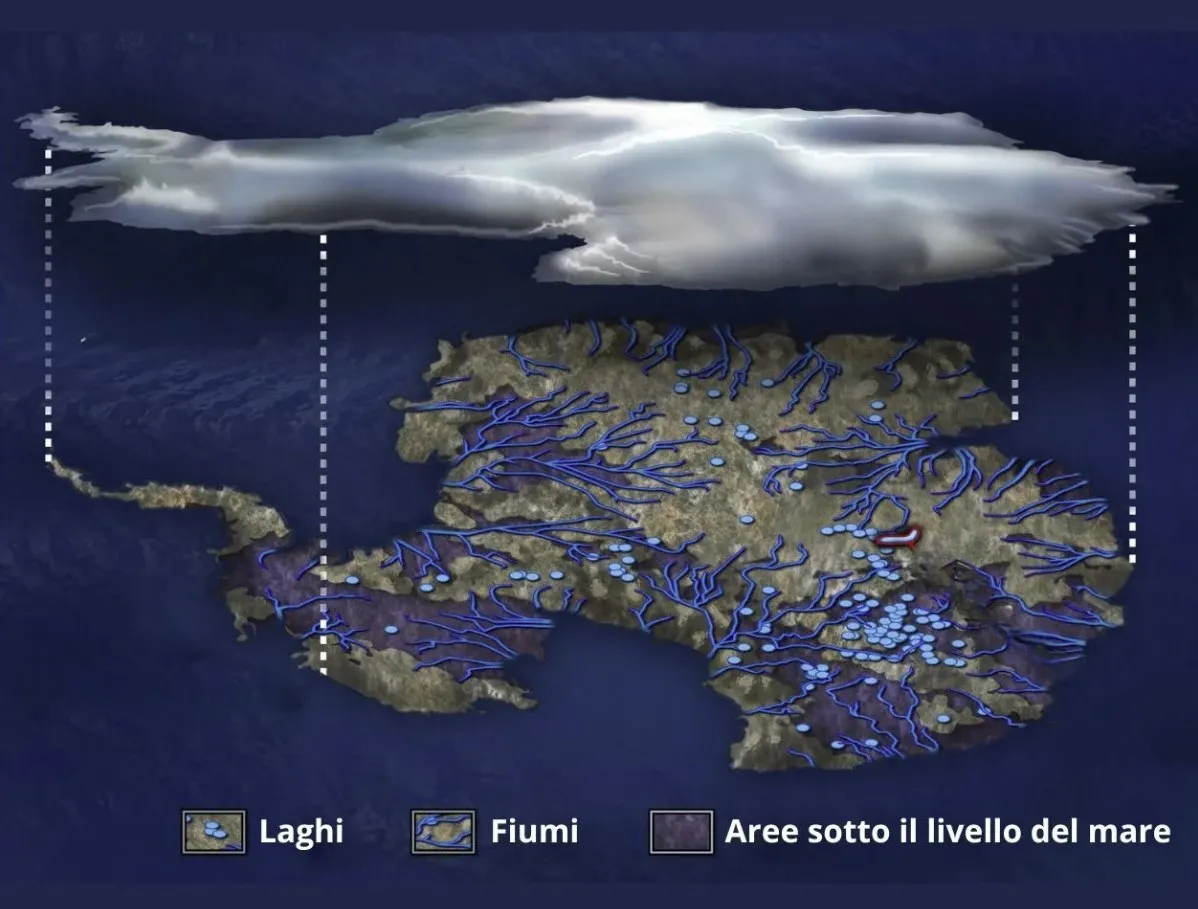
graphic showing a network of rivers in a freshwater lake under Antarctica's ice.

Graphic showing the lakes (blue dots), the rivers (the blue lines), and the areas below sea level (purple) beneath Antarctica’s ice. (Image credit: INGV)

“This finding highlights the complexity and diversity of food webs in Antarctic permanently ice-covered lakes, with symbiotic and predatory lifestyles a possibility not previously recognized,” the researchers wrote in the study.

Environments similar to Lake Enigma exist on icy moons like Europa or Enceladus. The lake’s extreme ecosystem could therefore offer insights into conditions in places where microbial life might be found on other worlds, study co-author Stefano Urbini, a geophysicist at the National Institute of Geophysics and Volcanology in Italy, wrote in a translated statement.

Antarctica quiz

Source link

Share. Facebook Twitter Pinterest LinkedIn Tumblr Email
Previous ArticleCES 2025 preview: What to expect
Next Article Tesla recalls nearly 700,000 vehicles over tire pressure light issue
Editor
  • Website

Related Posts

Lifestyle

2 rivers merged to form the Euphrates 3.6 million years ago, eventually leading to the Fertile Crescent

June 2, 2026
Lifestyle

NASA confirms fireball meteor exploded over northeastern US with force of 230 tons of TNT

June 2, 2026
Lifestyle

Astronauts could use lightning-like plasma jets to kill germs on the moon and Mars, demo hints

June 1, 2026
Add A Comment

Comments are closed.

Categories
  • Entertainment
  • Lifestyle
  • News
  • Sports
  • Tech
  • Travel
Recent Posts
  • 2 rivers merged to form the Euphrates 3.6 million years ago, eventually leading to the Fertile Crescent
  • NASA confirms fireball meteor exploded over northeastern US with force of 230 tons of TNT
  • Astronauts could use lightning-like plasma jets to kill germs on the moon and Mars, demo hints
  • First whole-genome sequence of a Greenland shark holds clues to their extreme longevity
  • Heading a soccer ball just once is enough to raise levels of proteins associated with brain damage
calendar
June 2026
M T W T F S S
1234567
891011121314
15161718192021
22232425262728
2930  
« May    
Recent Posts
  • 2 rivers merged to form the Euphrates 3.6 million years ago, eventually leading to the Fertile Crescent
  • NASA confirms fireball meteor exploded over northeastern US with force of 230 tons of TNT
  • Astronauts could use lightning-like plasma jets to kill germs on the moon and Mars, demo hints
About

Welcome to Baynard Media, your trusted source for a diverse range of news and insights. We are committed to delivering timely, reliable, and thought-provoking content that keeps you informed
and inspired

Categories
  • Entertainment
  • Lifestyle
  • News
  • Sports
  • Tech
  • Travel
Facebook X (Twitter) Pinterest WhatsApp
  • Contact Us
  • About Us
  • Privacy Policy
  • Disclaimer
  • UNSUBSCRIBE
© 2026 copyrights reserved

Type above and press Enter to search. Press Esc to cancel.