Close Menu
  • Home
  • UNSUBSCRIBE
  • News
  • Lifestyle
  • Tech
  • Entertainment
  • Sports
  • Travel
Facebook X (Twitter) WhatsApp
Trending
  • Scientists discover deadly, highly venomous box jellyfish near Singapore’s ‘Island of Death Behind’
  • Poll: What do you think of PMOS, the new name for PCOS?
  • Celestron Outland X 10×25 roof prism binocular review
  • Withings Body Scan review: Smart scale turned all-in-one health hub
  • World’s first ‘native’ color lidar will let robots and self-driving cars map the world in full color 3D
  • Bright-blue ‘potash ponds’ shine alongside a dark-green river in Utah — Earth from space
  • Deadly Ebola outbreak is a public health emergency of international concern, WHO declares
  • 1,200-year-old giant ‘death jar’ in Laos contains generations of human skeletons
Facebook X (Twitter) WhatsApp
Baynard Media
  • Home
  • UNSUBSCRIBE
  • News
  • Lifestyle
  • Tech
  • Entertainment
  • Sports
  • Travel
Baynard Media
Home»Lifestyle»Roman military fort discovered in Scotland far north of Hadrian’s Wall
Lifestyle

Roman military fort discovered in Scotland far north of Hadrian’s Wall

EditorBy EditorMarch 17, 2026No Comments3 Mins Read
Share Facebook Twitter Pinterest LinkedIn Tumblr Reddit Telegram Email
Share
Facebook Twitter LinkedIn Pinterest Email

Archaeologists in Scotland have discovered the remains of a Roman “fortlet” that was built beside a massive wall that ran across Scotland.

Known as the Antonine Wall, the defensive border separated what is now southern Scotland, which had been conquered by the Romans, from the unconquered northern Scotland. The 38-mile-long (62 kilometers) wall was made largely of turf, or earthen materials, and its construction started in A.D. 142 on the orders of Roman emperor Antoninus Pius (reign A.D. 138 to 161) following the Roman conquest of southern Scotland.

The wall had a series of forts, fortlets, camps, bathhouses and a military road that enabled Roman troops and their supplies to be quickly moved. The wall was abandoned by 165 after the Roman military retreated back to Hadrian’s Wall in northern England.

Article continues below


You may like

The newly discovered fortlet dates to the mid-second century to the mid-third century A.D., radiocarbon dating revealed. It was built on the southern side of the Antonine Wall in the town of Bearsden, about 5 miles (8 km) northwest of Glasgow, and spans the gardens of three private residences on an “area of high ground right next to the Antonine Wall,” archaeologists from Guard archaeology said in a statement. “It had commanding views over the landscape, particularly to the north, which was beyond Roman control.”

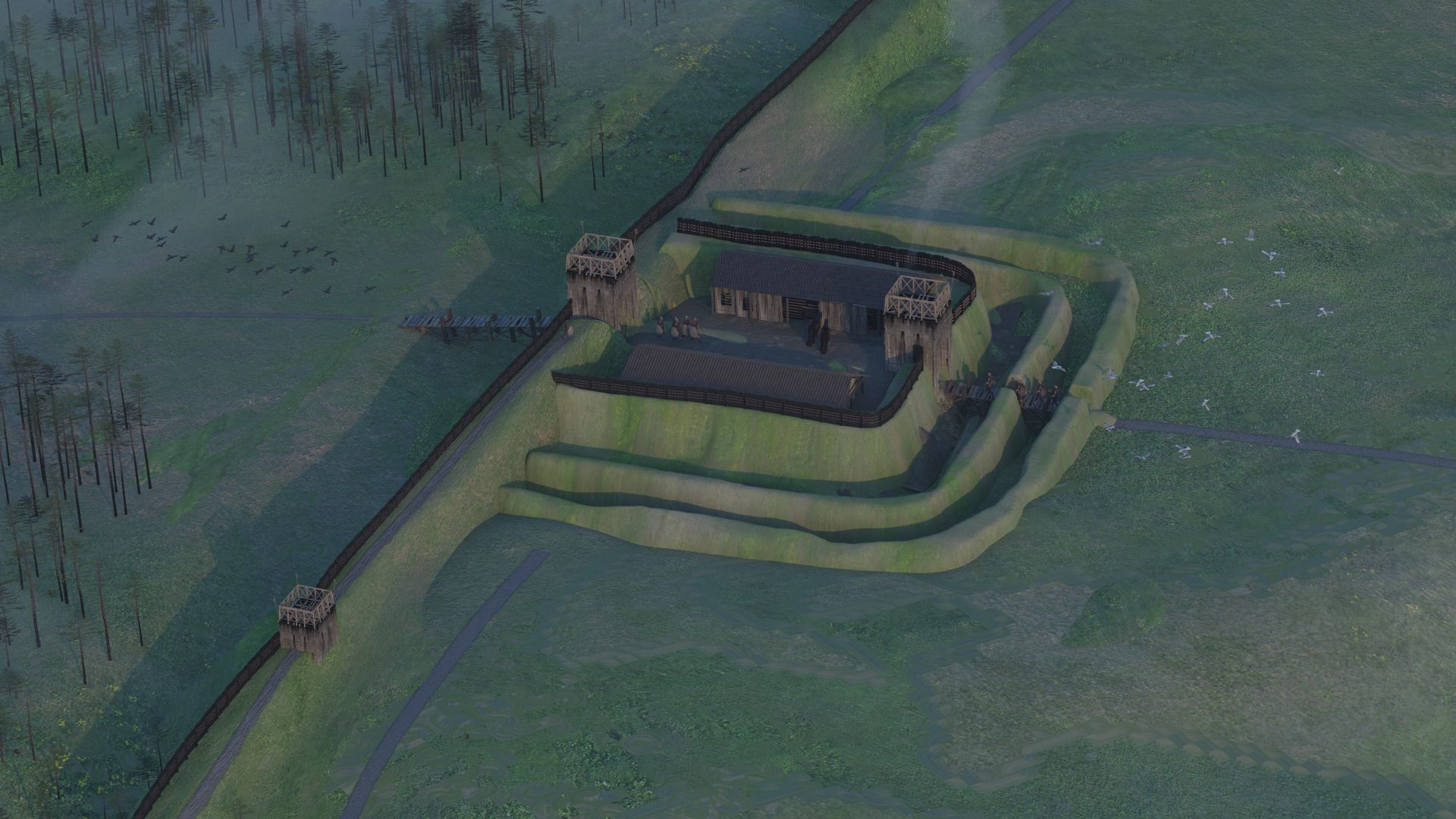
The fortlet also had a good view of a nearby Roman fort and could potentially have signalled the garrison if they spotted an enemy force. Most fortlets along the Antonine Wall could house between 20 and 50 soldiers at a time, the team noted.

An excavation site showing rectangular stones being unearthed with tools nearby

The base of a wall of the fortlet that was found in Bearsden, Scotland. (Image credit: © GUARD Archaeology Ltd)

Archaeologists initially discovered the fortlet in 2017 in the backyard of a private residence that was having an archaeological survey done ahead of construction work. The team later conducted a larger excavation and recently published the findings in the journal Archaeology Reports Online.

The fortlet was built on a stone base, the archaeologists wrote in the journal article. There was also a ditch located just outside the fortlet that may have helped defend it.

Get the world’s most fascinating discoveries delivered straight to your inbox.

Guard Archaeology created a digital reconstruction of the fortlet, which shows two buildings that could house a small garrison of Roman troops along with two watchtowers and a series of ditches and walls to protect them.

The fortlet would likely have been “an integral part of the Roman Wall defences which included forts and fortlets along its length” the archaeological team wrote in the journal article.


Roman Britain quiz: What do you know about the Empire’s conquest of the British Isles?

Source link

Share. Facebook Twitter Pinterest LinkedIn Tumblr Email
Previous ArticleAustin guaranteed income program helps single mom finish college degree
Next Article The County Animal Shelter has a Data Integrity Problem
Editor
  • Website

Related Posts

Lifestyle

Scientists discover deadly, highly venomous box jellyfish near Singapore’s ‘Island of Death Behind’

May 19, 2026
Lifestyle

Poll: What do you think of PMOS, the new name for PCOS?

May 19, 2026
Lifestyle

Celestron Outland X 10×25 roof prism binocular review

May 19, 2026
Add A Comment

Comments are closed.

Categories
  • Entertainment
  • Lifestyle
  • News
  • Sports
  • Tech
  • Travel
Recent Posts
  • Scientists discover deadly, highly venomous box jellyfish near Singapore’s ‘Island of Death Behind’
  • Poll: What do you think of PMOS, the new name for PCOS?
  • Celestron Outland X 10×25 roof prism binocular review
  • Withings Body Scan review: Smart scale turned all-in-one health hub
  • World’s first ‘native’ color lidar will let robots and self-driving cars map the world in full color 3D
calendar
May 2026
M T W T F S S
 123
45678910
11121314151617
18192021222324
25262728293031
« Apr    
Recent Posts
  • Scientists discover deadly, highly venomous box jellyfish near Singapore’s ‘Island of Death Behind’
  • Poll: What do you think of PMOS, the new name for PCOS?
  • Celestron Outland X 10×25 roof prism binocular review
About

Welcome to Baynard Media, your trusted source for a diverse range of news and insights. We are committed to delivering timely, reliable, and thought-provoking content that keeps you informed
and inspired

Categories
  • Entertainment
  • Lifestyle
  • News
  • Sports
  • Tech
  • Travel
Facebook X (Twitter) Pinterest WhatsApp
  • Contact Us
  • About Us
  • Privacy Policy
  • Disclaimer
  • UNSUBSCRIBE
© 2026 copyrights reserved

Type above and press Enter to search. Press Esc to cancel.