
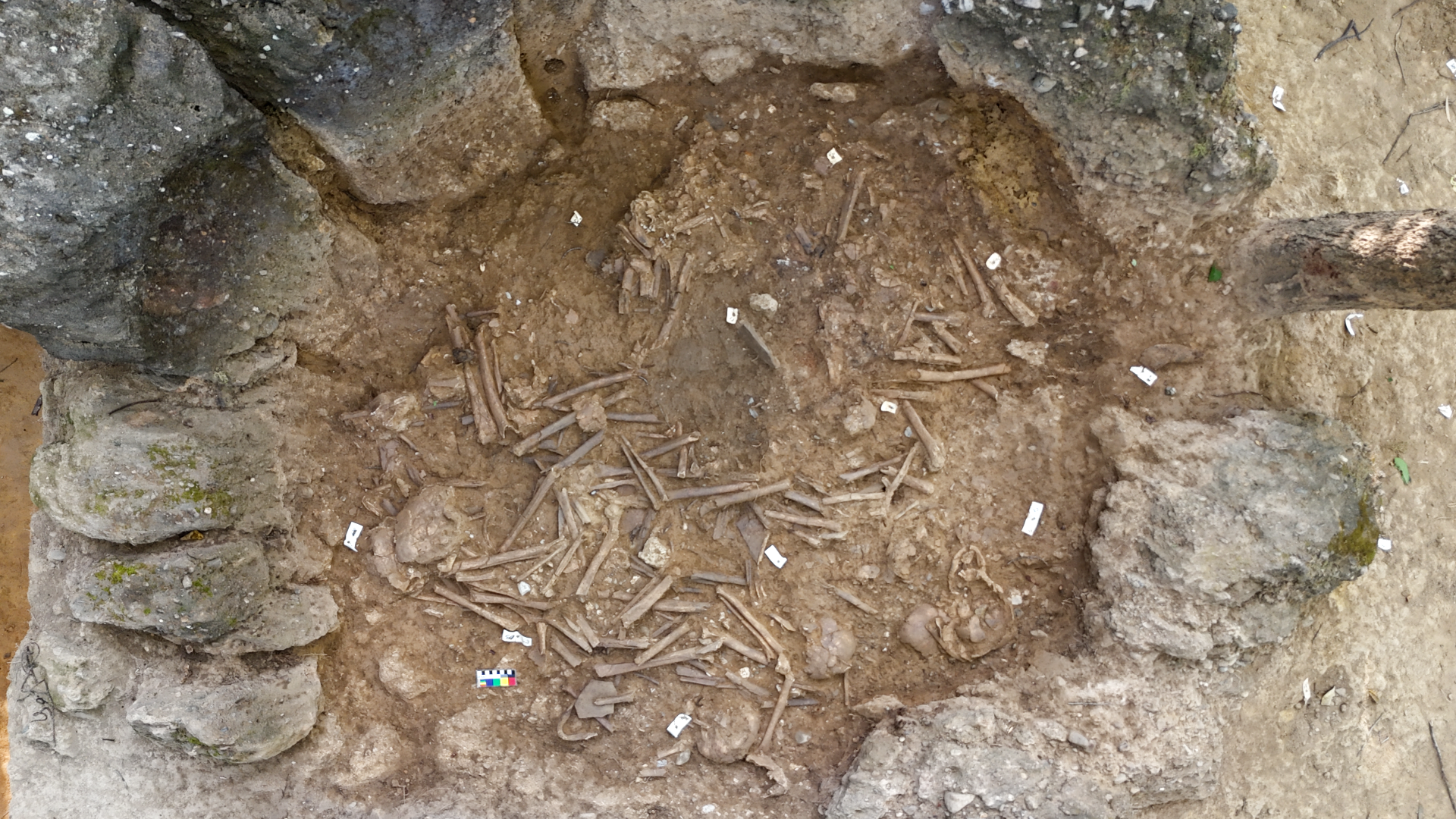
Archaeologists excavating an unusual “death jar” in Laos have discovered that it was used to collect the partly decomposed remains of multiple generations of people around 1,200 years ago. And rather than being the deceased’s final burial spot, the jar may represent one step in a complex mortuary process.
The large death jar, called Jar 1, is also the first of its kind on record to contain undisturbed human remains, the excavation team reported in a new study. Thousands of centuries-old death jars have been found in Southeast Asia over the decades, and while researchers suspected that the vessels may have been used for burials, there was no solid evidence for that until now.
The researchers excavated a large stone vessel at Site 75 on the mysterious Plain of Jars — a landscape in the Xieng Khouang Plateau of northern Laos that consists of more than 2,000 hollowed-out stone jars used in ancient burial rituals over the course of at least a millennium. The jars range in size from about 3.3 to 10 feet (1 to 3 meters) tall and were constructed along trade routes that were heavily used between 500 B.C. and A.D. 500. But little is known about the civilization that made the jars or their exact purpose.
While excavating the 6.7-foot-wide (2.05 m) jar at Site 75, the researchers were surprised by the sheer number of human bones inside the vessel and by the fact that the bones came from select parts of decomposed individuals. For example, skulls were placed along the edges of the jar, while arm and leg bones were bunched together, hinting that the jar was not the primary burial location. Also present in the jar were multicolored glass beads, many of which were manufactured in India.
Radiocarbon dating of several teeth from the jar produced an even bigger surprise: a series of dates much more recent than expected. The bones of the people, who ranged in age from young children to adults, were placed in the jar at several times between 890 and 1160. “The current evidence suggests this was a collective mortuary space used repeatedly over generations, potentially by extended family or community groups,” Skopal said.
More research is needed to better understand who the people were. “Ancient DNA will hopefully allow us to investigate biological relationships between individuals,” he said. “We have not yet completed the ancient DNA analysis, although this is one of the major next steps in the project.”

Archaeologist Nicholas Skopal squats next to one of the smaller jars at Site 75 in Laos.
(Image credit: Nicholas Skopal)
A jarring discovery
Although numerous researchers over the decades have hypothesized that the large stone vessels on the Plain of Jars were used for burials, this study is the first to confirm that idea.
“The functions of the stone jars were always speculated,” Anna Pineda, an archaeologist and doctoral candidate at Australian National University who has studied jar burials but was not involved in the study, told Live Science in an email. “To finally find human bones in situ inside the jars finally definitively answers one of those uses: as a mortuary container for secondary burials.”
Don Matthews, an archaeologist at Australian National University who was not involved in the study but has also worked on jar burials, agreed. “Certainly there has been deliberate human burial recorded outside the jars, but none inside the jars until now,” he told Live Science in an email.
It is still unclear, however, whether all of the jars functioned in the same way or whether this particular jar was part of an unusual or local custom.

Glass beads discovered inside the giant “death jar” in Laos.
(Image credit: Nicholas Skopal)
“The discovery of human remains inside a large stone jar is a new and significant addition to the Plain of Jars research,” Matthews said, “but needs to be tempered until wider research and excavations observe similar burials within the Plain of Jars.”
The glass beads are also a key line of evidence that could help archaeologists understand more about the Plain of Jars culture and their burial practices.
“The concentration of beads and objects within Jar 1 suggests these items were likely important components of the final mortuary ritual and ancestral commemorative practices,” Skopal said. The high quantity of likely trade beads speaks to mercantile connections across Southeast Asia, Pineda said.
“It is always good to be reminded that communities in the past were globally well-connected, while still understanding that local customs, including mortuary practices, were being observed,” Pineda said.
Skopal, N., Pradier, B., Bounxayhip, S., Cooper, C., Dussubieux, L., Devantier-Thomas, T.G., Pilgrim, T., Van Berkel, S., Demko, D., Valentin, F., Skopal, J., Baker, D., Florin, S.A., Posth, C., Clark, G. (2026). The death jar: a new mortuary tradition at the Plain of Jars, Lao PDR. Antiquity. https://doi.org/10.15184/aqy.2026.10352
What do you know about the bones in your body? Test your knowledge with our human skeleton quiz!
