Close Menu
  • Home
  • UNSUBSCRIBE
  • News
  • Lifestyle
  • Tech
  • Entertainment
  • Sports
  • Travel
Facebook X (Twitter) WhatsApp
Trending
  • Science news this week: PCOS has a new name, Neanderthals were the world’s oldest dentists, and the first nuclear bomb explosion spawned an ‘alien’ crystal
  • Newly discovered, blue-whale-size asteroid will fly super close to Earth Monday — and you can watch it live
  • Don Juan Pond: Antarctica’s salty, syrupy lake that never freezes, even when it’s minus 58 F
  • Withings ScanWatch 2 review: Style meets next-level health monitoring
  • AI Chatbots are turbo-charging violence against women and girls: We urgently need to regulate them | Yvonne McDermott Rees
  • ‘The biggest El Niño event since the 1870s’: ‘Super’ El Niño is now the most likely scenario by the end of this year ‪—‬ and the humanitarian cost could be huge
  • Antarctica’s sudden sea ice loss is one of the most extreme and confusing events in the modern climate record. Scientists now know why it’s happening.
  • ‘I heard gasps’: Artemis II astronauts reveal inside story of their mind-bending solar eclipse
Facebook X (Twitter) WhatsApp
Baynard Media
  • Home
  • UNSUBSCRIBE
  • News
  • Lifestyle
  • Tech
  • Entertainment
  • Sports
  • Travel
Baynard Media
Home»Lifestyle»Kawah Ijen: The volcano in Indonesia that holds the world’s largest acidic lake at its heart
Lifestyle

Kawah Ijen: The volcano in Indonesia that holds the world’s largest acidic lake at its heart

EditorBy EditorDecember 27, 2024No Comments3 Mins Read
Share Facebook Twitter Pinterest LinkedIn Tumblr Reddit Telegram Email
Share
Facebook Twitter LinkedIn Pinterest Email

QUICK FACTS

Name: Kawah Ijen crater lake

Location: East Java, Indonesia

Coordinates: -8.05796494233988, 114.2415831801649

Why it’s incredible: The volcano’s crater lake is as acidic as car battery acid, yet it still hosts life.

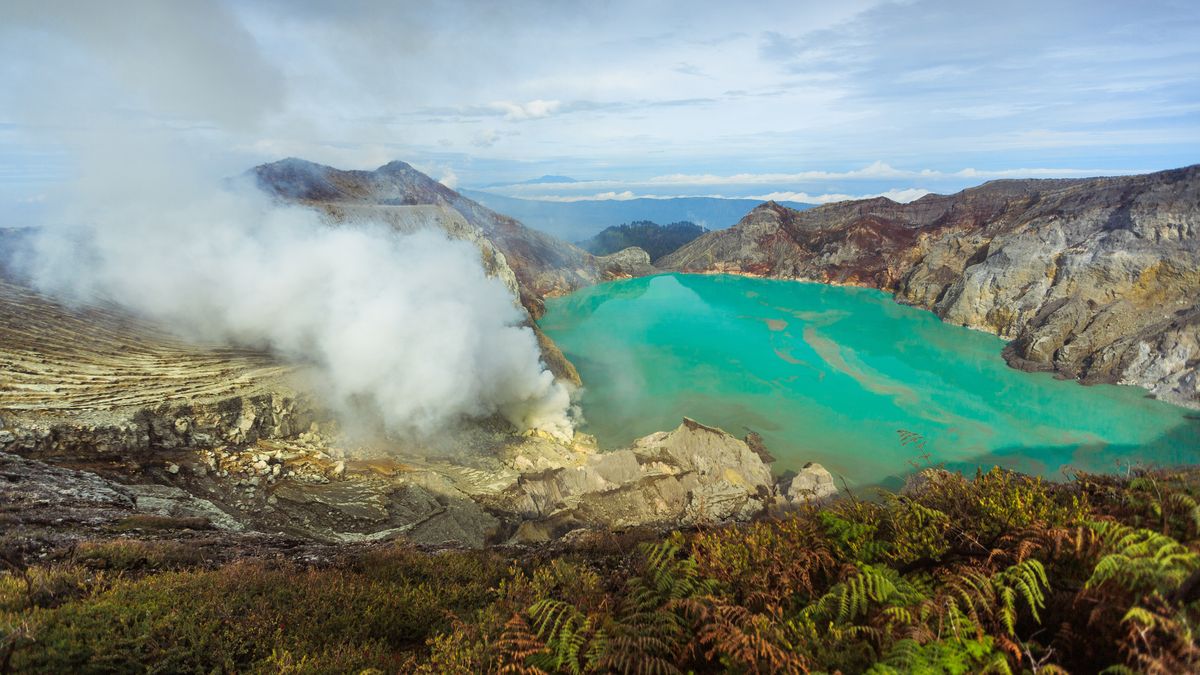
Kawah Ijen is a giant, active volcano on the island of Java with a crater that contains the world’s largest acidic lake. The water has a pH lower than 0.3 in parts of the lake where hydrothermal fluids rise up from inside Earth’s crust, filling the water with minerals, as well as sulfuric and hydrochloric acids.

A pH of 0.3 is similar to that of battery acid, a solution that creates and stores electrical energy in cars. For comparison, gastric acid has a pH between 1.5 and 2, and lemon juice scores between 2 and 3. But despite conditions that would dissolve human skin instantly, Kawah Ijen’s acidic lake is home to a small community of microbes, according to a 2006 study.

Related: ‘A challenge and an opportunity for evolution’ — The extreme, hidden life thriving in Earth’s most acidic and alkaline lakes

Kawah Ijen crater lake’s bluish-green color is so bright, it’s visible from space.The minerals and acids in the crater lake give the water its seemingly artificial turquoise color. They originate from a chamber of red-hot magma below the volcano, which last erupted in 1999. The volcano stands 9,085 feet (2,769 meters) tall and the crater measures 2,300 by 2,625 feet (700 by 800 m) wide.

Night time image of blue flames produced by sulfurous gas at Kawah Ijen volcano in Indonesia. We see bluish-purple flames against a black background.

This picture taken on June 15, 2016 shows brilliant blue flames lighting up the night sky above Kawah Ijen volcano. (Image credit: GOH CHAI HIN/Staff/Getty Images)

‘Bitter water’ river

Rain regularly replenishes Kawah Ijen’s acidic lake, but the new water immediately turns corrosive due to vents that release gas continuously at the bottom of the lake. When the crater is full, water overflows into a stream on the volcano’s west side that feeds into the Banyupahit River basin — the name of the river means “bitter water” in the Javanese language.

If the crater lake’s extremely acidic waters weren’t eerie enough, Kawah Ijen also emits sulfurous gases that catch fire when they come into contact with oxygen in Earth’s atmosphere. When the gases ignite above the volcano, they produce electric blue flames that mostly go unnoticed during the day, but create an astonishing spectacle at night.

Often, the sulfur in these gases condenses after catching light, forming a liquid that flows a short distance along the volcano before solidifying into yellow deposits. Local people mine these deposits, breaking off chunks of sulfur which they sell to a sugar refinery in the area that uses them to remove color impurities from the sugar.

Get the world’s most fascinating discoveries delivered straight to your inbox.

There is considerable risk involved in these mining operations, according to the website Geology.com, including harm from poisonous sulfur gases, regular gas explosions and dangerous paths up and down the volcano.


Discover more incredible places, where we highlight the fantastic history and science behind some of the most dramatic landscapes on Earth.

Source link

Share. Facebook Twitter Pinterest LinkedIn Tumblr Email
Previous ArticleRef Watch: Aston Villa’s Jhon Duran right to be shown red card vs Newcastle, says Dermot Gallagher | Football News
Next Article Why Billie Lourd Is “Griefful” on Anniversary of Carrie Fisher Death
Editor
  • Website

Related Posts

Lifestyle

Science news this week: PCOS has a new name, Neanderthals were the world’s oldest dentists, and the first nuclear bomb explosion spawned an ‘alien’ crystal

May 16, 2026
Lifestyle

Newly discovered, blue-whale-size asteroid will fly super close to Earth Monday — and you can watch it live

May 16, 2026
Lifestyle

Don Juan Pond: Antarctica’s salty, syrupy lake that never freezes, even when it’s minus 58 F

May 16, 2026
Add A Comment

Comments are closed.

Categories
  • Entertainment
  • Lifestyle
  • News
  • Sports
  • Tech
  • Travel
Recent Posts
  • Science news this week: PCOS has a new name, Neanderthals were the world’s oldest dentists, and the first nuclear bomb explosion spawned an ‘alien’ crystal
  • Newly discovered, blue-whale-size asteroid will fly super close to Earth Monday — and you can watch it live
  • Don Juan Pond: Antarctica’s salty, syrupy lake that never freezes, even when it’s minus 58 F
  • Withings ScanWatch 2 review: Style meets next-level health monitoring
  • AI Chatbots are turbo-charging violence against women and girls: We urgently need to regulate them | Yvonne McDermott Rees
calendar
May 2026
M T W T F S S
 123
45678910
11121314151617
18192021222324
25262728293031
« Apr    
Recent Posts
  • Science news this week: PCOS has a new name, Neanderthals were the world’s oldest dentists, and the first nuclear bomb explosion spawned an ‘alien’ crystal
  • Newly discovered, blue-whale-size asteroid will fly super close to Earth Monday — and you can watch it live
  • Don Juan Pond: Antarctica’s salty, syrupy lake that never freezes, even when it’s minus 58 F
About

Welcome to Baynard Media, your trusted source for a diverse range of news and insights. We are committed to delivering timely, reliable, and thought-provoking content that keeps you informed
and inspired

Categories
  • Entertainment
  • Lifestyle
  • News
  • Sports
  • Tech
  • Travel
Facebook X (Twitter) Pinterest WhatsApp
  • Contact Us
  • About Us
  • Privacy Policy
  • Disclaimer
  • UNSUBSCRIBE
© 2026 copyrights reserved

Type above and press Enter to search. Press Esc to cancel.