Close Menu
  • Home
  • UNSUBSCRIBE
  • News
  • Lifestyle
  • Tech
  • Entertainment
  • Sports
  • Travel
Facebook X (Twitter) WhatsApp
Trending
  • 800-year-old notebook with ‘rather unpleasant odor’ found in medieval German toilet
  • Celestron AstroMaster LT 70AZ review
  • Global warming is accelerating 5,000 times faster than rice can evolve
  • Scientists discover deadly, highly venomous box jellyfish near Singapore’s ‘Island of Death Behind’
  • Poll: What do you think of PMOS, the new name for PCOS?
  • Celestron Outland X 10×25 roof prism binocular review
  • Withings Body Scan review: Smart scale turned all-in-one health hub
  • World’s first ‘native’ color lidar will let robots and self-driving cars map the world in full color 3D
Facebook X (Twitter) WhatsApp
Baynard Media
  • Home
  • UNSUBSCRIBE
  • News
  • Lifestyle
  • Tech
  • Entertainment
  • Sports
  • Travel
Baynard Media
Home»Lifestyle»Giant ‘X’ appears over Chile as 2 celestial beams of light cross: Space photo of the week
Lifestyle

Giant ‘X’ appears over Chile as 2 celestial beams of light cross: Space photo of the week

EditorBy EditorAugust 17, 2025No Comments3 Mins Read
Share Facebook Twitter Pinterest LinkedIn Tumblr Reddit Telegram Email
Share
Facebook Twitter LinkedIn Pinterest Email

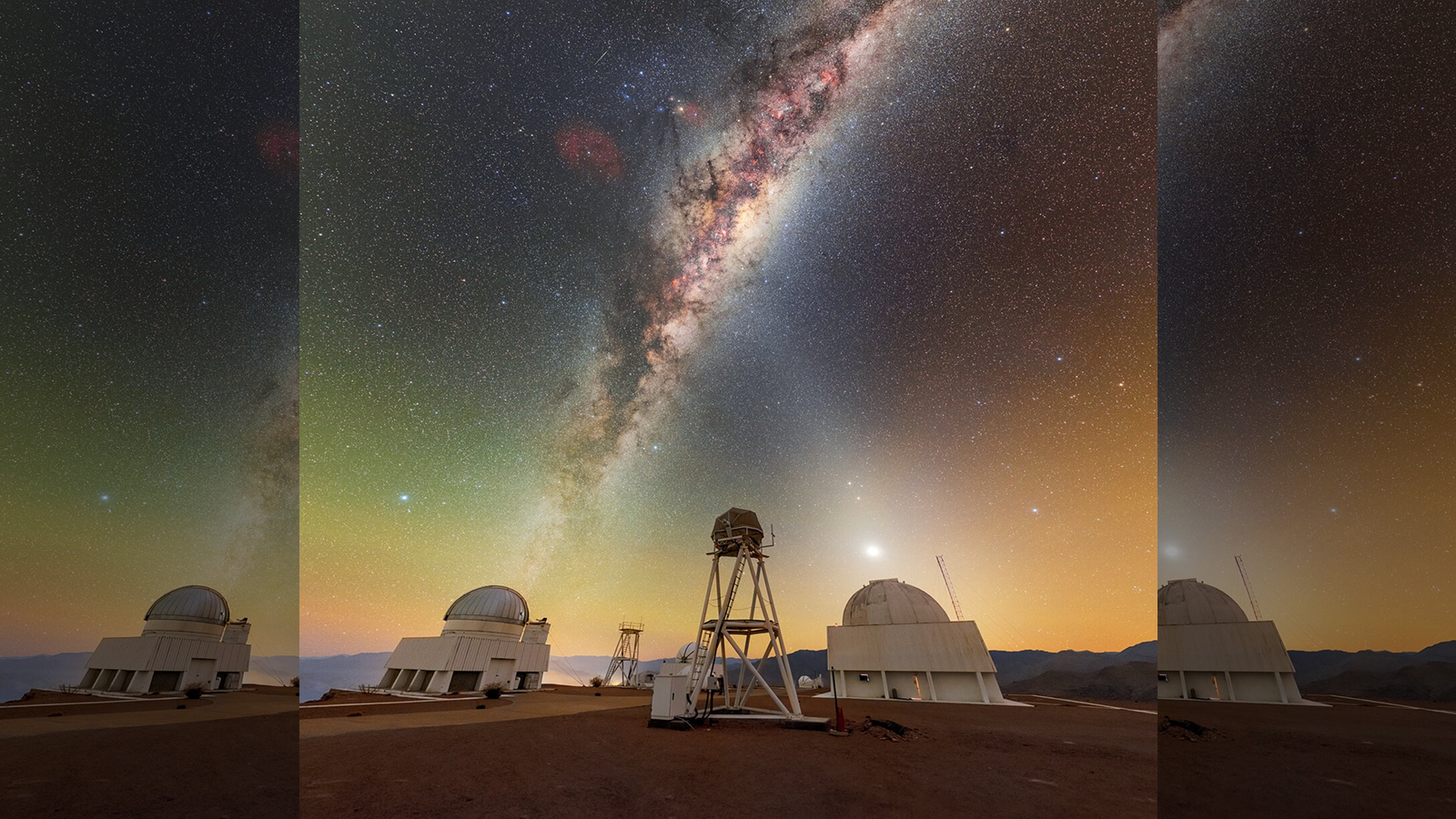
Photograph taken of the night sky showing the Milky Way and zodiacal light crisscross above the Cerro Tololo Inter-American Observatory in Chile.

The Milky Way and zodiacal light crisscross above the Cerro Tololo Inter-American Observatory in Chile. (Image credit: CTIO/NOIRLab/NSF/AURA/P. Horálek (Institute of Physics in Opava))

QUICK FACTS

What it is: The luminous band of the Milky Way and the faint glow of zodiacal light

Where it is: Cerro Tololo Inter-American Observatory, Chile

When it was shared: Aug. 6, 2025

This stunning image from astrophotographer Petr Horálek captures two of the night sky’s most glorious sights in one — the glowing heart of the Milky Way and the elusive “zodiacal light.” Despite appearing alongside one another, these two streaks of light could not be more different in origin and composition.

Astronomers have constructed some of humanity’s best telescopes in the Southern Hemisphere to better see the bright core of the Milky Way — dense with stars and nebulae. That core passes through constellations including Scorpius, Sagittarius and Ophiuchus, which are higher in the sky the farther south they’re viewed from.

This image was taken at the Cerro Tololo Inter-American Observatory (CTIO), located at an altitude of 7,200 feet (2,200 meters) in the Chilean Andes within the southern Atacama Desert. At this height, above the densest and warmest part of Earth’s atmosphere, incredibly clear and dark skies are the norm, enabling observers to see not only the bright band of the Milky Way but something less obvious that resides in the solar system — zodiacal light.


You may like

The biggest visible solar system phenomenon in the night sky, zodiacal light is a faint, diffuse glow in the night sky that casual observers often miss. It consists of sunlight reflecting off dust in our cosmic neighborhood, possibly from passing asteroids and comets or from the leftovers of planet formation. In 2020, a paper also claimed that zodiacal light may be primarily made of dust blown off Mars. Either way, the glow of the solar system is an arresting sight, but hard to see.

Zodiacal light is at its brightest around the equinoxes and is visible along the ecliptic — the apparent path the sun takes through the sky — as a triangular beam of light on the horizon a few hours before sunrise or after sunset. That timing has led to it being called either the “false dawn” or “false dusk,” though its name comes from the fact that it’s visible over the 13 constellations that make up the zodiac.

Horálek’s spectacular image was taken in 2022 when he was an audiovisual ambassador for NOIRLab, which operates CTIO. In the photo, from left to right, are the U.S. Naval Observatory Deep South Telescope, the DIMM1 Seeing Monitor, the Chilean Automatic Supernova Search dome, the UBC Southern Observatory and the Planetary Defense 1.0-meter Telescope.

Get the world’s most fascinating discoveries delivered straight to your inbox.

Source link

Share. Facebook Twitter Pinterest LinkedIn Tumblr Email
Previous ArticleNorth Korean Christians lose access to Gospel as radio broadcasts cut
Next Article Princess Kate, Prince William to move home in Windsor to Forest Lodge
Editor
  • Website

Related Posts

Lifestyle

800-year-old notebook with ‘rather unpleasant odor’ found in medieval German toilet

May 20, 2026
Lifestyle

Celestron AstroMaster LT 70AZ review

May 20, 2026
Lifestyle

Global warming is accelerating 5,000 times faster than rice can evolve

May 19, 2026
Add A Comment

Comments are closed.

Categories
  • Entertainment
  • Lifestyle
  • News
  • Sports
  • Tech
  • Travel
Recent Posts
  • 800-year-old notebook with ‘rather unpleasant odor’ found in medieval German toilet
  • Celestron AstroMaster LT 70AZ review
  • Global warming is accelerating 5,000 times faster than rice can evolve
  • Scientists discover deadly, highly venomous box jellyfish near Singapore’s ‘Island of Death Behind’
  • Poll: What do you think of PMOS, the new name for PCOS?
calendar
May 2026
M T W T F S S
 123
45678910
11121314151617
18192021222324
25262728293031
« Apr    
Recent Posts
  • 800-year-old notebook with ‘rather unpleasant odor’ found in medieval German toilet
  • Celestron AstroMaster LT 70AZ review
  • Global warming is accelerating 5,000 times faster than rice can evolve
About

Welcome to Baynard Media, your trusted source for a diverse range of news and insights. We are committed to delivering timely, reliable, and thought-provoking content that keeps you informed
and inspired

Categories
  • Entertainment
  • Lifestyle
  • News
  • Sports
  • Tech
  • Travel
Facebook X (Twitter) Pinterest WhatsApp
  • Contact Us
  • About Us
  • Privacy Policy
  • Disclaimer
  • UNSUBSCRIBE
© 2026 copyrights reserved

Type above and press Enter to search. Press Esc to cancel.