
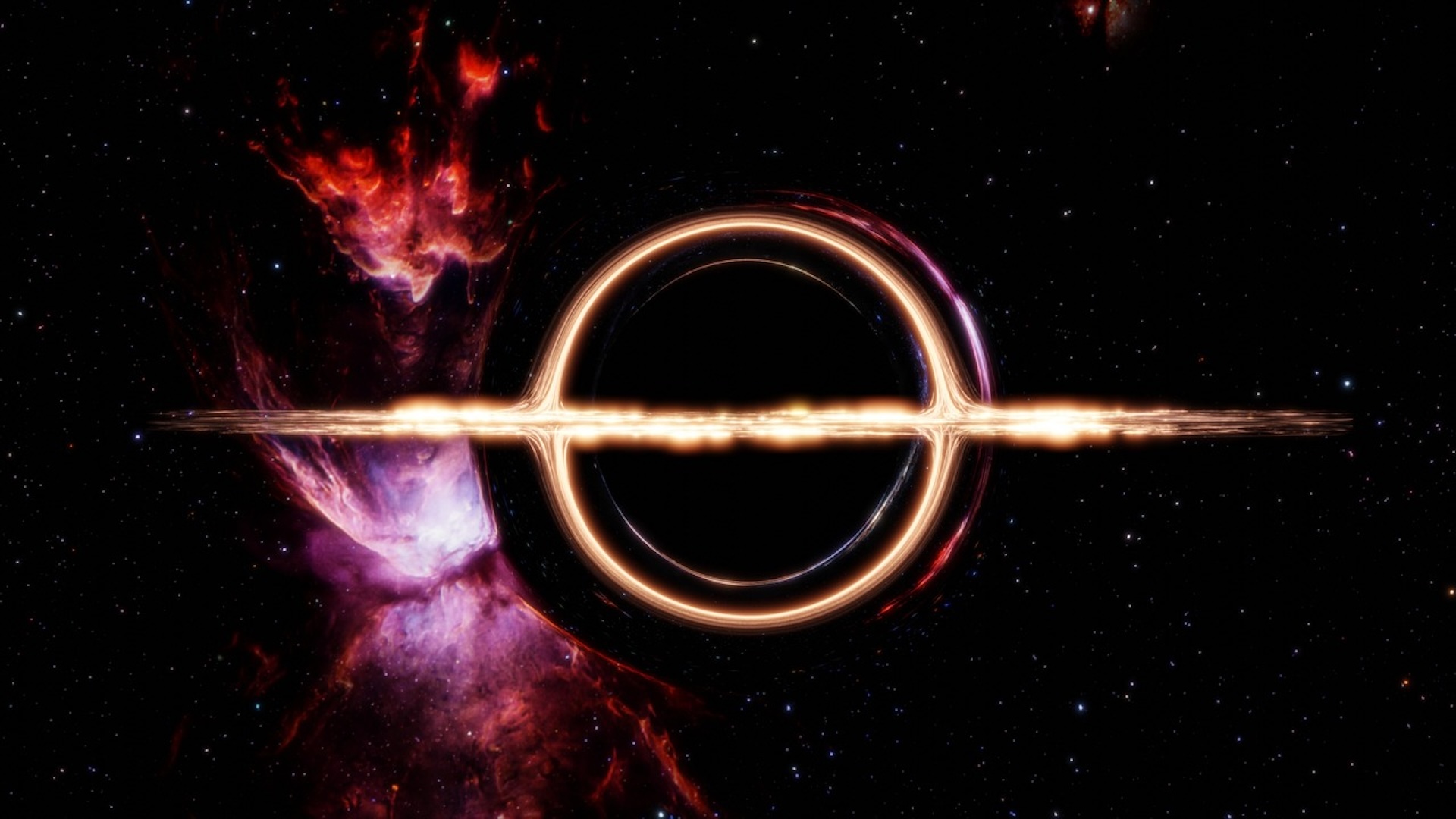
Theoretical physicists have proposed a potential solution to one of the most puzzling problems in modern physics: the black hole singularity paradox. By modifying Einstein’s theory of general relativity, the center of a black hole with infinite curvature could be replaced by a highly curved but regular region of space-time, the researchers suggest in a new study.
“Singularities are regions of the universe where space, time and matter are crushed and stretched into nonexistence,” study co-author Robie Hennigar, a postdoctoral researcher at Durham University in the U.K., told Live Science via email. “This is a very serious problem, as if singularities were to really exist in our universe, it would be catastrophic for science.
“We could no longer use the equations of physics to predict the future from the past and present,” he continued. “For these reasons, most practising scientists expect that singularities are not physical, but are telling us that general relativity must be replaced by a more complete theory to describe the universe near singularities.”
Related: Scientists may have just discovered 300 of the rarest black holes in the universe
Correcting Einstein
Since its introduction in 1915, general relativity has been remarkably successful in explaining astrophysical and cosmological phenomena, including the formation of black holes, the structure of neutron stars, and the large-scale structure and evolution of the universe.
However, the theory has fundamental limitations. It is incompatible with quantum mechanics, which governs the behavior of particles at the smallest scales, and it predicts singularities — points of infinite density — at the centers of black holes and at the Big Bang.
To address this issue, the researchers used a concept known as quantum gravity, which is commonly applied in attempts to unify Einstein’s general relativity with quantum mechanics, which predicts continuous particle creation and annihilation in empty space, along with perpetual fluctuations in all fields, including gravity. Their study, published in February in the journal Physics Letters B, suggests that at extremely high energies or incredibly small distances, general relativity should be modified by an infinite series of additional terms in its equations.
“In quantum gravity, one considers all corrections to the equations relating the energy and momentum of a system with the spacetime curvature that are consistent with known physical principles,” Hennigar said. “Different approaches to quantum gravity will place different importance on different terms in the equations, but they all suggest that Einstein’s equations need to be refined.”
By incorporating these modifications into their calculations, the researchers examined how black holes would behave under this revised framework. Their results showed that when an infinite number of new terms are included, the singularity vanishes. Instead of an infinitely dense point, the black hole’s core becomes a highly curved but regular region of space-time.
Testing the theory
Although the new model resolves the singularity problem mathematically, scientific theories must ultimately be tested through observation. The researchers acknowledged that directly confirming their idea presents a significant challenge.
“The absence of singularities itself is hard to test experimentally, because it would occur inside a black hole, or at the very beginning of the universe,” Pablo Cano, a postdoctoral researcher at the University of Barcelona and another co-author of the study, told Live Science in an email. “However, we can look for signatures of the theories that lead to singularity resolution.
“The modifications of general relativity that we consider become larger in stronger gravitational fields, but are very small otherwise,” Cano added. “This means that, for instance, gravitational waves coming from collisions of black holes — where gravitational fields are much stronger than in the solar system — provide a way of searching for these effects.”
Another promising avenue is the study of the early universe. If the effects of this modified gravity theory influenced cosmic inflation — the rapid expansion that followed the Big Bang — evidence of these changes might be imprinted in primordial gravitational waves. Future experiments targeting these signals could help test the validity of the theory.
Next steps
In addition, further theoretical work is needed to determine whether singularity-free black holes can form naturally through gravitational collapse and whether the team’s approach can address other types of singularities, such as those associated with the Big Bang.
“We have recently shown that the collapse of a certain type of matter gives rise, within this framework, to the formation of these regular black holes,” said Pablo Bueno, a research fellow at the University of Barcelona and a co-author of the study. “We would like to test this under more general assumptions. This may give rise to intriguing features in other areas, such as explicit models of bouncing cosmologies in which the usual Big Bang scenario is replaced by a never ending series of expansive and contracting phases.”
Black hole quiz: How supermassive is your knowledge of the universe?
